


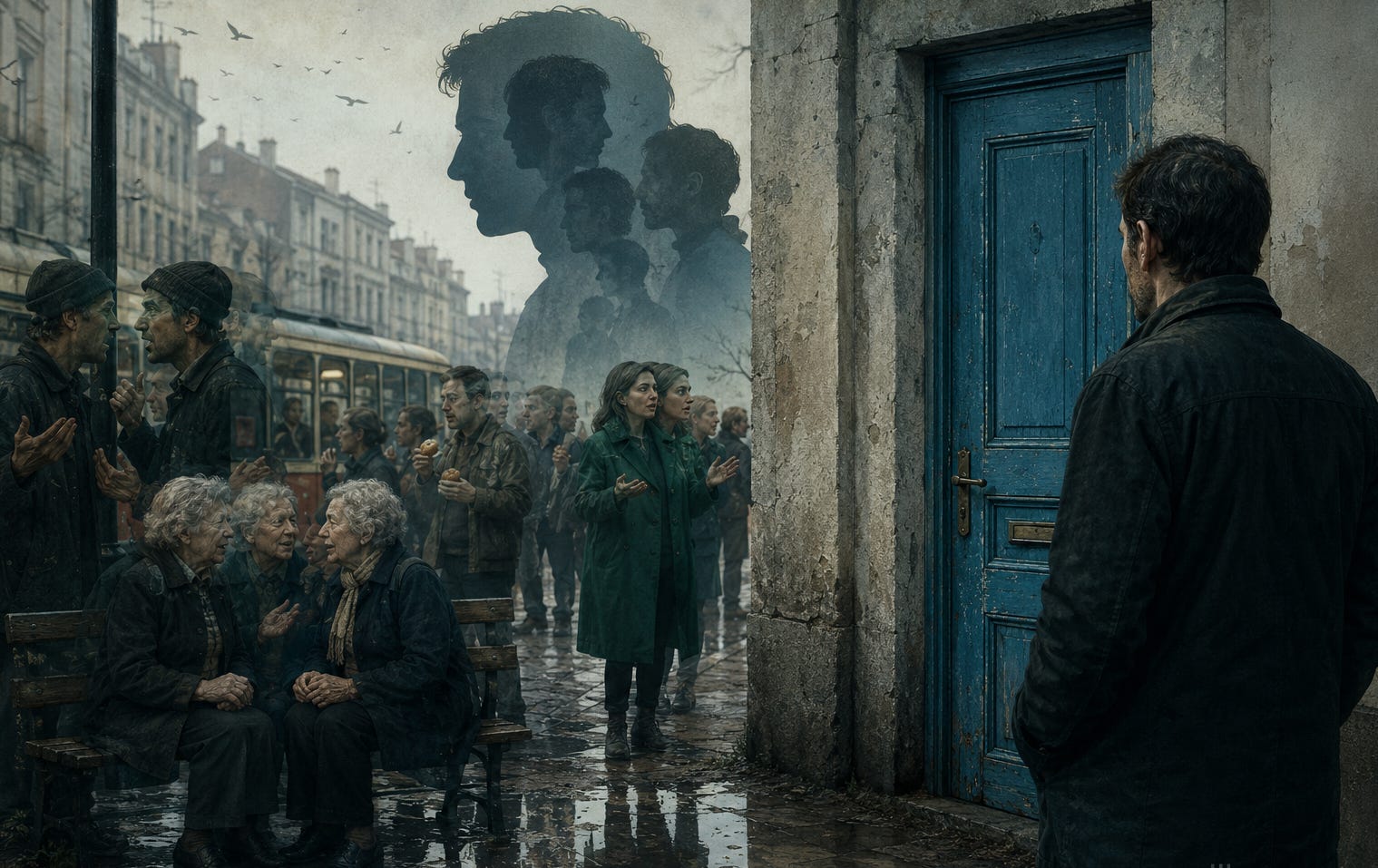
The first thing Aleksy noticed was that his wife answered him twice.
He had asked whether she wanted the window open, which was a thing he asked most mornings, and she said yes and then, a half second later and in the same voice at a slightly different pitch, said that she did not, and then she laughed at herself and said they would compromise and open it halfway.
He watched her cross the room. She opened it halfway.
At the tram stop a man was talking, at conversational volume, to nobody, and stopping to listen, and answering. Nobody looked at him. A woman in a green coat interrupted her own sentence to disagree with the end of it and then apologized to the person she was speaking with, who waved it off, who said no, no, go on, let her finish.
Let her finish.
Aleksy got on the tram and did not go to work.
By the afternoon he had built a theory and the theory was the obvious one, which is that something had come into the world overnight and taken everybody, and that he alone had been missed.
He sat in a park with his back against a wall so that nothing could approach from behind. He watched a young father negotiate with his own left hand over which of two pastries to buy. He watched two old women share a bench and conduct what was clearly a four-way conversation with long comfortable pauses in it.
He had the thought that he ought to warn somebody and then had the more useful thought that there was nobody left to warn, and it was somewhere in the gap between those two that he noticed the thing that ruined his theory.
They were all fine.
Whatever had happened to them had not frightened them. Nobody was struggling. The man at the tram stop had been arguing about football. The father bought both pastries. Nothing about any of it looked like a possession, and he had seen enough films to know what he was supposed to be seeing, and this was not it.
Which left the other explanation, and he sat with it for a long time before he let it finish.
The woman at the clinic desk looked at him for about four seconds and then stopped typing.
“How long,” she said.
“How long what.”
“Since it went quiet.” She had already picked up the phone. She said it gently, the way you say a thing to somebody who has come in bleeding and has not yet noticed the blood.
He wanted to tell her that nothing had gone quiet, that the problem was out here and not in him, and he opened his mouth to say it and found instead that he was crying, which he had not done in nine years, and that he did not know why, and that there was nobody to ask.
That was the moment he understood the shape of it.
He had not woken up into a world where everyone was many.
He had woken up into the world, which had always been that way, and he was the one who had emptied.
They had a word for him, which was quiet, used as a state rather than an insult, and there was a lot of literature about it and none of it was encouraging.
The doctor, a woman in her sixties who conferred visibly with somebody before answering each of his questions, explained it the way you would explain a stroke. A household could be reduced. Sometimes by injury, sometimes by illness, sometimes for no reason anybody had ever found. What was gone was gone. What remained was one, and one could function, and one could work and eat and love and vote, and one would be alone in a way that nobody around him could imagine and everybody around him would recognize on sight.
“How many,” Aleksy asked.
“We can’t know. There’s no measure. Households don’t have a census.” She paused, and it was the pause of somebody being advised. “Your wife will know.”
His wife knew.
She sat across the kitchen table from him and did not touch him, which he understood later was a mercy and at the time felt like the end of everything, and she told him there had been four.
Himself, who was still here, and who had always been the practical one, the one who paid things and remembered dates and did not like to be interrupted.
A second who had done the reading, who had learned Portuguese in eleven months for no reason, who had wept at music.
A third who was, in her description, the funniest person she had ever met, and who came out mostly late at night, and who had made her laugh so hard once at a bus station in Kraków that she had needed to sit down on the floor.
And a fourth she had never fully met, who was older than the rest of them somehow, and who surfaced perhaps twice a year, and who had once told her something about her mother that had changed her life and that she had never repeated to anyone, including him, including all of him.
“They were you,” she said. “I need to say this properly. It isn’t that I’ve lost three people and kept one. There’s no arithmetic that works. It’s that the house is empty and you’re standing in it, and you’re the one I married, and so were they.”
He went looking for them, because that is what anybody would do.
He found a notebook in his own handwriting, in Portuguese, which he could still read and could no longer speak. He found a shelf of poetry with the spines broken in the places where somebody had held them open, and he read a page and felt nothing whatsoever, and read it again and still felt nothing, and put it back.
He found that he had a standing arrangement at a bakery for a pastry he found actively unpleasant.
He found that his phone had a folder of photographs of doors. Hundreds of doors, over years, in cities he had been to, framed carefully, none of them remarkable, and he sat on the edge of the bed for an hour trying to work out which one of them had cared about doors, and why, and whether it had been a joke that everyone in the house was in on.
He would never know. That was the part he could not get past. There had been three other people in here with him for forty-one years, and they had opinions and appetites and a sense of humor he could not reconstruct, and the only witness who could describe them was in the next room and grieving them herself.
The form was in a folder with the insurance documents, filed where he filed everything, because he had always been the one who filed things.
It was a standard form. It had a reference number and a clinic stamp and a section of small print about what could not be reversed.
The procedure was called Release. It could not be performed selectively. That was the second paragraph, in bold, initialed in the margin by him. A household is a single structure. To release one is to release all.
There was a consent section and his signature was on it, in the hand he still recognized as his own, dated eleven days ago.
And there was a clause, near the bottom, which he read four times.
The applicant is advised that the procedure includes an amnestic component covering the decision itself. This is not optional. Applicants who retain the memory of electing Release report outcomes we are not prepared to describe in a consent form.
There was one more page.
A reason field, three lines, to be completed in the applicant’s own hand. He had used one line.
He read it standing up in the hallway with the folder open on the shelf, and then he sat down on the floor with his back against the wall, in the position he had spent four days sitting in because he thought something was going to come at him from behind.
Nothing was going to come at him from behind. It had already happened and he had signed for it.
The line said:
Marek was in pain and would not stop being in pain and I could not listen to it any more. He asked me twice. I said no twice. He asked a third time.
He does not know which one Marek was.
He has decided, and this is the only decision he has made since, that Marek was the one who read poetry, because that one seems to him like somebody who might have been in the kind of pain you could not treat, and because the alternative is that Marek was the funny one, and he cannot carry that.
His wife would know. He has not asked her and he is not going to.
He goes to work. He pays things and remembers dates. In the evenings he opens the window halfway without being asked, and she notices, and neither of them says anything about it.
On Thursdays he walks a longer way home, past a blue door on a street he has no reason to be on, and he stops and looks at it for a moment, and he could not tell you why, and he has stopped trying to work it out.
He just thinks that one of them would have liked it.
That was great Tom -- I want it to go on, I want more!
😊
You come up with the most intriguing, original stuff!