


On Monday evening, June 1, 2020, U.S. Park Police and other federal officers forcibly cleared demonstrators from Lafayette Square, the seven-acre park directly north of the White House. The clearing used tear gas, pepper spray, batons, and rubber projectiles. It happened at roughly 6:35 pm, about twenty-five minutes before the city’s own curfew took effect. It happened because the sitting president wanted to walk across the park and pose in front of St. John’s Episcopal Church with a Bible.
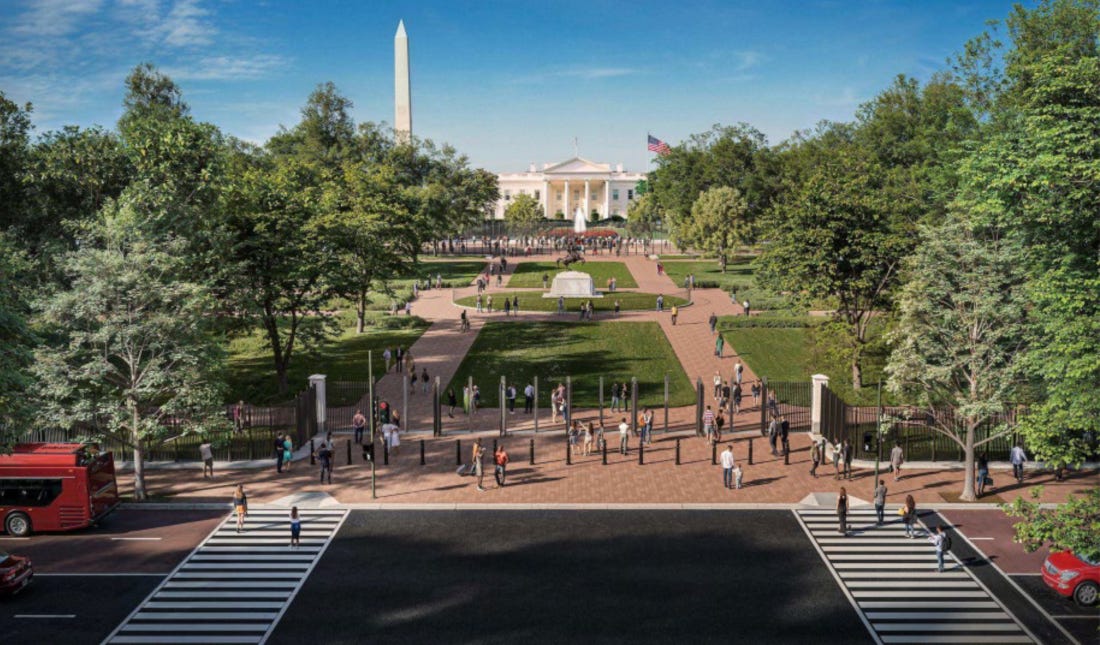
Yesterday his administration presented, to the National Capital Planning Commission, a proposal to enclose that park in permanent fencing eight to nine feet tall, with gates that can be closed during what the Secret Service calls heightened conditions.
The proposal is described, by a vice chair of the U.S. Commission of Fine Arts, as not closing the park but enclosing it. That distinction is meant to reassure. It is worth pausing on, because it is the whole argument.
What Lafayette Square has been
The park is public land. It sits directly across Pennsylvania Avenue from the White House and has been the country’s most prominent venue for demonstrations against the government for more than a century. Suffragists picketed there. So did opponents of every war since. So did civil rights marchers, anti-nuclear activists, and every category of American who ever wanted to be visible to the person living across the street. That is what the park is for. That is why it exists in the specific location it exists in.
You cannot substitute a different park. Proximity is the entire meaning.
What enclosure changes
An enclosed public space is not a public space with a fence around it. It is a space you enter through a gate, at times of somebody else’s choosing, in numbers that gate permits, under conditions that gate enforces.
Every one of those variables is a discretionary decision. Who staffs the gate, when it opens, when it closes, what counts as a heightened condition, what items you may bring through it, and who is turned away because their bag looks wrong.
None of that requires any additional law. The law of public assembly is unchanged. Nobody has banned a protest. What has changed is the shape of the room the protest happens in, and the shape of a room is what determines what happens inside it.
A pattern
Yesterday’s proposal did not arrive alone. The same commission approved, this spring, the demolition of the East Wing of the White House and construction of a ballroom whose finished size will be larger than the Executive Mansion it is attached to. The panel is now considering an underground visitor screening center as well.
The pattern is consistent, and each of these changes is presented as a security measure defended on grounds no reasonable person can dismiss. What they share is that each one replaces a space citizens could enter freely with a space they enter through infrastructure controlled by the executive branch.
Renaming a lake is a cheap act. This is not. It is what happens when the renaming instinct is given a budget.
The specific insult
The president who is proposing the fence is the president who used the park to stage a photograph on June 1, 2020, and who used federal force to make the staging possible.
The Inspector General’s report on that afternoon, published in 2021, concluded that the Park Police had cleared the square as part of a pre-planned operation to install antiscale fencing. The IG said the operation was not undertaken to facilitate the president’s walk to the church. Reasonable people can weigh the sequencing and reach their own conclusion; what is not in dispute is that the clearing happened, and that the church walk happened, and that they happened together.
Whether or not the tear gas was for the photograph, the photograph was made possible by the tear gas. That is not a rhetorical claim. It is a description of what took place in the twenty-five minutes between 6:35 and 7:00 pm on a specific June evening.
The person who benefited from that clearing is the person now proposing to make its architecture permanent. He is doing so through an advisory panel filled with his own appointees, whose chair noted that the commission received more than 100 public comments, most objecting.
What a fence answers
The proposal answers a question that has not been asked, which is whether the American public presents a security threat to the American president by being visible outside his window.
The question that has been asked, repeatedly, is whether the president presents a threat to the American public by using federal force against them in that park. That question has not been answered because it has not been permitted to reach the surface. Enclosing the park is one way of ensuring it never does.
A fence eight to nine feet tall with gates the government controls is not a security perimeter. It is an editorial decision about which faces the president has to see when he looks out.
The park is called Lafayette Square. It was named for a Frenchman who fought for the American revolution against a king. This is worth mentioning only because the man for whom the park is named would have recognized precisely what a fence around it means, and would have said so.
He also asked Milley if protesters could be "just"" shot in the legs". Nobody should have ever forgotten this crap.
He's so vile