

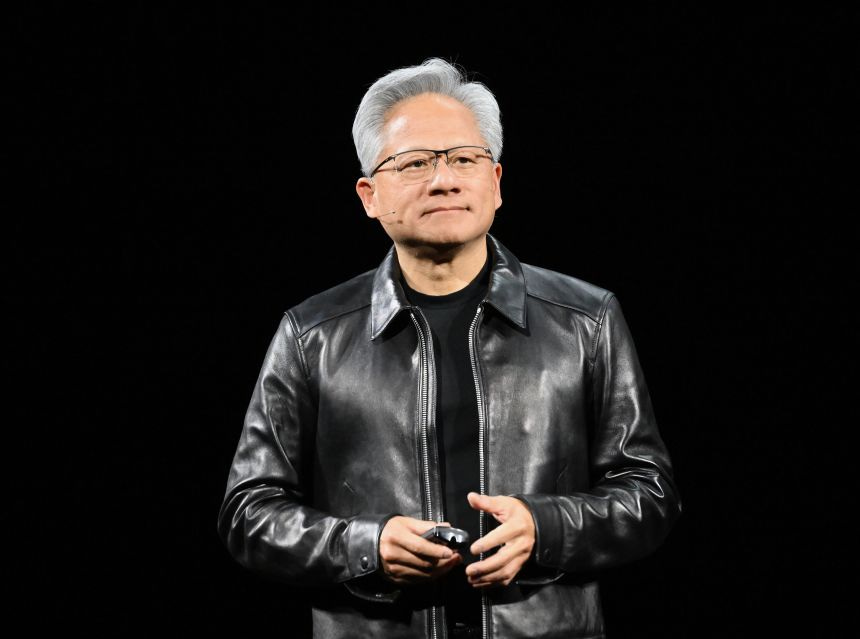
Jensen Huang resigned as chief executive of Nvidia on Thursday, thirty-three years after he co-founded it, after a week in which he admitted an extramarital relationship with a woman U.S. intelligence has identified as a suspected operative for Beijing, and after reports of two more relationships, one with an executive who reported to him. The board named its chief financial officer interim CEO. The stock has lost about half a trillion dollars in market value since the scandal broke, about 5 percent of it on Thursday alone. The president, on Truth Social, said Huang had done “a fantastic job” and that “A Legend replaces a Legend!”, and told reporters that Nvidia should hire Tim Cook.
The affair is Huang’s problem and his family’s. The chips are the country’s, and the chips are the story.
What the president knew, and when. By the New York Times’ account, U.S. intelligence officials told the president in late 2025 that the woman, Alice Huang, no relation, was gathering information for Beijing. She had founded a company in 2023, Megaspeed, to build data centers in Asia on Nvidia hardware, and federal investigators had been looking at it since last year for possible diversion of chips to China. The president, the Times reports, took no action and was wary of disrupting Nvidia’s sales. In December 2025 he announced that Nvidia could sell its H200, the most capable chip then cleared for export anywhere, to approved buyers in China, with 25 percent of the proceeds going to the United States Treasury. In May 2026, on Air Force One en route to Beijing, with Huang a last-minute addition to the delegation, Secretary of State Rubio told the president about intelligence linking the CEO to the suspected operative. Rubio had supervised a classified memo on the relationship. The president was, at that moment, weighing whether to approve exports of chips more advanced than the H200.
Asked this week whether he’d known about it during the May trip, the president said, “No, I didn’t hear about it then.” Asked about Huang’s statement that he hadn’t known the woman might be a spy, the president said, “I really believe him.”
What that sequence means. Set the personal conduct aside, since the president has. The United States government possessed intelligence that the chief executive of its most strategically important company was in a relationship with a suspected foreign intelligence asset whose own company existed to move that company’s product into Asia. The government’s response, over the following five months, was to expand the company’s license to sell to China and take a cut. The decision to let the H200 go was made by the man who had been told. The decision on the next chip was being made by the same man when he was told again, by his own secretary of state, on his own plane. The White House’s answer, through spokesman Davis Ingle, is that “all investment decisions are made entirely by independent managers” and there were “no conflicts of interest,” which answers a question about the president’s portfolio; the question asked was about export control.
Who is asking. Brian Mast, the Republican who chairs House Foreign Affairs, says Huang has agreed to appear before lawmakers, likely “under oath, transcribed, video recorded.” Warren and Coons have written to Rubio, Commerce Secretary Lutnick and chief of staff Miller asking them to preserve every record on Nvidia’s China exports and to confirm by November 17 whether “prudent defensive counter-intelligence action was taken.” Republican senators, per the overnight roundups, want Commerce to explain why the department never blacklisted Megaspeed. Hakeem Jeffries: “Now we have to get to the bottom of whether” the country’s “national security has been compromised.” In January the committees asking will be Democratic, and the White House counsel has already written to one of their chairmen that investigations may be “blatant criminality.” This is the first file that letter will be tested on, and it is a file about selling the crown jewels to a rival with the lights on.
The part readers of this publication will recognize. In June the Commerce Department suspended access to the most advanced American AI models for export-control reasons, for eighteen days, on a Friday, with no warning, and lifted it when the controls were lifted. The same department, the same statute, the same summer. The models were held at the border for eighteen days while the chips that run them were cleared for Shanghai with a 25 percent commission and a CEO the intelligence community had flagged. Export control, it turns out, is a thing the administration enforces against American software and sells to Chinese buyers, and the difference is who’s paying.
What’s next. Huang’s testimony, if Mast’s “likely” becomes a date. The November 17 preservation deadline. The FBI investigation of Megaspeed, which the president announced personally and which is now an investigation of a decision he made. And the interim CEO’s first earnings call, on which she will be asked whether the H200 license survives, and will not know, because the man who issued it has not said, beyond “A Legend replaces a Legend!”, which, on reflection, may be the most accurate thing he said all week, depending on which legend he meant.