


Somewhere around 4,500 BC, in the desert of what is now southern Arizona, people got down on the ground and carved a fish. Not a small fish. A 272-foot fish, scraped into the desert floor one stone at a time, so large it can only be properly seen from above, by birds, gods, and eventually Cessnas. It is called the Las Playas Intaglio, and researchers now believe it is at least 6,500 years old and possibly 7,500, which makes it the oldest known geoglyph in the Americas. It predates the first Stonehenge by about 1,500 years. It predates Egypt’s first pyramid by about 2,000. It was already four thousand years old when Peru started on the Nazca Lines, which means the fish was ancient before the famous mysterious desert drawings were drawn.
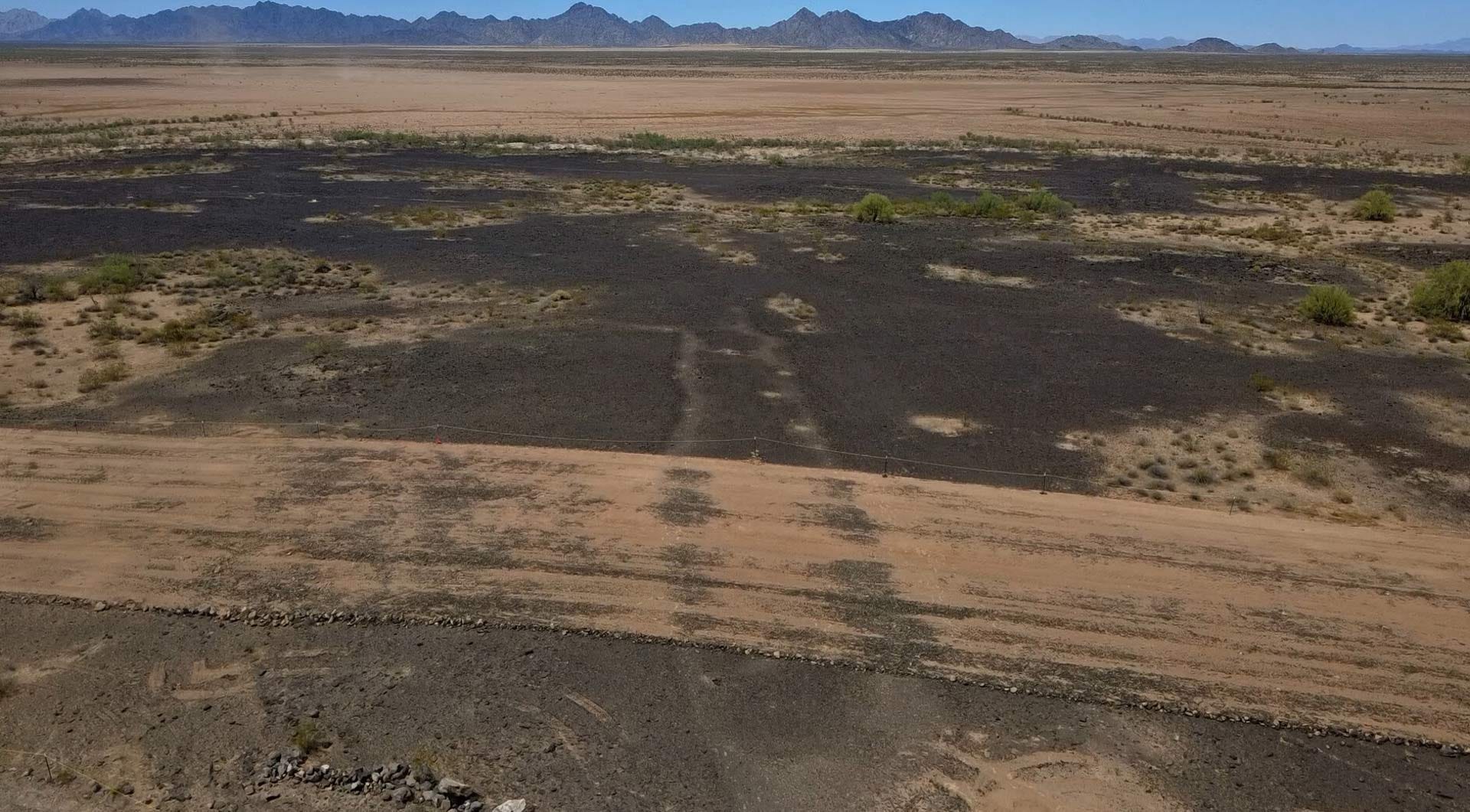
Consider what that fish has outlived. The pharaohs rose, built their tombs, and fell. Rome happened, entirely, start to finish. The Maya built cities and left them to the jungle. Spain arrived with horses, smallpox and paperwork. Mexico happened. The United States happened. The railroad came through, two world wars came and went, the atomic bomb was tested one state over, and through all of it a giant fish lay quietly in the Sonoran Desert on the ancestral land of the Tohono O’odham, bothering no one, visible to no one at ground level, protected principally by the fact that it is in the middle of nowhere and made of the ground itself.
What finally got it was a fence.
In April, contractors building the administration’s second border wall drove their equipment through the site and scraped a 50-foot swath through the carving, according to the Center for Biological Diversity, which documented the damage in September. Fifty feet out of 272. Call it a fifth of the oldest artwork on two continents, removed by a crew that was there to make sure nobody crosses an imaginary line that is, by the most generous counting, 173 years old.
Customs and Border Protection explained that the contractor “inadvertently disturbed” the site. This is a sentence to hold up to the light. The site is 272 feet long. It is not hiding. It has been in the archaeological record for decades, on a national wildlife refuge, on land the government itself administers. “Inadvertently disturbed” is what you say when you knock over a vase at a party. When heavy machinery grades a path through a listed archaeological site, the inadvertence under discussion is that nobody checked, because nobody had to.
And nobody had to on purpose. The Department of Homeland Security builds the wall under waiver authority that lets it set aside the laws protecting environmental, cultural, historical and religious sites. The laws that would have required a survey, the survey that would have found the enormous fish already on the maps, were waived so the fence could go faster. The protection system did not fail. It was turned off, formally, by the people whose job was to run it, which is how a 6,500-year losing streak for entropy ended in a single April morning.
CBP’s statement says the remaining portion of the site “has been secured and will be protected in place,” which is the kind of thing you can only announce after your own contractor has driven through the part that wasn’t. The commissioner is “engaged directly with tribal leadership” on next steps, and the agency is reviewing its construction protocols, which is government for the vase is already broken but we have spoken sternly to the elbow. The Tohono O’odham, whose ancestors’ land this is and whose reservation the wall also crosses, are meanwhile in federal court trying to keep construction away from Quitobaquito Springs, a sacred water source, with the waiver authority standing against them there too.
The researchers who dated the fish published their findings with a line that deserves to outlive the news cycle: the site’s age underscores “the significance of this site and the parallel great misfortune resulting from its damage.” The advocate who documented the scrape, Russ McSpadden, was less formal. “It’s a cultural and historical atrocity.”
Here is the part I keep returning to. The people who carved the fish had no metal, no wheel, no writing. They made something that lasted six and a half thousand years, and they made it so that it could only be seen whole from a vantage point no human of their era would ever reach. It was, whatever else it meant, a long bet on the future. The society that finally hit it had satellites that photograph the site from orbit, laws specifically written to protect it, and archaeologists who had already mapped it. Every one of those advantages was available, and the wall went through anyway, because the one thing we built that they couldn’t was a form that says none of it applies.
The fish will now be famous for the gash. Six thousand five hundred years of surviving, and its entry in history gets written by a grader operator in April. The wall it was damaged for has a design life of about thirty years.
This action is soooo them.
For decades we had to step back and not allow the construction of a highway in Northern Michigan because the construction would damage the breeding ground of a certain species of butterfly.
What gives them the right to plow through a centuries-old petroglyph for a wall? Destruction is more important than preservation. That is so unconscionable!