


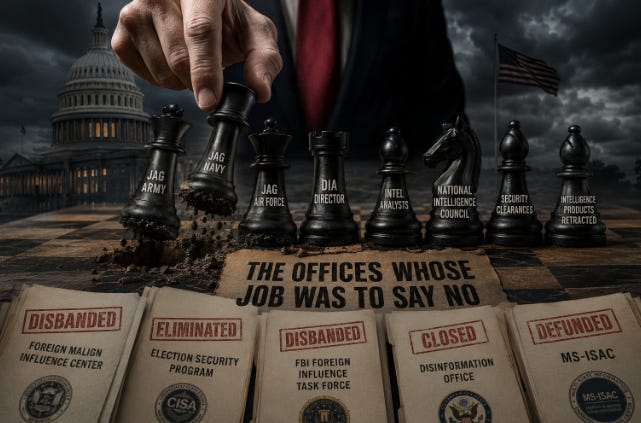
On the afternoon of February 21, 2025, the President of the United States fired the Chairman of the Joint Chiefs of Staff, the Chief of Naval Operations, the Vice Chief of Staff of the Air Force, and the judge advocates general of the Army, the Navy, and the Air Force.
Most of the coverage went to the Chairman, because he had two and a half years left on a four-year term and because his replacement was pulled out of retirement, which no president had ever done for that job. Some went to the Chief of Naval Operations, because she was the first woman to lead a service.
Almost none went to the three lawyers.
A judge advocate general is the senior uniformed attorney of a military service. The office exists for one purpose that matters more than all its others combined: when a commander is given an order, the JAG is the person who tells him whether it is lawful. That is the entire job. It is the mechanism by which the American military distinguishes itself from the militaries that follow whatever they are told.
All three were removed on the same day, without stated cause.
Whatever else can be argued about the last eighteen months, and a great deal can be argued in both directions, one thing cannot: nobody saves a dollar firing a judge advocate general. There is no efficiency rationale, no bloat to trim, no redundancy to consolidate. The position is one person. The savings are zero.
Which raises the question of what the firings were for, and once you start asking that question about the JAGs, you notice that the answer generalizes.
The category
Set the budget arguments aside entirely for a moment and sort the removals of the past eighteen months by what the removed person actually did for a living.
The three judge advocates general, whose job was to say an order is unlawful.
Lieutenant General Jeffrey Kruse, director of the Defense Intelligence Agency, fired in August 2025, weeks after a classified DIA assessment of the damage from the Iran strikes reached conclusions the White House did not want.
Mike Collins, acting chair of the National Intelligence Council, and his deputy Maria Langan-Riekhof, fired in May 2025. The National Intelligence Council is where the government’s most senior subject experts compress the disagreements of eighteen agencies into a single National Intelligence Estimate. The Council was then moved out of CIA and relocated inside the Director of National Intelligence’s own headquarters.
Two senior analysts, fired in May 2025 over an assessment on Tren de Aragua that did not support the administration’s public position.
Thirty-seven security clearances revoked in August 2025, including that of one of the intelligence community’s most respected Russia experts. The stated reason was politicization of intelligence.
Nineteen finished intelligence products retracted by CIA on subjects including white-nationalist terrorism, on the director’s assertion that they had failed to meet objectivity standards.
The 2016 assessment of Russian election interference, reopened by the director of the CIA and publicly denounced as a corrupt and politicized act.
Every one of those people or products existed to deliver a conclusion the recipient had not ordered in advance. That is the common property. Not ideology, not seniority, not agency, not budget line. The function.
You do not have to believe any theory of intent to observe the pattern. You have to be able to read a list.
The offices that did one specific thing
The second pattern is narrower and, if anything, harder to explain away.
The Foreign Malign Influence Center, which existed to track foreign influence operations and threats to American elections, was declared redundant and its functions dispersed.
CISA’s Election Security Program was eliminated.
In February 2025, the Attorney General disbanded the FBI task force investigating foreign influence operations, including those targeting elections.
In April 2025, the State Department closed the office that countered Russian, Chinese, and Iranian disinformation.
The Multi-State Information Sharing and Analysis Center, which provided free cybersecurity monitoring to some 18,000 state and local governments, including the ones that run elections, was defunded.
Five offices. Four agencies. One function. Eighteen months. A midterm in November.
Each of those decisions has a defense available in isolation. Redundancy, consolidation, mission focus, cost. The defenses do not survive being stacked, because there is no version of consolidation in which the consolidated function disappears from every agency at once.
What is left of the cyber agency
CISA, the civilian agency responsible for defending American critical infrastructure, has gone from roughly 3,400 employees in January 2025 to about 2,400. Its authorized strength is 3,292 positions and only 2,324 are filled.
The Stakeholder Engagement Division, whose whole job is helping private companies defend themselves, lost 96 of 189 people. Among the cuts were probationary members of the red teams, the specialists who simulate attacks in order to find holes before adversaries do. Nearly all of the agency’s senior leadership resigned or announced departure by May 2025. Five of ten regional directors are serving in an acting capacity, and regional directors are the people a state calls when something is happening. The federal cybersecurity scholarship pipeline was cut by more than sixty percent. The FY2027 request eliminates election security, chemical security, and cyber education and training entirely.
Representative Andrew Garbarino, a Republican who chairs the House subcommittee with jurisdiction, has said publicly that he does not understand how reducing the staff helps the agency do the job.
In May 2026, Google confirmed the first AI-generated zero-day exploit capable of defeating two-factor authentication.
The part where they dismantled the thing they say they are afraid of
The administration’s foundational claim about COVID-19 is that it came out of a laboratory. Hold that in mind while reading the following.
BARDA, the agency that develops vaccines and therapeutics against novel pathogens, was cut by $361 million. Project BioShield lost $100 million with another $125 million proposed. The Strategic National Stockpile lost $61.8 million. The Hospital Preparedness Program, H-CORE, and the Medical Reserve Corps were eliminated outright. The Administration for Strategic Preparedness and Response was folded into CDC. The FY2027 request cuts CDC by forty percent.
In August 2025, HHS terminated 22 mRNA vaccine development contracts worth roughly $500 million. One of them, with Tiba Biotech, was not for an mRNA vaccine at all. It was a therapeutic using RNA interference, a different technology approved by the FDA in 2018. It was cancelled anyway.
NIH removed biodefense and pandemic preparedness as a strategic priority, and according to reporting in Nature, instructed staff to scrub the word biodefense from the agency’s website. Roughly a third of NIAID’s $6.6 billion budget funds biodefense-related work.
An administration that believes a laboratory produced the last pandemic has spent eighteen months disassembling the apparatus that would detect the next one. Both things are true at the same time and no one has been asked to reconcile them.
The missiles, which is a different verb
The interceptor situation is real and it deserves to be described accurately rather than folded into the rest.
CSIS estimates fewer than 827 Patriot interceptors remain, against a pre-war inventory of roughly 2,200. That is about sixty-five percent expended. THAAD is down roughly thirty-eight percent, leaving somewhere between 234 and 278. The United States produces 183 of the high-end Patriot variants per year, and it takes about three and a half years from contract signature to delivery. Hegseth has said replenishment will take months and years depending on the system. CSIS puts it at three years minimum and describes a window of vulnerability for a Western Pacific conflict. Mark Cancian has said continued fighting could degrade the ability to fight China or North Korea.
Deliveries to Japan, Australia, and the Netherlands are being delayed to backfill American stocks. NBC reported that commanders in the region have begun declining to intercept Iranian missiles headed toward unpopulated areas of American bases, in order to conserve interceptors.
That last detail is worth reading twice. American air defense is now being rationed in an active theater.
But this is depletion by use, not by cut, and the distinction matters if you want the argument to hold. Nobody defunded the Patriot program. The inventory was spent fighting a war the president began on February 28 without asking Congress for authorization. It is his, but by a different mechanism than the rest of this, and collapsing the two makes the whole case easier to dismiss.
The Guard, and a contradiction on the record
The National Guard deployment in Washington is on pace to cost $602 million a year. The Metropolitan Police Department, with roughly 4,900 officers, operates on less. CBO put the 2025 domestic deployments at about $496 million and estimates $1.1 billion for 2026. Roughly 4,700 guardsmen from nineteen states have been involved. Guardsmen have been assigned to collect trash, landscape public areas, and remove graffiti. More than three dozen D.C. police officers are themselves Guard members and have been placed on leave in order to deploy, which subtracts working police officers from the city in the name of adding security to it.
A House committee report found no measurable effect on crime.
Here is the part that should be quoted wherever this comes up. That same committee report states that National Guard leaders, speaking to committee staff, expressed significant concerns that the mobilization has degraded readiness and will continue to.
In June 2026, Major General Ronald Burkett II of the National Guard Bureau told reporters at a roundtable that domestic missions like the one in Washington are building readiness rather than detracting from it, and that he was not tracking any concerns from either the Army or Air National Guard.
Same institution. Same period. Opposite statements. One made privately to congressional staff and one made publicly to cameras.
What I am not claiming
There is a large and genuinely alarming story about American shipbuilding, and it is not this administration’s fault, and saying otherwise would poison everything above.
Virginia-class submarines are averaging four years behind schedule and delivering at about 1.2 per year against a requirement of two. Constellation-class frigates are three years late. The Enterprise has slipped to 2034, and the Eisenhower, commissioned in 1977, has had its retirement pushed into the 2030s to cover the gap. The fleet dips to around 287 ships this year while China’s passes 370.
None of that is new and very little of it is political. Only two shipyards in the country can build nuclear-powered warships. Both are at capacity. Both are short of nuclear-certified welders and machinists, and you cannot conjure those with an appropriation. CBO found that delays grew slightly between 2025 and 2026 despite substantial new investment, which is the clearest possible evidence that money is not the binding constraint. Zumwalt, the Littoral Combat Ship, and Constellation all failed under previous administrations of both parties.
The one fair criticism is that the Senate-confirmed position of Assistant Secretary of the Navy for Research, Development and Acquisition, the single job most responsible for fixing this, has gone unfilled.
I include this because an argument that explains everything explains nothing, and because the parts of this that are real do not need the parts that aren’t.
What the list actually shows
Strip out the shipbuilding, separate the missiles into their own column, and what remains is not a story about budgets. Budget stories have budget explanations. This one does not, because the single cleanest item in it saved no money at all.
Three judge advocates general were removed in one afternoon. The intelligence officer whose agency contradicted the president on the Iran strikes was removed weeks after doing so. The senior analysts who wrote an unwelcome assessment were removed. The Russia expert lost his clearance. The election-threat offices were closed in four separate agencies inside a year and a half. The pandemic-detection apparatus was dismantled by an administration that says a pandemic was manufactured on purpose.
I am not going to tell you what the intent was, because I cannot read minds and because the version of this argument that asserts intent is the version that gets waved away.
I will tell you what the effect is, because the effect is not in dispute. Fewer people in the government are now positioned to say no, to say that is unlawful, or to say that is not what the evidence shows. The offices that watch for foreign interference in an election have been closed four months before an election. And the officers who remain have watched what happened to the ones who delivered the wrong answer.
They are not going to need to be fired.
That is the point of firing the first ones.
This is a nightmare