


Sometime last week, before Donald Trump banned CNN, MS NOW, and Politico from the White House, an aide put a Politico graphic and a set of television clips in front of him. According to CNN, citing multiple people familiar with what happened, the aide was Natalie Harp, and the material was among the things that set him off. By Friday he had posted the ban. By Saturday morning the Secret Service was confiscating reporters’ badges at the gate.
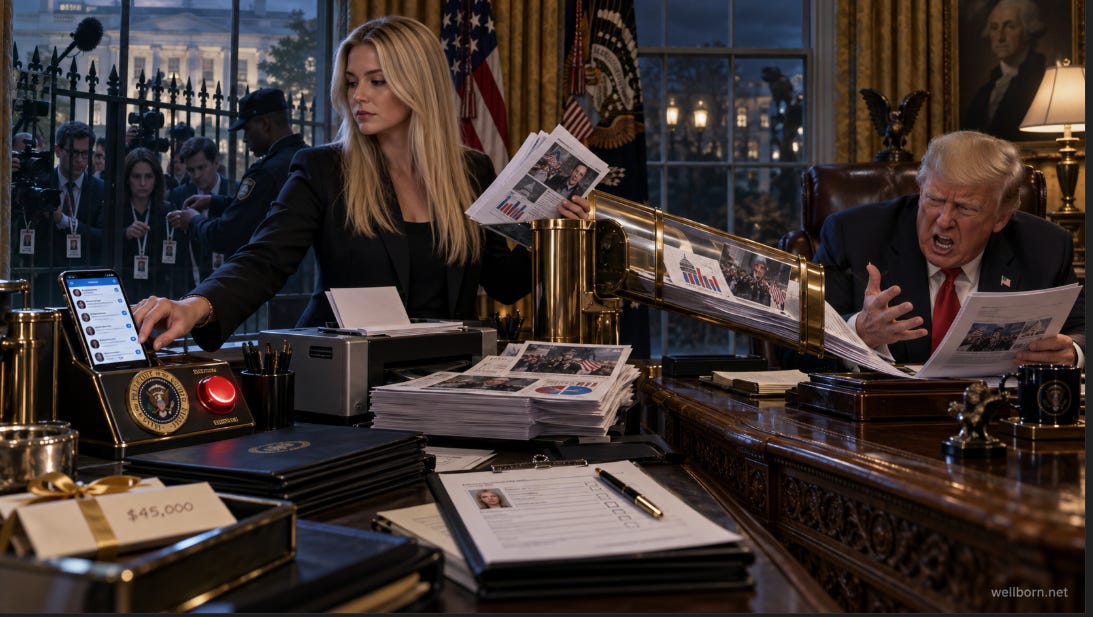
Asked why he did it, the President said there was “No reason” and called it “just cumulative stories over the last two years.” CNN’s reporting fills in a narrower answer: a week of bad news for the White House, coverage suggesting he had hurt Republican chances in November, and a thirty-five-year-old executive assistant who decided which pieces of that coverage he would see, and when.
I wrote about Harp in July, when the question was mostly who she is. The question now is what she does, and the answer has become a problem of constitutional scale.
How this presidency takes in information
Every president is shaped by what reaches his desk. For most of them that means a chief of staff, a national security adviser, a staff secretary, a communications office, and a morning intelligence briefing, each layer with its own professionals, its own paper trail, and its own habit of pushing back. The process is slow on purpose. It exists so that no single person, and no single mood, decides what the president believes to be true about the world that morning.
Trump has never been known for reading that paper, and by most accounts what reaches him instead is printouts. Harp’s job, going back to the 2024 campaign when she traveled with a laptop and a portable printer, has been to produce them: poll numbers, flattering coverage, social media posts, and, when useful, the things that make him angry. MS NOW, reporting on her role in August, described her as a gatekeeper who supplies the President with printed polls and favorable news. White House officials who have tried to work around her have told reporters that she “plays into the less productive and more troublesome parts of his nature.”
For an ordinary president, the person who runs the printer would be a scheduling detail. For this one, whose governing style is to react, and whose reactions become policy within hours, the person who chooses what he reacts to is holding one of the most consequential jobs in the government.
How this presidency speaks
The same person controls much of the other direction too.
After Dan Scavino, the longtime keeper of Trump’s social media, stepped back from day-to-day posting, Harp took over a large share of the President’s Truth Social account. Greg Greene, who managed social media for Democrats during the Obama years, described the difference to The New Republic in structural terms. His work passed through multiple layers of approval and consultation with a communications director. Harp’s, by his description, has very little standing between her and the send button.
What goes out through that button is official. The President’s posts move markets, announce tariffs, threaten foreign governments, and, this weekend, removed three news organizations from the White House. When a video depicting Barack and Michelle Obama as apes appeared on the account at 11:44 p.m. on February 5, the White House first called the outrage fake and then said the video had been posted “erroneously.” Semafor reported that aides inside the building were furious at whoever had done it, and The New Republic later reported that Harp supplied the video. The White House has never publicly said who posted it.
That uncertainty is itself the point. Nobody outside the building can say with confidence which of the President’s words on any given night are his, which were drafted by an aide and approved, and which were an aide’s selection that he never saw before it went out. Semafor’s source said Trump “had not seen the video before it got posted.”
The year without a clearance
In August, MS NOW reported that Harp worked in the White House for more than a year without completing the background investigation that every staffer with her access is supposed to undergo. She declined, repeatedly, to fill out the forms. White House counsel and security officials raised concerns. The matter was resolved only when Trump personally intervened, and she then completed the paperwork. One national security official told reporters that her proximity to the President and his residence “gives her access to more sensitive information than other senior White House officials.”
Karoline Leavitt says Harp now “has a security clearance like everyone else.” That may be true today. For more than a year it was not, and during that year she sat beside the President, handled his phone and his accounts, and moved in and out of rooms where the most sensitive business of the government is conducted. The system designed to catch that failed, and the only person who could fix it was the President himself, because nobody else in the building could make her comply.
That detail explains the rest. Staff have tried, according to multiple reports, to put distance between Harp and the President. One person described her as “persistent and not realizing that’s what they were trying to do.” It has not worked, because her standing comes from him, and he outranks the organizational chart.
The money
In early September, the Washington Post reported that Trump’s financial disclosure showed he had given Harp a cash holiday gift of $45,000. Two other close aides, Margo Martin and Chamberlain Harris, received the same amount, and Walt Nauta received $20,000. For Harp, whose White House salary is about $150,000, the gift amounted to nearly a third of her government pay.
The White House says the gifts reflect a longstanding practice of generosity and “have nothing to do with any of these individuals’ official government duties.” Richard Painter, who was the chief ethics lawyer in George W. Bush’s White House, told the Post the payments could violate the federal law that bars outside supplementation of a government salary. Don Fox, a former acting head of the Office of Government Ethics, called them “troublesome” because of the sense of indebtedness they create.
Set the legal question aside and the structure is plain. The aide who controls the President’s information and much of his voice is paid by the taxpayers and also, substantially, by the President personally. Her loyalty runs to the man, and it is compensated by the man. That is how a household works. It is a strange way to staff the executive branch of the United States.
Who she was before
Harp came to the White House from One America News, where she spent the aftermath of the 2020 election promoting the claim that it had been stolen. On January 6, 2021, she posted repeatedly in support of the effort to stop the certification, including “FIGHT FOR TRUMP!” and “today we STOP THE STEAL.” Letters she wrote to Trump in 2023, which surfaced in late 2024 and alarmed members of his own team, addressed him as her “Guardian and Protector in this Life” and told him, “You are all that matters to me.”
None of that is a crime, and personal devotion to a boss is not a disqualification for employment. It becomes a public question when that person occupies the narrow channel through which the President learns what is happening in the country, and through which the country hears what the President has decided.
What kind of power this is
Harp decides nothing formally, holds no statutory authority, and signs no orders. Every decision that has passed through her hands was the President’s to make, and he owns all of them, including the press ban. It would be a mistake, and an easy one, to treat her as a puppeteer and him as the puppet.
But power in a presidency has always been about more than signatures. It is about agenda: what the decision-maker is looking at, in what order, with what framing, and at what hour. In a normal White House that power is spread across dozens of accountable people. In this one, a remarkable amount of it has collapsed into a single unelected aide, who is not confirmed by the Senate, does not testify to Congress, answers no press questions, went more than a year without the vetting her access required, and receives a substantial private payment from the man she serves.
If you want to know why a president who says he had “no reason” for expelling three newsrooms nonetheless did it on a particular Friday, the most useful fact available is who showed him what on the days before. By that measure, and it is the measure that governs this presidency, Natalie Harp is the most powerful person in the country who never faced a single voter.
What Congress can do
The House Oversight Committee can request a basic accounting that any prior White House would have produced without argument: who has login access to the President’s Truth Social account, what approval process governs posts, and who posted the February 5 video. Posts made on the President’s account are presidential records under the Presidential Records Act, and the National Archives can be asked whether the White House is preserving the drafts and approvals behind them.
Senators with oversight of the Office of Government Ethics can ask for a formal opinion on the $45,000 gifts. And any member of Congress can ask the question that CNN’s reporting now makes unavoidable: when federal power was used against three news organizations last week, what did the President see first, and who chose it?
The answers will not remove Harp. They would put on the record, for the first time, how this presidency actually makes up its mind.
By accounts, she generally only provides him with the flattering news. She chose to show him those negative pieces, knowing exactly how he would react. Trump's ego makes him very malleable. Susceptible to flattery, but equally susceptible to insult. A doubly compromised president. A malignant narcissist with frontotemporal dementia should NOT be the leader of the US.
She, in some ways, is the tip of the iceberg of the current unqualified federal government.
I'm glad that the broadcast networks have chosen not to cover the felon-in-chief in support of the media outlets that he banned from the White House.