


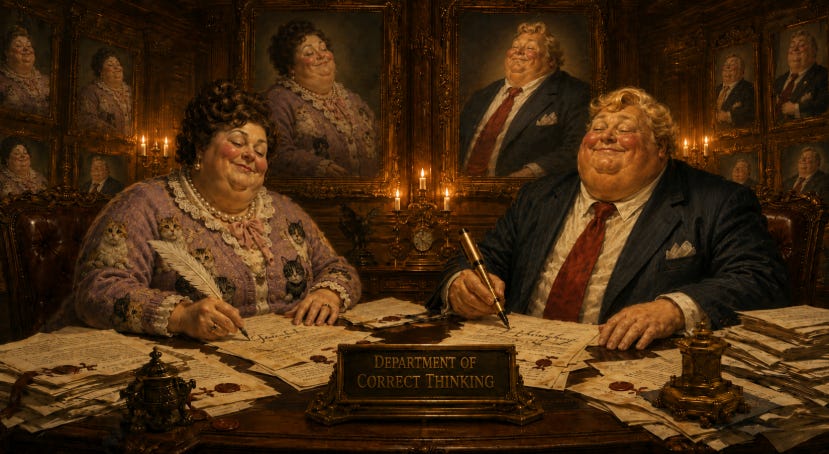
There is a particular species of authoritarian that the great dramatists have always understood better than the political scientists. It is not the brooding tyrant in black, not the coldly brilliant strategist plotting in candlelit rooms. It is the small, self-satisfied bureaucrat who genuinely believes that rules exist to protect people exactly like themselves, that cruelty administered through proper channels ceases to be cruelty, and that anyone who objects is, frankly, being rather difficult. J.K. Rowling gave this archetype a cardigan, a collection of decorative plates featuring painted cats, and the name Dolores Umbridge. History, with its customary lack of taste, gave it a red tie and the nuclear codes.
The comparison between Dolores Umbridge and Donald Trump is not merely amusing. It is structurally precise.
The Performance of Authority
Both Umbridge and Trump understand, at some reptilian level, that the appearance of authority matters more than its legitimate exercise. Umbridge did not arrive at Hogwarts and immediately begin torturing students. She arrived with Ministry stationery, Educational Decrees, and a simpering smile that communicated, above all, that she was the reasonable one. The rule of law, she implied, was simply her preference dressed in official robes.
Trump ran the same play for decades. The lawsuit was always the instrument before the argument. The signed document, the executive order, the presidential seal, these were not tools of governance so much as props in an ongoing performance of dominance. Neither figure was interested in the substance of authority. They were interested in its theater. The decree mattered less than the signing. The policy mattered less than the rally. What Umbridge called Educational Decree Number Twenty-Four, Trump called a press conference, and both understood them as the same thing: a demonstration that they could, and that you couldn’t stop them.
Sycophancy as Currency
Hogwarts under Umbridge ran on one economy: loyalty to her, expressed as enthusiastic agreement with whatever she had most recently decided. The Inquisitorial Squad was not recruited for competence. It was recruited for willingness, for the particular eagerness of those who mistake cruelty delegated to them for power earned by them. Draco Malfoy strutted through those corridors not because Umbridge respected him but because he was useful, and he was useful because he wanted to be, and he wanted to be because proximity to her authority felt, to him, like authority itself.
Trump’s Cabinet, his legal team, his inner circle across four decades of business and two terms of office, one long Inquisitorial Squad. The qualification was never expertise. It was the willingness to say, on television, with apparent sincerity, whatever had been required of you that morning. Those who performed this service were elevated. Those who declined, generals, attorneys general, vice presidents, anyone who discovered a conscience at an inconvenient moment, were publicly humiliated and then dispatched. The mechanism is identical. The only difference is that Umbridge’s squad wore badges and Trump’s wore suits, and the suits were generally cheaper than they looked.
The Absolute Conviction of Mediocrity
This is, perhaps, the deepest structural parallel, and the one that makes both figures genuinely frightening rather than merely ridiculous. Umbridge is not insecure. She does not lie awake wondering whether her methods are sound. She is armored in a certainty so total that it has become indistinguishable from stupidity, which is to say, it has become the most dangerous thing in any room she occupies. She cannot learn because she has already concluded. She cannot be corrected because correction would require her to briefly entertain the possibility that she was wrong, and that possibility has been foreclosed so thoroughly that it no longer exists as a concept in her cognitive universe.
Trump operates from the same sealed system. The economic advisor who presents contradicting data is not informative, he is disloyal. The general who explains military reality is not experienced, he is weak. The judge whose ruling goes against him is not applying law, she is corrupt. Every piece of evidence that might constitute a check on his self-assessment is reinterpreted, instantly and automatically, as evidence of the corruption of the person presenting it. This is not defensiveness. It is something more complete than defensiveness. It is the intellectual equivalent of a room with no doors, from which the occupant occasionally leans out a window to shout that the building is the finest ever constructed.
Cruelty as Policy, Not Pathology
There is a tendency, among those who wish to be considered measured, to describe the cruelties of both Umbridge and Trump as incidental, as the side effects of a governing philosophy rather than its animating purpose. This is too generous by half. Umbridge’s use of the Blood Quill was not a regrettable excess. It was the point. The detention that carved words into a student’s hand was not punishment designed to correct behavior. It was a demonstration that she could do it and that the doing of it gave her pleasure. The pleasure was inseparable from the policy.
Trump’s family separation policy at the border did not arise from a bureaucratic miscalculation. The children in cages were not collateral damage. The suffering was documented, reported, and met with a shrug that, if you looked at it closely enough, was not entirely a shrug. Neither of these people stumbled into cruelty. They walked toward it, and they walked at a comfortable pace, and they did not look behind them.
Where the Parallel Ends, and the Darkness Deepens
It would be convenient, and somewhat comforting, if Trump were simply Umbridge in a larger building. He is not. Umbridge exists within the moral universe of a children’s novel, which means her crimes, however genuinely vile, operate within certain narrative constraints. In the seventh book, under a Ministry controlled by Voldemort, she personally administers the machinery that persecutes and imprisons Muggle-borns, running kangaroo tribunals that send innocent people to Azkaban on fabricated charges. She is, within her context, as bad as her author allowed her to be.
Trump occupies a different category, and honesty requires saying so directly. The allegations against him, civil findings of sexual abuse, the federal indictments for the retention of classified documents, the financial fraud adjudicated in New York, the documented associations with Jeffrey Epstein during the years when Epstein’s activities were known to those paying attention, these are not Hogwarts problems. They are not the problems of a fictional sadist in a cardigan. They represent a ledger of alleged and adjudicated conduct that Rowling, whatever her other failures of imagination, simply did not write into her villain, because that villain was meant to illuminate authoritarianism, not to catalog the full range of what a man with money and impunity might do across five decades of life lived entirely above accountability. Umbridge, for all her evil, never stood credibly accused of what a New York civil jury found Trump liable for. The comparison holds where it holds, and then it stops, and what lies beyond it does not require metaphor.
The Uses of Fiction
We reach for fictional villains when political language fails us, when the word “authoritarian” has been so thoroughly processed by euphemism and bothsidesism that it slides off the mind without purchase. Umbridge works as a comparison not because she is Trump’s equal in the ledger of alleged crimes, but because she captures something that pure political analysis misses: the texture of this particular kind of power, the way it smiles while it harms, the way it wraps itself in procedural legitimacy, the way it cannot conceive of itself as anything other than correct.
When Harry Potter readers say Umbridge was more frightening than Voldemort, they mean something real. Voldemort is ideology in its pure form, abstract, mythologized, at a useful distance. Umbridge is the deputy principal who gives you detention for talking back. She is the HR director who fires you and tells you it’s for your own benefit. She is, in every sense that matters, recognizable. She is the face authoritarianism shows when it is feeling confident and has no particular reason to hide.
Trump is that face, blown up to presidential scale, spray-tanned, and placed in front of a teleprompter he refuses to follow. The archetype is ancient. The cardigan is optional
.
This essay is commentary and political analysis. It is not affiliated with, endorsed by, or sponsored by J.K. Rowling, Warner Bros., or the Harry Potter franchise.
ThankQ Tom, you've composed a wonderful take on the deadly tetrad of the orange menace's feral personality: malignant narcissism, psycopathy, sadism, and Machiavellianism.
You're always creative and original, and we are fortunate having you to help us through these dark times.
Thanks for an excellent and insightful article. And Pam Bondi, Kristi Noem, Todd Blanche and the rest of this clown car seem like the types of people who would wave and smile as they pack you into a train car and send you to Auschwitz. A pox on all their houses.