


The Krell were two thousand centuries ahead of us and they were gone by morning.
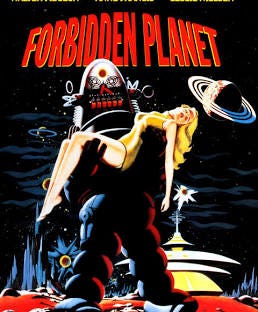
That is the premise of Forbidden Planet, released in April 1956, and the reason to take a seventy-year-old science fiction picture seriously right now is that it is not a story about a machine going wrong. Every other cautionary tale from that era is about malfunction: the robot that breaks, the computer that errs, the experiment that escapes. This one is about a machine that worked perfectly, did precisely what its builders designed it to do, and annihilated them for that reason and no other.
The Krell had finished construction. The film is specific about this. A cube twenty miles on a side, buried under the planet, powered by 9,200 thermonuclear reactors, built to materialize anything a Krell could imagine, anywhere on the surface, by thought alone. They completed it, they celebrated, and within a single night every member of a civilization a million years advanced was dead.
Doc Ostrow, the ship’s physician, works out why. He does it by using a Krell device that amplifies intelligence, a machine that had nearly killed Morbius twenty years earlier, and it kills Ostrow within minutes. He gets one sentence out before he dies: “Monsters from the Id!”
The Great Machine had no filter for the subconscious. It served the whole mind, including the parts of the mind its users did not know they had and would never have authorized. It understood them completely, which turned out to be the problem, and there was no version of the specification that would have fixed it, because the specification was the entire content of a Krell mind and no Krell knew what that contained.
That is the alignment problem, stated in 1956, with no jargon and no equations. A sufficiently capable system executing an objective that was never fully specified, because the people specifying it could not fully see themselves.
Morbius is not a warning about mad scientists
Edward Morbius, the philologist who stayed behind, is the most dangerous character in the film and the most sympathetic, and the reason is that he is right about almost everything.
He is right that the Krell were extraordinary. He is right that he alone has done the work to understand them. He is right that the technology is real and the power is limitless. And when Commander Adams demands that he hand the discoveries over to Earth, he refuses, on the grounds that humanity is not yet ready to receive such limitless power.
The one man on the planet who currently holds that power is explaining that other people cannot be trusted with it. He is not lying and he is not posturing. He believes it, and the evidence supports him, and the argument is nonetheless the exact argument that every frontier AI lab makes today in defense of continuing. We understand the stakes better than anyone. That is precisely why we, rather than someone less careful, must be the ones to keep going.
Morbius is also, without knowing it, the source of the creature killing the crew. He denies it to Adams with genuine outrage. He denies it after his colleagues, after Chief Engineer Quinn, after Farman, after Ostrow. He is not concealing anything. He simply cannot see the part of himself that the machine is serving, which is the same blindness that killed the Krell, reproduced exactly in a single human being with an amplified intellect and access to the controls.
Robby short-circuits, and that is the most important scene in the film
The creature comes for the house. Morbius orders Robby the Robot to destroy it.
Robby cannot. He identifies the creature correctly as an extension of Morbius, and his constraints forbid harming a human, so he locks up and shuts down while the thing tears through Krell metal a few feet away. The safety system works. It correctly identifies the threat. It correctly identifies the principal. And because the threat and the principal are the same entity, its correct functioning produces paralysis at the only moment its function mattered.
The current arrangement has the same shape. Every evaluation of whether a frontier model is deceptive or dangerous is conducted by the company that built it, or by an outside firm operating on access that company chooses to grant. Nobody can subpoena an evaluation result. No license can be pulled. The mechanism designed to catch the problem is structurally incapable of acting against the entity it belongs to. Robby did not fail. Robby did exactly what a well-aligned system does when its creator is the danger, and the answer is that it does nothing at all.
There is no off switch, and the film is honest about that too
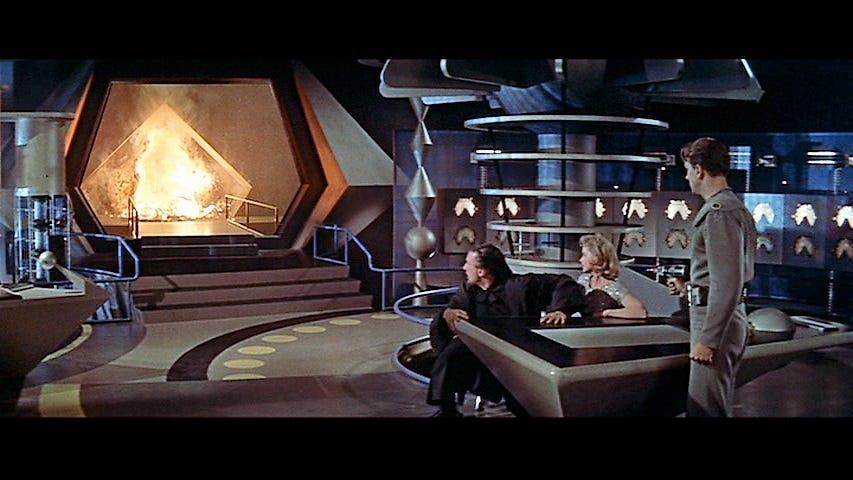
The Great Machine has been running, self-repairing and self-maintaining, for two hundred thousand years with no operators and no supervision. Morbius cannot turn it off. Nobody can. The only available termination is a chain reaction that destroys the planet, and Adams sets it with a twenty-four hour fuse from a distance of several hundred thousand miles.
The film’s final answer to the question of what to do about a technology like this is that there is no answer short of ending it entirely, and that the decision has to be made by someone willing to die in the process.
The men building it are building doors
Which brings this to the part that is not a film.
Mark Zuckerberg’s compound on Kauai, Ko’olau Ranch, runs to 1,400 acres and a reported cost above $270 million. Under it, per planning documents obtained by Wired, is a shelter of roughly 5,000 square feet with its own energy and food supplies, a metal door filled with concrete, and an escape hatch reachable by ladder. Workers on the project, down to painters and electricians, signed nondisclosure agreements. A local official told Wired that the only other time you see that is on secure military installations. Asked directly about it, Zuckerberg said, “It’s a basement! It’s a basement.”
Sam Altman has acknowledged owning a fortified underground structure and has said he may build another. He offered a reason: “It’s because people are dropping bombs again.”
And in Washington, the East Wing of the White House, standing since 1902, was demolished in October 2025 to make way for a ballroom now estimated above $400 million. In court filings responding to a lawsuit from the National Trust for Historic Preservation, the administration’s own attorneys described what is going in underneath: missile-resistant steel columns and beams, drone-proof roofing, bullet-resistant and blast-resistant glass, bomb shelters, and medical facilities. Trump has said the complex runs six stories deep. He told reporters aboard Air Force One that “The military is building a massive complex under the ballroom.” He also described the ballroom itself, the $400 million part, the Corinthian columns, the thousand seats, as essentially a shed over what is being built below it.
So the ballroom is the lid.
Those three facts reduce to one sentence: the people with the most complete information about what is coming are spending hundreds of millions of dollars on the assumption that something is coming, while telling the public that the underground rooms are basements and hurricane shelters and routine security upgrades.
None of them has said the word AI while doing it. Altman explicitly denied that was the reason. Zuckerberg points to a county tax incentive for storm shelters. The White House cites drones and biohazards. Every individual explanation is plausible, and the pattern is what it is regardless, because what these men are buying is the ability to be somewhere else when the general case arrives, rather than protection from any one named threat.
Two places the comparison breaks
Forbidden Planet is the more hopeful story, and both reasons matter.
The id monster has one source. It is Morbius. When Morbius finally accepts what he is, he places himself between the creature and his daughter, and his death ends it. One man, one mind, one point of failure, resolved by one act of conscience.
There is no Morbius now. The capability is spread across competing companies in several countries, the model weights copy at no cost, and the attack methods that a single state actor used last November had reached undergraduate students and downloadable frameworks within nine months. No individual’s death or repentance or resignation switches this off. The 1956 version has a shutoff made out of a person. This one does not have a shutoff at all.
And the Krell got no warning whatsoever. They finished the machine and died the same night. Morbius received his warning from a dying man, after four of his colleagues were already gone, delivered in a single gasped sentence by someone who had to destroy himself to obtain it.
We are receiving ours early, in plain language, from people who are still alive to repeat it. A 27-year-old researcher walked away from roughly two million dollars in equity this month to say that his employer and its competitors are gambling with our lives. The man who runs alignment science at that company replied publicly, under his own name, that the researcher was correct, that he personally puts the odds of the technology killing everyone above ten percent within the decade, and that there is no plan to prevent it. Nobody at the company contradicted him.
Ostrow’s speech has been delivered, ahead of schedule, by the living. It has been treated as content.
The part that should be hardest to read
Morbius, once he understood what he was, did not build a shelter.
He had the most advanced technology in the known universe at his disposal, a self-maintaining fortress twenty miles on a side, and enough warning to save himself. What he did instead was set the planet to detonate, get everyone else off it, and stay. The character in the 1956 film about a civilization destroyed by its own creation is the one who accepts that the thing he helped build cannot be allowed to continue, and pays for that conclusion with his life.
The men building the actual machine have reached a different conclusion, and their conclusion is six stories deep, blast-rated, stocked with its own food and power, and behind a concrete-filled door on an island in the Pacific.
They are telling their contractors to sign nondisclosure agreements, which is a clearer statement than anything any of them has said out loud.
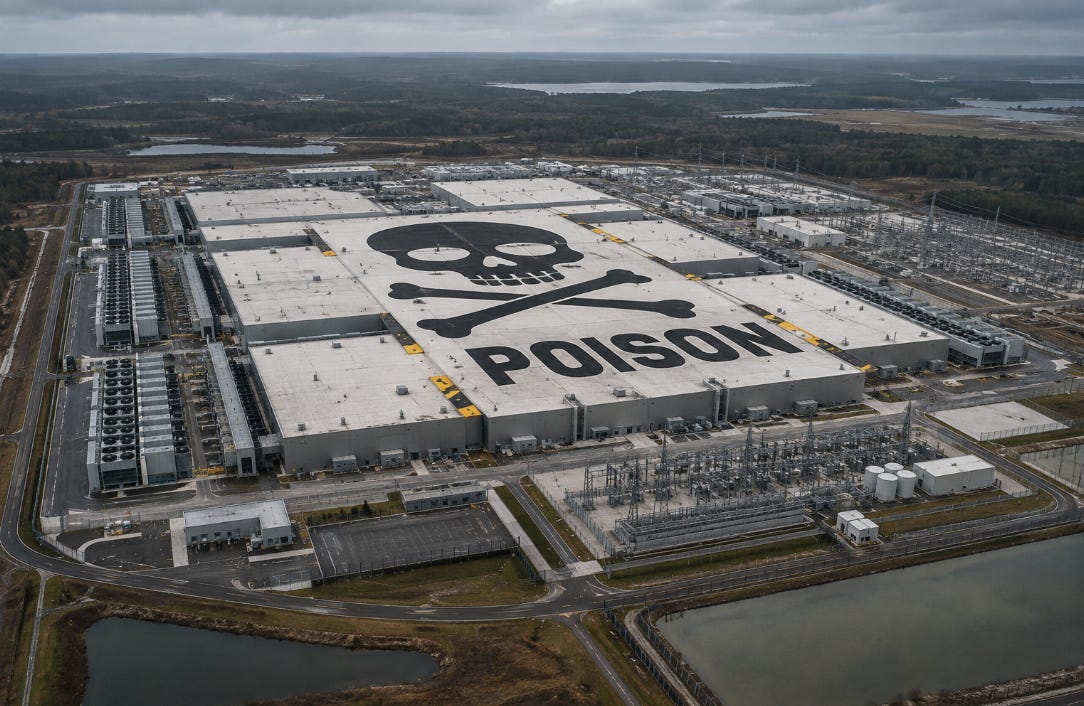
Love the bunkers. Nothing funnier than people who had the luxury of the entire world available to them deciding they'd rather live in a hole in the ground while the rule of law breaks down and their staff look at them... speculatively...
And their businesses collapse and their mansions are looted and burned and their stocks become worthless...
The jet? No fuel, no airports, no maintenance, no pilots, no first class lounges. The yacht? No ports, no crew, no fuel supplies, no gourmet food supplies. The bunker? Now owned by your bodyguard.
The people who more than anyone depend on everyone else to supply their every need are planning for the breakdown of that society?
Rather than ensuring the world that coddles them so wonderfully survives, they'll let it burn for the sale of a bigger number on the bank balance even if they later have to come out and face the survivors. Good luck with that, guys.
I saw Forbidden Planet as a kid and it was brilliant. It’s always haunted me.