


On Thursday, the Department of Justice sued the State of Alaska to stop it from certifying the result of a United States Senate election that has not yet happened.
The complaint asks the court to hold up certification if Mary Peltola wins while a second candidate named Daniel J. Sullivan Jr. remains on the ballot, pending an investigation into whether votes cast for one Sullivan were intended for the other. He will remain on the ballot. Early voting began October 19, and the ballots are printed, so the condition reduces to a single clause: if Peltola wins. The complaint was signed by Associate Attorney General Stanley Woodward, who in private practice represented Trump allies and January 6 defendants. Alaska’s target certification date is November 25.
The day before the filing, the president posted that “We are looking at powerful legal options,” promising “to remove the fraudulent Daniel J. Sullivan Jr. from the Ballot,” and has called the candidacy “CHEATING.” On the day of the filing, Attorney General Todd Blanche told reporters it is not the department’s intention to “improperly interfere with elections.” Asked whether the department might move against a certification, he said, “Yes, of course there’s scenarios that we can all come up with hypothetically,” and named “some doomsday scenario.”
The complaint rests on a single statute, the National Voter Registration Act, and on a single line from it. Alaska, the government says, has a duty “to protect the integrity of the electoral process.” That language is real. It sits at 52 U.S.C. § 20501(b)(3).
The complaint leaves out how the sentence begins. The full provision reads “The purposes of this chapter are,” followed by a list of four, the third being the integrity language. It explains why Congress wrote the law. The obligations the law actually imposes come in the sections after it, and every one of them concerns voter registration: the motor voter form, registration by mail, registration at public assistance agencies, maintenance of the rolls. Not one of them addresses who may appear on a ballot. Not one addresses certification.
Government lawyers quoted the third purpose and deleted the six words announcing that it was a purpose. That edit is the case.
What the document actually asks for. Derek Muller of Notre Dame, who went through the filing on Friday, found that the prayer for relief does not quite ask for anything. Paragraph 43 requests a declaration. Paragraph 44, the one that would request an order, is missing its verb. Muller called the legal theory “absurdly thin” and wrote that the department filed to “win the press release rather than the litigation.” His assessment of the authority claimed: “The statute simply doesn’t let the Department of Justice enjoin certification.” Rick Hasen, writing in Slate the same day, reached the same conclusion and used the same word, calling it a press release rather than a legal document.
A federal complaint seeking to suspend the certification of a Senate seat went out over the signature of the department’s third-ranking official with a sentence fragment where the request for relief belongs. Either nobody proofread it, or the filing was never meant to be read closely by a judge.
The man at the center of it. Dan J. Sullivan Jr. is a retired schoolteacher from Petersburg, a fishing town of about 3,000 people in the southeast panhandle. He announced on May 29 and filed as a Republican three days before the deadline. The general election ballot lists him with no party. Through September 30, his campaign had raised $30,230 and spent $26,754, leaving $3,476 on hand. Senator Dan S. Sullivan had raised $13.8 million. Peltola had raised $32.6 million.

Asked about the accusation, Sullivan Jr. told the New York Times, “My intention is not to trick people,” and said he hoped people were “informed enough to know the difference between an incumbent senator and a teacher.” To his hometown paper, the Petersburg Pilot, in June, on whether he had coordinated with the Democrat: “I have not spoken to Mary (Peltola). I wouldn’t even know who to speak to.” On being investigated by the federal government: “I’m just a guy, and they’re scary.”
Aubrey Wieber of the 907 Initiative, an Alaska government watchdog group, put the problem with the theory in one question. If a $30,000 candidacy were the Democrats’ hidden weapon, someone would have spent enough money to make sure he finished in the top four. “No one has found any indication that Dan J. Sullivan is a sham candidate,” Wieber said.
Alaska already litigated this, and the state lost. The Division of Elections tried to keep him off the ballot. On June 10, it issued a preliminary finding of ineligibility and days later a final one, holding that his paperwork was not filed in order to declare an actual good-faith candidacy. On June 26, Anchorage Superior Court Judge Thomas A. Matthews reversed, ruling that no provision of Alaska law, Alaska regulation, or the United States Constitution supports a good-faith requirement for candidacy. On June 29, the Alaska Supreme Court affirmed and ordered his name onto the primary ballot, with a full opinion to follow.
The questions from the bench are worth reading now that the federal government has adopted the losing argument. Justice Aimee Oravec pointed out that challengers run for all sorts of reasons and that the state’s standard had no limiting principle: “These are not necessarily candidates that are seeking office so much as attention.” She also told the division’s lawyer where the remedy belonged, saying, “You control the ballot.” Justice Jennifer Henderson on the intent test: “It seems amorphous, frankly.” The court sent the ballot design back to the division, which published a sample ballot that distinguishes the two men and identifies the incumbent as the incumbent.
So the ballot-access question was decided four months ago by the state’s highest court, on the merits, against the premise the Justice Department filed on Thursday.
The primary already measured the harm. This is the part the complaint cannot survive, and it is a matter of public record. Alaska ran the experiment on August 18, with both Sullivans on the same ballot. Peltola took 82,244 votes, or 49.5 percent. Senator Sullivan took 68,726, or 41.4 percent. Sullivan Jr. took 4,107, which is 2.5 percent. Out of 166,004 votes cast, the maximum possible confusion effect was about four thousand, and the gap between the leading Democrat and the incumbent Republican was more than thirteen thousand.
There is a further problem for the theory, and it is structural. Alaska’s general election is conducted by ranked choice voting. The top four from the open primary advance, and voters rank them. A voter who marks the wrong Sullivan first can mark the right one second, and when the schoolteacher is eliminated his ballots transfer to whoever those voters ranked next. Confusion over two names on a ranked ballot is the kind of voter error a ranked ballot is designed to absorb. The tabulation is scheduled for November 18, with certification targeted for November 25, and a defeated candidate has five days after that to request a recount under AS 15.20.430, with the state paying if the margin is under half a percent.
The criminal track, which came first. The civil suit is the second federal action against this candidacy. NBC News reported in July that prosecutors were looking for evidence of wire fraud, or of a conspiracy to deprive Alaskans of a free and fair election, which could be charged as a civil rights violation. The investigation, per that report, is being run by the U.S. Attorney’s office in Alaska together with the state’s acting attorney general. On August 18, primary day, NBC reported that a grand jury had issued subpoenas.
The Alaska Beacon then tried to find a single recipient. Sullivan Jr. said he had not received one. Peltola’s campaign had not received one. The Alaska Democratic Party had not received one. The consultant who had helped him start the campaign had not received one. The Division of Elections had not received one. The U.S. Attorney’s office would neither confirm nor deny that an investigation exists.
Hasen, considering what an indictment would even charge, wrote, “I don’t see how the government could criminalize his running for office” for impure motives, and noted the obvious remedy in a democracy: “The solution to this problem is counterspeech.” A prosecution on this theory, he noted, would also reach a great deal of ordinary politics, including every instance of a party quietly encouraging a candidate who splits an opponent’s vote.
The same week, in the same state, a judge actually did withhold a certification. On Thursday, the day DOJ filed, Anchorage Superior Court Judge Josie Garton ruled that Lieutenant Governor Nancy Dahlstrom and the Division of Elections had wrongly placed a disqualified candidate on the ballot. The candidate is Jose Tagle, a Republican running for state House District 22. He had submitted a blank financial disclosure, the Alaska Public Offices Commission moved to disqualify him in late August after he failed to fix it within the grace period, and Dahlstrom followed that decision and then reversed herself days later and put him back. Garton held that the commission’s decision was final, that the lieutenant governor had no discretion to ignore it, and that “APOC’s decision was effective immediately.”
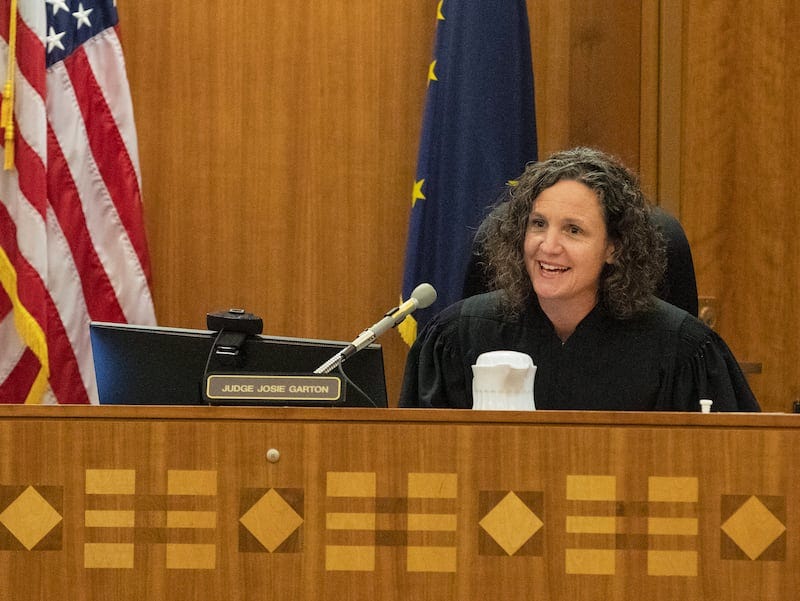
Her remedy is the instructive part. Early voting had started, so she declined to order ballots reprinted, writing that the erroneous certification “does not undermine the fundamental fairness of the election.” She ordered the commission to notify Tagle that he has thirty days to challenge his disqualification. And she wrote that “Tagle’s election may not be certified” if “he does win a majority of votes in the general election.”
That is a court withholding a certification, and it is conditional on the result, the same shape as the federal complaint. The resemblance ends there. It was brought by the Alaska Democratic Party under a state statute, against a specific candidate, on a closed factual record, after an administrative agency had made a final decision, with an appeal path preserved for the candidate. It took three months and two rounds of litigation, including one the party lost in August for filing too early.
Set that beside a federal complaint built on a purpose clause, filed twelve days before the election, asking that an entire Senate race go uncertified if the wrong candidate wins, pending an investigation with no defined end. One of those is how a certification gets lawfully held up. The other is a letterhead.
The pattern it belongs to. Hasen’s piece lists the rest of the month. The department went to court in California demanding that Los Angeles County segregate mail ballots from a list of roughly 20,000 people flagged as likely noncitizens, a list delivered first on a thumb drive and then as a spreadsheet; the county sampled 200 of the names and found mostly unregistered people and people born in the United States. The department asked for a ruling by noon Thursday and appealed to the Ninth Circuit before the court had ruled.
On the same Thursday it announced 28 arrests for noncitizen voting, with the New York Post given an exclusive look at a pre-dawn raid. It has lost 26 cases seeking unredacted state voter lists. A federal court blocked the March 2025 executive order requiring documentary proof of citizenship, holding that “our Constitution does not allow the President to impose unilateral changes to federal election procedures.” The Supreme Court signaled that the Postal Service would likely lose on its mail ballot rule. A Homeland Security list of 16,000 potentially ineligible Nevada voters came back from state review at zero. On November 3 the department will send about a thousand election monitors to polling places in every state.
And on the same Alaska ballot, Measure 2 would repeal ranked-choice voting and the open primary and return the state to closed partisan primaries. The president supports it. The most recent survey has it losing, 47 percent to 53. The 2024 version failed by 0.24 percent. So Alaskans are being asked to end the system, while the Justice Department sues over a result that system has not yet produced.
What the filing is for. It will not succeed, in the judgment of two of the country’s leading election law scholars, delivered within a day of the filing, and the department’s own filing cannot locate the verb for what it wants. Peltola leads by about 2.6 points across the public averages, and a comfortable win moots the whole thing, as Muller noted when he wrote that a wide Democratic victory or a narrow Republican one could end it.
The purpose is to put a document in the record. After Thursday, a federal lawsuit seeking to suspend the certification of a Senate election is a thing the Department of Justice has filed. The next one can cite this one as ordinary practice. The attorney general has already said out loud that he can imagine the scenario, and has declined to rule it out. The window in which that matters runs from November 3 to November 25.
A Senate seat is being treated as something that gets certified when the result is acceptable and investigated when it is not. The theory is thin, and the filing is doing real work anyway, because its job is to make the second half of that sentence read as law.