


On Monday, August 24, the Justice Department filed notice that it intends to appeal Judge Emmet Sullivan’s order requiring it to remove redactions from a set of documents in the Jeffrey Epstein files.
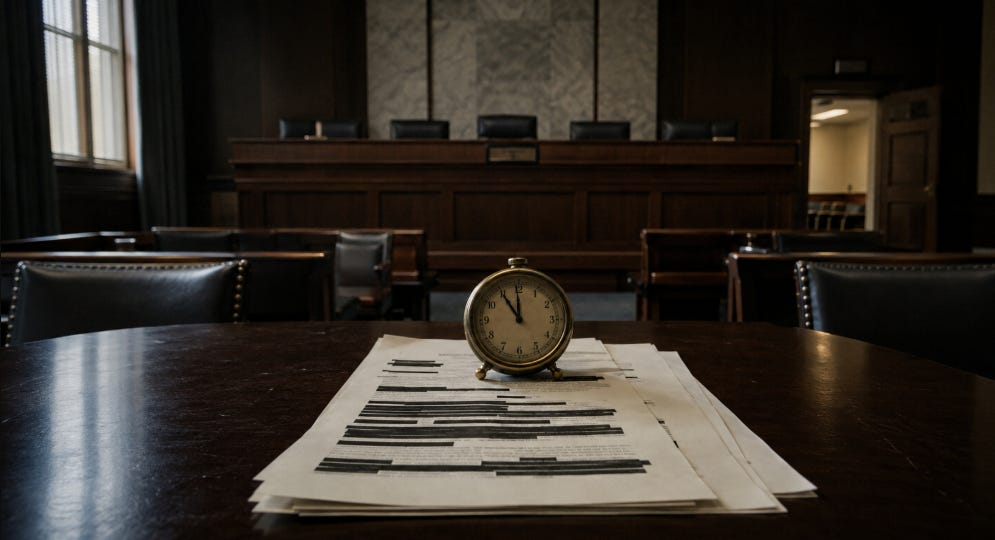
The filing is four pages of procedure. It advances no legal argument, identifies no error in Sullivan’s reasoning, and offers no theory of why the order should be reversed. It does something else instead, which is to state that the department is not certain it has the right to appeal at all. The department’s own word for the state of the law on that question is inconclusive. Its own term for the document is a protective notice of appeal.
That combination is worth stating plainly, because it is unusual. A party that believes a ruling is wrong appeals it and says why. A party filing a protective notice is doing something narrower: preserving an option it may not have, on the last day it could preserve it, without committing to a position it would then have to defend.

Sullivan entered the preliminary injunction in June, which opened a sixty-day window to appeal, and the notice arrived on the final day of it.
What the order actually requires
Sullivan’s June injunction found that the department’s redactions and withholdings violated the Epstein Files Transparency Act, the statute Congress passed to compel production of these records. In his ruling he noted that the Attorney General had conceded a violation of the Act.
The order gave DOJ two options. Produce the material, or show cause in court explaining why each redaction must stand. In the two months since, the department has pursued the second path, submitting justifications, and Sullivan has repeatedly found them insufficient.
The documents at issue are a defined set rather than the full archive. They include email exchanges in which the identity of Epstein’s correspondent is blacked out, names of alleged co-conspirators appearing in a draft indictment, records not written in English, and FBI interview materials concerning a woman who has said she was assaulted by Donald Trump when she was a minor, an allegation he denies.
That last category is a category, and this piece will treat it as one. What the record establishes is that these are documents a federal court has ordered produced and the executive branch has declined to produce. The contents are not known publicly, and nothing in a filing dispute establishes anything about the underlying allegation in either direction. The story here is the noncompliance.
The department’s stated basis for the redactions is victim protection. It argues that some of the blacked-out material identifies people who corresponded with Epstein and who it says should be understood as co-conspirators rather than victims. Sullivan has not accepted that characterization as sufficient across the board, which is the disagreement now headed to the D.C. Circuit, if it is headed anywhere.
The judge who has done this before
Two weeks ago, on August 13, Sullivan brought DOJ lawyers into his courtroom to explain their compliance with his earlier orders. He then spent close to half an hour, speaking without notes to a full and silent room, describing a case he handled seventeen years ago.
That case was the prosecution of Senator Ted Stevens of Alaska. Justice Department prosecutors withheld exculpatory evidence from the defense. The conviction was ultimately vacated on the government’s own motion in 2009, months before Stevens died in a plane crash. Sullivan held government attorneys in civil contempt, and an appeals court sustained him.
He told the lawyers in front of him that he had no wish to travel that road again. He also told them he does not blindside people, and that his willingness to enforce his orders was a promise rather than a threat.
There is a specific meaning to a judge delivering that particular history lesson, unprompted, to that particular audience. He was telling career attorneys that contempt findings attach to individuals and follow them, and that he has made them stick before.
Eleven days later, the department filed a notice of appeal that argues nothing.
Why the mechanism matters more than the filing
A notice of appeal is not a stay, and on its own it leaves Sullivan’s order in force. What it changes is the terrain. It opens a second front in a different court, it gives the department something to point at when asked why it has not produced the documents, and it consumes weeks that would otherwise be spent on compliance.
The pattern is now legible across the whole case. Congress passed a statute requiring production. The Attorney General conceded noncompliance. A court entered an injunction. The department responded with justifications rather than documents. The court found them wanting and warned of contempt. The department then filed, on the final available day, an appeal it acknowledges it may lack standing to bring.
Every step is individually defensible as ordinary litigation conduct. Parties do file protective notices when appellate jurisdiction is genuinely unclear, and that happens. What the sequence produces, whatever the intent behind any single move in it, is delay in a matter where Congress already voted that the time for delay had passed.
The underlying lawsuit was brought in April by Katie Phang, an attorney and independent journalist, who argued the department was violating the Act. Sullivan agreed with her in June. It is now late August, and the documents have not been produced.
At the hearing this month, Sullivan said the public has a right to know what is happening in the case, and that the victims and the court have that right as well.
The department’s answer, filed eleven days later, was a document that declines to say what it thinks the law is.
The law according to Todd "Carte" Blanche and his ignominious predecessor; Pamela Jo "Bondo" "Spam Blondie" Bondi is whatever Der Fuehrer/Mr. President Donald Drumpf says it is.