


Every government keeps secrets. That is not the scandal. The scandal is the inventory: what gets classified, what gets released, who gets protected by the dark and who gets destroyed in it. Audit the inventory and you learn what the state actually values, because secrecy is a budget, and budgets are confessions.
Run the audit on this administration and three case files that look unrelated turn out to be the same file.
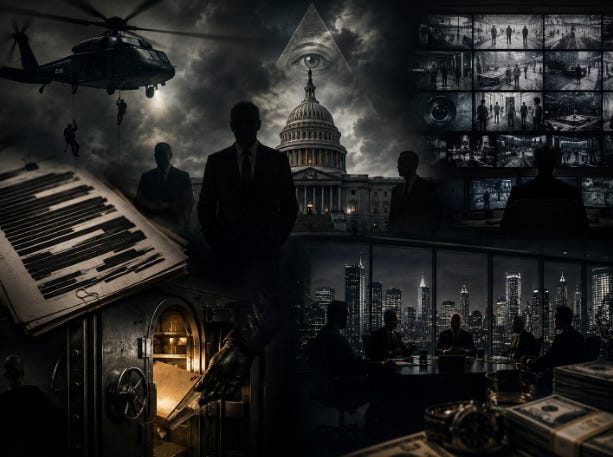
File one: the secrets that protect
Start with Epstein, because the Haberman and Swan excerpt published this week settles any remaining doubt about how the inventory works at the top. The president’s senior staff held repeated meetings in the Situation Room, the most secure space in the federal government, to manage the public relations of his association with a sex trafficker, and they chose that room specifically because they feared their own colleagues would leak. The classification infrastructure of the United States, built to protect nuclear weapons and troop movements, was deployed to protect a reputation.
Notice what was never in the secure room: the victims. The women whose testimony built the case were treated throughout as a containment problem. The files about their abuse became bargaining chips, the transparency act was signed under duress and slow-walked in practice, and the one cooperative voice the administration elevated was Ghislaine Maxwell, the convicted procurer, interviewed personally over two days by the deputy attorney general who used to be the president’s defense lawyer, then transferred to a softer prison. The inventory’s first rule: secrecy flows toward the powerful, exposure flows toward their victims. The state’s discretion is a service, and the service has a client list even if the files supposedly do not.
File two: the secrets that punish
Now the sky. In 2023, David Grusch, a decorated intelligence officer, testified to Congress under oath that the government operates UAP crash retrieval and reverse engineering programs hidden from congressional oversight, and that people who tried to report them through proper channels faced brutal retaliation. Other witnesses described careers ended, clearances pulled, families threatened. Whatever one concludes about the underlying claims, the retaliation testimony was specific, sworn, and never rebutted with evidence, only with denials from the offices being accused. When Congress tried to legislate its way in, the Schumer-Rounds UAP Disclosure Act, modeled on the JFK Records Act with eminent domain over recovered materials and an independent review board, the strongest provisions were stripped in conference in December 2023 at the request of legislators tied to defense appropriations. The board died. The eminent domain died. The secrecy survived its own reform.
Then in February of this year the president directed the agencies to find, review, and declassify UAP records, and in May the Department of War launched war.gov/UFO under the PURSUE program. Two tranches are public, roughly 160 files in the first and over 200 in the second, with a third in production. I have analyzed these releases in detail in this publication, and they matter; pilots’ reports and sensor video that sat in vaults for decades are now downloadable by anyone. But mark the structure. More than a hundred of the first tranche’s files carried redactions. The agencies that originated the documents review what the public sees of them. Researchers’ verdict landed within the week: data alone is not disclosure. The releases answer the demand for transparency while the program design guarantees the government remains the curator of its own confession. The witnesses who forced this moment got no vindication, no review board, no protection. They got a website where the institution that punished them releases what it chooses, on a schedule it chooses, with the parts it chooses removed.
File three: the secrets that cost trillions
Underneath both files runs the money, and the money is the part no tranche will ever cover. The Pentagon has failed every audit it has ever attempted, seven consecutive failures and counting, an agency holding roughly $4 trillion in assets that cannot fully account for them, year after year, with no consequence that any other entity on earth would survive. Add the formal black budget, north of $100 billion annually in classified intelligence and defense programs, compounding for decades, and the special access programs layered beneath even that, some of them, per the sworn testimony above, hidden from the very committees that exist to fund and oversee them. Trillions have moved through accounting fog since the Cold War. Nobody can tell you precisely where, and the system is engineered so nobody can.
This is the load-bearing secret, the one that makes the other two possible. A classification apparatus that can lose track of trillions can hide anything: a crash retrieval program, a kompromat operation, a favor economy. The Epstein files and the UAP files are retail secrecy. The unauditable budget is wholesale.
The machinery is one machine
Lay the three files side by side and the crossover stops looking like coincidence and starts looking like an operating system.
The same actors recur. The deputy attorney general managing the Epstein containment came from the president’s defense table. The agencies redacting the UAP releases are the agencies accused of the original concealment. The appropriators who gutted the Disclosure Act steward the budget that cannot pass an audit. At every junction, the people controlling the valve are the people the valve protects.
The same techniques recur. Selective release dressed as transparency: a tranche here, a memo there, a signed act with a throttled implementation. Elevation of compromised voices, Maxwell as character witness, while credible ones, the victims, the cleared whistleblowers, are smeared or starved of standing. The conversion of disclosure itself into a loyalty ration, dispensed when the base gets restless, withheld when it gets quiet.
And the same lesson recurs, the one the Haberman excerpt accidentally teaches. All that machinery, the Situation Room, the redaction authority, the trillions in fog, could not actually kill the Epstein story. Selective disclosure buys time, not safety. Every metered release confirms the existence of the unreleased remainder, which is why the strategy generates the very obsession it is meant to quiet. The UAP community understood this years before the political press did: a government that releases 160 files with 100 redactions has just published proof that it is still hiding something, in its own typeface, on its own domain.
What the inventory tells us
So read the inventory as the confession it is. This state classifies to protect the powerful from their pasts, declassifies to manage the restless, retaliates against witnesses who skip the line, abandons victims whose truths are inconvenient, and runs the whole operation on a budget deliberately kept beyond arithmetic. The contents of any particular vault, the Epstein remainder, the unredacted UAP record, the black programs, almost matter less than the demonstrated shape of the system: who it shields, who it spends, who it silences.
The honest position is neither credulity nor dismissal. It is insistence on the structural point. We do not need to know what is in the vaults to know the vaults are run for someone other than us, because the metering itself is the evidence. Transparency that arrives in tranches, curated by the accused, is not transparency. It is an allowance. And the first act of a free citizenry is to notice who is holding the purse.