Charlie Kirk was assassinated on September 10, 2025, shot during an appearance at Utah Valley University. He was 31.
What happened next was not grief. Grief is private and quiet and does not require a target. What happened next was a campaign, coordinated and public and explicitly encouraged from the highest levels of the American government, to identify every person who said something insufficiently reverent about a dead political operative and to strip them of their livelihoods. It was, by any honest measure, the largest organized cancellation drive in recent American history, and it was run by the exact people who had spent the previous decade building their entire political identity around the claim that cancellation was the gravest threat to American freedom.
And here is the part they did not anticipate. It is failing in court. Not everywhere, not all at once, and not without cost to the people caught in it. But steadily, case by case, in front of judges appointed by presidents of both parties, the firings are being ruled unconstitutional, the fired are being reinstated, and the public institutions that did the firing are paying out settlements that have now crossed two and a quarter million dollars with hundreds of cases still pending.
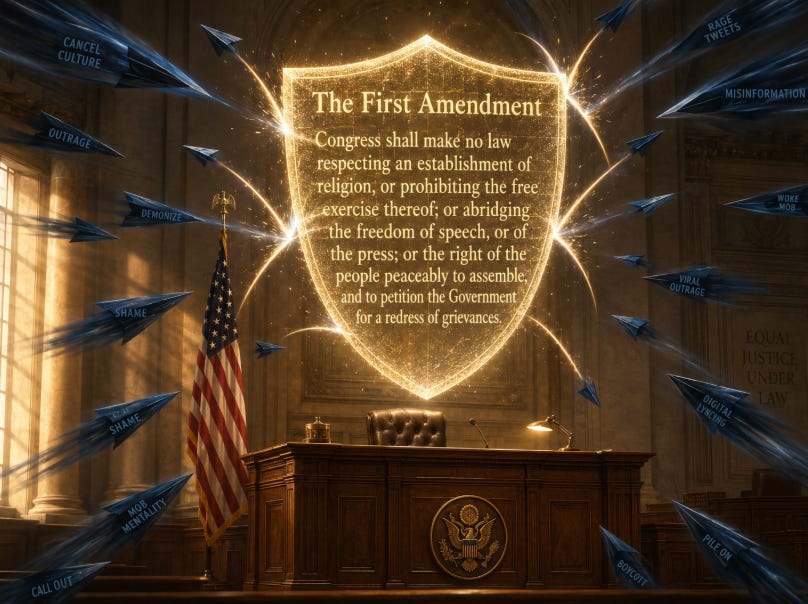
This is a story about hypocrisy, and it is a story about consequences. But underneath both, it is a story about something more reassuring than either, which is that the First Amendment, in the hands of judges who still apply the law, is holding.
The Scale of It
Start with the numbers, because the numbers establish that this was not a handful of isolated overreactions.
According to a Reuters investigation, more than 600 people were fired, suspended, or formally investigated by their employers for what they said about Kirk’s death. Six hundred. Teachers, professors, biologists, public defenders, health educators, nurses. People whose posts were, in many cases, visible only to a few dozen Facebook friends. People who said things that ranged from pointed political commentary to genuine callousness, but who said them, crucially, as private citizens on their own personal accounts on their own time.
The campaign to punish them was not organic. It was directed. Vice President JD Vance personally encouraged supporters to report offending posts to employers. Pro-Trump influencers and lawmakers called for a mass firing drive and instructed their followers on the mechanics of it: find the post, find the employer, flood the phone lines and the inboxes, make the person radioactive. The account Libs of TikTok functioned as a clearinghouse, surfacing private posts to millions of followers and, in at least one documented case, getting a state biologist fired over an Instagram story she still does not know how the account obtained.
The State Department announced it would penalize foreigners for “praising, rationalizing, or making light of” the killing. The federal government of the United States made your opinion about a private citizen’s death a matter of immigration enforcement.
This was a state-adjacent, in some cases explicitly state-directed, campaign to punish protected political speech at scale. That is not a characterization. That is the sequence of events.
What the Law Actually Says
Here is where the machine ran into something it did not account for.
The First Amendment does not protect you from your private employer. If you work for a private company and you post something your boss hates, the company can generally fire you, and this is the mechanism by which “cancel culture” has always operated against private-sector workers. The right spent years correctly noting that this kind of social-pressure firing was corrosive to a culture of free expression, even when it was legal.
But a very large number of the people caught in the Kirk dragnet did not work for private companies. They worked for public universities, public school districts, state agencies, and government offices. And when the government is your employer, the First Amendment absolutely does apply. A government employer cannot fire you in retaliation for protected speech on a matter of public concern unless it can show that your speech actually disrupted the workplace in some concrete way that outweighs your right to speak. This is settled doctrine, decades old, tested and refined across a long line of Supreme Court cases. It is not obscure. It is not novel. It is the law.
The vulgarity of the speech does not change the analysis. This is the point that the firing campaign fundamentally failed to understand. The First Amendment’s protection does not scale with how sympathetic the speaker is. A health educator who wrote that Kirk’s death was “a reflection of the violence, fear and hatred he sowed” is exercising exactly the same constitutional right as a person who wrote something gentle. The Constitution protects the speech precisely because, and not in spite of the fact that, powerful people wanted it punished. That is what the protection is for. Speech that offends no one has never needed a First Amendment.
So when a public university fired a health educator for a Facebook post, it did not commit a moral error that the market would eventually correct. It committed a constitutional tort, the kind that federal courts exist to remedy, the kind that comes with damages.
The Receipts
The settlements tell the story.
Suzanne Swierc, a health educator at Ball State University, fired over a single Facebook post that the school admitted was the sole reason for her termination: $225,000.
Darren Michael, a tenured professor at Austin Peay State University in Tennessee, fired for sharing a 2023 news article about Kirk’s own stated views on gun deaths, reinstated after the school admitted it violated his due process rights: $500,000.
Brittney Brown, a biologist with the Florida Fish and Wildlife Conservation Commission, fired for reposting a darkly sarcastic item from a whale-fact account: her case became one of the most instructive of all, and I will return to it.
Melisa Crook, an Iowa high school teacher: $145,000 and full benefits. A Clemson University professor, reinstated with a confidential settlement. An Iowa public defender, reinstated by a state appeals body that flatly rejected her office’s claim that “live by the sword, die by the sword” was unprotected speech, then compensated $125,000.
And the case that should trouble anyone regardless of politics: Larry Bushart, a retired Tennessee law enforcement officer, was not merely fired but jailed. He spent 37 days in a county jail on a $2 million bond for posting a meme, a meme that quoted Donald Trump’s own words about a school shooting, which the sheriff claimed caused “mass hysteria.” The charges were dropped. The Intercept found no evidence the hysteria the sheriff described had actually occurred. Bushart’s settlement: $835,000. A man was imprisoned for over a month in the United States of America for posting a meme, and the state had to pay him nearly a million dollars for it.
By late May 2026, the settlements had crossed $2.2 million, with the Foundation for Individual Rights and Expression tracking at least nine more cases actively moving through federal courts and hundreds more thought to be in the pipeline.
The Part That Should Reassure You
It would be easy to write this as a simple story of comeuppance, and there is satisfaction in it. But the more important story is quieter, and it is about the judges.
Consider the Brittney Brown case. When Brown first sought an emergency injunction to get her job back immediately, the federal judge, Mark Walker, denied it. He wrote that “the First Amendment is not absolute” and that Brown had not yet, at that early stage, met the extraordinary standard required to force her immediate reinstatement before trial. On its face, a loss.
But look at what the judge actually did. He applied the four-part legal test for a preliminary injunction and found that three of the four prongs favored Brown. He held that the question of whether her post actually disrupted her agency was a factual question requiring real evidence, not the agency’s say-so. He fast-tracked the case. Brown’s own attorney called it “about the best order I’ve ever received following a lost motion” and said the writing was on the wall for an eventual win at trial.
That is not a judge rubber-stamping either side. That is a judge doing the actual work: applying a demanding legal standard neutrally, refusing to shortcut it even for a sympathetic plaintiff, and insisting that the government produce real proof of real disruption before it can escape liability for firing someone over speech. The system worked precisely because the judge did not treat the case as a political question with a predetermined answer. He treated it as a legal question with a legal answer, and the law, worked honestly, protects the speaker.
This is the thing worth holding onto. Across dozens of these cases, in red states and blue, judges have looked at coordinated pressure campaigns backed by the Vice President of the United States and the machinery of federal outrage, and they have reached for the same body of First Amendment doctrine that has protected unpopular speech for generations, and they have applied it. The heckler’s veto, the legal term for exactly this tactic of manufacturing disruption to get a speaker punished, is losing in court because judges recognize it for what it is.
The institutions did not all hold. Six hundred employers folded to the pressure. Universities that should have known better fired tenured faculty. A sheriff jailed a man for a meme. The pressure worked, in the moment, on the people who lacked the spine to resist it.
But the courts held. And in a moment when so much of the constitutional order feels like it is bending under sustained assault, that is not a small thing. It is, arguably, the whole thing. The First Amendment is not a self-executing spell. It is a promise that only means anything if there are judges willing to enforce it against power, on behalf of exactly the people power most wants to silence. Those judges, so far, are still there. They are still doing the job.
The Hypocrisy, Named Plainly
None of this absolves the movement that built the machine.
For ten years, the American right built a cottage industry out of cancel-culture grievance. It published books about it. It held conferences about it. It made careers out of the claim that the left had created an intolerant climate in which a single wrong word could end a person’s livelihood, and that this was a fundamental threat to the American experiment. Charlie Kirk himself built much of his brand on precisely this argument.
And then, given the opportunity, they ran the most aggressive, most coordinated, most state-backed cancellation campaign the country has seen. Not as a private social pressure, which is what they had spent a decade condemning, but with the Vice President’s encouragement and the State Department’s participation and county sheriffs making arrests. They did not merely engage in the thing they claimed to abhor. They industrialized it and pointed the government at it.
The principle, it turns out, was never free speech. The principle was our speech. The objection was never to punishing people for their words. The objection was only to their side’s people being punished. When the power to punish landed in their hands, they used it with an enthusiasm that made the cancel-culture they had spent a decade decrying look quaint.
The courts are now the record of that hypocrisy, written in settlement figures. Every $225,000, every $500,000, every $835,000 is a formal legal finding that the people who claimed to be free speech’s greatest defenders violated it the moment it was convenient, and that the Constitution they invoke when it suits them applies even when it does not.
Two and a quarter million dollars so far. Hundreds of cases still coming.
The First Amendment is holding. The people who claimed to love it most are the ones paying the judgments.