


I’m not a therapist. I’m not a philosopher. I hold no credentials that qualify me to tell you how to navigate the worst moments of your life. What I have is something different -- a collection of experiences I didn’t choose, losses I wasn’t prepared for, and a particular kind of disorientation that I now recognize as the thing nobody warned me about. Not the grief itself. The loss of the map.
I speak from experience, I didn’t ask for and wouldn’t wish on anyone.
This piece isn’t about avoiding pain. You can’t. Anyone who tells you otherwise is selling something. This is about the difference between being devastated and being destroyed -- and whether some of the destruction is optional.
I believe it is. That’s why I’m writing this.
What Actually Breaks
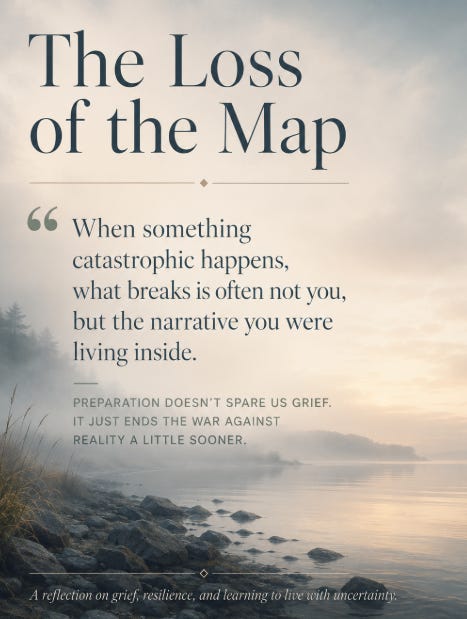
When something catastrophic happens -- the call, the diagnosis, the ending you didn’t see coming -- the assumption is that you are breaking. The pain is structural damage to yourself as a person.
In my experience, that’s not quite what’s happening.
What breaks is the narrative. Most of us are running an unconscious story about how our lives are supposed to go. Not a plan exactly -- something more ambient than that. A felt sense that certain things are stable, certain people will remain, certain versions of our future are simply waiting for us. We don’t examine this story because we don’t have to. It runs in the background, organizing everything.
When reality violates that story hard enough, the story collapses. And because we’ve never separated ourselves from it, we experience that collapse as personal destruction.
I know I did. And the confusion between those two things -- the story ending versus me ending -- is where some of the longest and hardest suffering lived for me. Nobody named it at the time. I’m naming it now because I think it matters.
Why We’re Not Built For This
The brain is extraordinarily good at normalizing. At building stable models of the world and operating inside them efficiently. This is mostly useful -- it’s what lets you function without being overwhelmed by every variable in your environment.
But stability has a cost. The more comfortable and predictable life becomes, the more the brain treats that stability as baseline reality. Not as one possible configuration of circumstances -- as the way things simply are.
The Stoics understood this problem two thousand years ago. They practiced something called negative visualization -- deliberately imagining the loss of the things they valued. Not to be morbid. Not to live in dread. But to keep the mind honest about what is actually permanent and what isn’t.
I didn’t discover this until after I needed it. But when I did, it reframed a lot of things for me. Not as pessimism. As honesty.
What I Eventually Figured Out
I want to be careful here not to make this sound cleaner than it was. Nothing I’m about to describe came to me quickly or neatly. It came in pieces, after the fact, assembled slowly from wreckage.
The first thing was this: when my narrative collapsed, I had built almost no separation between the story I was living and my sense of who I was. They were the same thing. So when the story broke, I broke with it -- or felt like I did. What I’ve come to think is that a person is more resilient when their identity isn’t resting on a single point. When who you are is distributed across more than one thing -- your relationships, your work, your private interests, your values -- the loss of any one piece is devastating but not total. I didn’t know that going in. I know it now.
The second thing was about beliefs. I held certain ideas about how the world worked with a grip that didn’t leave room for reality to contradict them. When it did, I didn’t just lose something -- I lost the framework I was using to make sense of everything. What I understand now is that a belief held too tightly becomes a liability. That’s not the same as believing nothing. It just means staying willing to update. Keeping a little slack in the rope.
The third thing was the hardest. Learning to sit with not knowing what comes next without forcing a false resolution. The mind wants answers and will manufacture them if you aren’t careful. Some of the worst decisions I’ve made came from needing the open question to close before it was ready. Sitting with uncertainty is a skill. I was bad at it for a long time. I’m better at it now.
What I Mean When I Say Prepared
I want to be honest about this because it’s where I could easily mislead you.
Prepared doesn’t look like calm. It doesn’t look like the composed person in the movie who receives terrible news and says something quietly wise. I have never been that person and I’m not promising you’ll become one either.
What it looks like, from the inside, is this: when the last hard thing happened to me, I was still shattered. I still moved through it in a way that was non-linear and sometimes ugly. But I wasn’t simultaneously at war with the fact that it was happening. I wasn’t spending what little energy I had screaming internally that this wasn’t supposed to happen, that the story was supposed to go differently, that some mistake had been made that could be corrected if I just refused to accept it long enough.
That war -- the war against reality itself -- is where I had spent enormous energy in previous losses. Preparation didn’t spare me the grief. It just ended the war a little sooner. That turned out to matter more than I expected.
A Few Things That Helped Me
Not a program. Not steps. Just things that, looking back, made a difference.
I started occasionally asking myself what I was treating as permanent that wasn’t. Not obsessively -- just honestly. Health, relationships, stability, the beliefs I was most certain about. Keeping that question somewhere accessible didn’t make me anxious. It made me slightly less shocked when things moved.
I stopped trying to immediately resolve discomfort when smaller things went wrong. I let myself sit in the not-knowing for a beat before reaching for the nearest explanation or fix. It’s low stakes practice for something that eventually shows up at high stakes. At least it was for me.
And I started paying attention to how much of my sense of self was load-bearing on any single thing. When I noticed the weight was unevenly distributed, I tried to shift some of it. Gradually. Without drama.
None of that prevented anything. But it changed my relationship to what I couldn’t prevent.
One Last Thing
I don’t have this figured out. I still get blindsided. What I have now that I didn’t have before is a slightly looser grip on the way I think things are supposed to go. That’s it. It’s not dramatic. But when the floor dropped out the last time, I wasn’t also surprised that floors can drop. That small difference mattered more than I expected.
I wrote this because I wish someone had written it for me earlier. Not to tell me what to do -- just to name what was happening. If it names something for you, that’s enough.
Nothing in this piece constitutes professional mental health advice. I’m a person who has been through some things and thought hard about them. If you’re in crisis, please reach out to someone qualified to help.