


Dylan Borland is not a new name in this story. In September 2025, he sat in front of the House Oversight Committee as an Air Force veteran describing what happens to people who report unidentified anomalous phenomena through official channels: they end up, in his words, “discarded, isolated, hopeless.” He testified alongside a Navy chief warning about unreported near-misses in restricted airspace and a fellow veteran who told the committee that transparency is the foundation of truth, and that without it, witnesses like himself get dismissed.
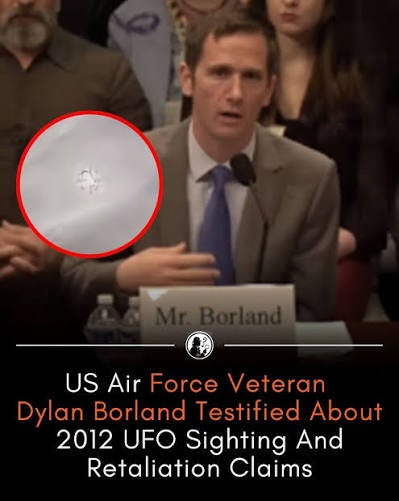
A year later, almost to the week, Borland appeared on Sean Hannity’s podcast. Hannity asked him directly whether he knew, as a fact, that the government has recovered craft, and whether his nondisclosure obligations let him say so in public. Borland said yes. That is the entire exchange. No document changed hands, no second source corroborated it on air, and no follow-up question pressed him on what “recovered craft” is supposed to mean. It is a single-word answer that has already generated headlines calling it a stunning claim, and the honest description of it is that it is a claim, made by a man Congress has already heard from, that nothing yet on the public record supports or refutes.
That gap between the claim and the substance behind it is the actual story, because the government spent the last fourteen months building the specific mechanism that made Borland’s “yes” possible to say out loud, and the mechanism is real even where the claims riding on top of it are not.
The chain starts with Trump’s own directive, issued after former President Obama made offhand comments about aliens on a podcast. Trump told agency heads to begin identifying and releasing government files on UAPs and extraterrestrial life. Defense Secretary Pete Hegseth confirmed in February that the Pentagon would comply, while declining to promise a timeline, saying the department needed time to determine what compliance should actually look like. By that point the All-domain Anomaly Resolution Office, the Pentagon’s dedicated UAP office, was already sitting on more than 2,000 open cases, up from roughly 1,600 just two months earlier. That caseload growth says more about incentives than about extraterrestrials: once an official reporting channel exists and carries less career risk than silence, people use it.
The legal architecture caught up to the political directive on July 31, when the Office of the Director of National Intelligence issued guidance ordering the Department of War and the rest of the intelligence community to build a formal disclosure pathway. The guidance created something specific: a PURSUE Task Force, with designated representatives at each agency, whose job is to receive UAP-related disclosures from current and former employees and contractors. Agencies had thirty days to name those designees to ODNI and to tell their own workforce that nondisclosure agreements, oaths, and other secrecy commitments no longer block someone from disclosing UAP information to the President or to a PURSUE representative. Read carefully, that is a narrower grant than it sounds. It does not authorize anyone to disclose classified material to the public, to a reporter, or to Sean Hannity. It clears one specific obstacle, the NDA, for disclosure to one specific internal channel, the task force. What a source says on a podcast afterward is a separate, personal decision that the guidance neither authorizes nor prevents; the waiver only means the government itself won’t claim the NDA as the reason it can’t investigate what he told it internally.
Parallel to that, AARO has been negotiating to buy access to an archive it does not own and never built. The National UFO Historic Records Center, run by researcher David Marler, holds what is described as North America’s largest private collection of UAP case files, including personal papers from J. Allen Hynek, the astronomer who worked on the Air Force’s own Project Blue Book before that program shut down in 1969. AARO’s proposed contract runs a base year with four optional renewal years, for digital access to material the Pentagon specifically wants because its own pre-1990 records were, by its own account, fragmented, lost, or preserved only because civilians kept copies the government didn’t. The office chasing this deal is fulfilling a congressional mandate, written into defense authorization law, to compile a comprehensive historical accounting of U.S. government involvement with UAPs going back to 1945 and to build a permanent collection at the National Archives. That a federal office is reduced to shopping for its own history from a private collector is itself the most honest evidence available of how incomplete the government’s internal record actually is.
None of that is nothing. A task force with named designees, a thirty-day compliance clock, a growing caseload the Pentagon has to formally track, and a specific contract to recover fifty-year-old records are the kind of unglamorous administrative facts that either produce something or don’t, on a timeline someone can actually check. September 18 brought the Pentagon’s sixth document release under this same push: 71 files spanning 1952 to 2025, including 37 previously classified reports from a Defense Intelligence Agency program that studied speculative aerospace physics from 2008 to 2012, and a 2010 document describing three engineers who reported radiation-illness-like symptoms after unexplained aerospace incidents, with the cause left unidentified. The Pentagon’s own framing of the release said the speculative research documents should not be read as validating the concepts they explored. That caveat is doing real work. It is the difference between the government releasing what it studied and the government confirming what it found.
Set the mechanism next to the claim and the mismatch is the point. Borland’s congressional testimony a year ago was about the cost of disclosure, not the content of it: he described what happens to people who try to report through the system, not what the system contains. His podcast answer this week is the opposite, a claim about content with none of the process behind it that the testimony described. If the PURSUE pathway is doing what it’s supposed to, the place that claim belongs first is inside the task force ODNI just built, generating an internal record AARO can eventually weigh against everything else in its 2,000-plus caseload, not on a podcast where the only verification available is a host’s follow-up question and a guest’s one-word answer.
This is not the first time an administration has promised a disclosure process and delivered a caseload instead of an answer. Congress created a legal path for UAP whistleblowers in the 2022 defense authorization act, and it took until this July for the executive branch to issue the guidance that made the path usable, three years apart. The pattern that history suggests is not that nothing is happening. It’s that the administrative machinery of disclosure moves in years and the public appetite for it moves in podcast segments, and the gap between those two speeds is exactly where a claim like Borland’s gets to circulate as though it settled something, when what actually exists is a compliance deadline, a pending contract, and a caseload that keeps growing because the door is, for the first time, genuinely open. Whether anything walks through it that a serious newsroom can verify is a different question than whether the door exists. Right now, the door is real. What’s come through it in public is one word.
This man has been had it for ages: https://www.theblackvault.com/documentarchive/
Relying on the executive branch (including the Pentagon, the Office of President, the IC, the MIC aerospace contractors etc) for disclosure, confirmation, transparency or whatever adjective you prefer, is asking the foxes to police themselves, and come clean about the 80-year-old chicken feathers stuck to their lips. Unless Congress asserts its Constitutional authority over the military, and insures that the governance of boards of review (including subpoena power and the appointment of directors) falls under their jurisdiction, and not that of the president or the DOJ, this process will not succeed in revealing the most essential information, or in restoring the Constitutional order of checks and balances created by the Framers.