


There is a provision in the United States Constitution that was written to solve the precise problem the country is now living through, and it has never once been used.
Section 4 of the Twenty-Fifth Amendment allows for the involuntary removal of a president who is alive but no longer capable of doing the job. Not a president who has died. Not a president who has resigned. Not a president who has committed a crime. A president who is still breathing, still occupying the office, and no longer able to discharge its powers, whether through physical catastrophe, neurological decline, or the slow erosion of the mind that age and illness can bring. It was designed for a president who cannot be removed by election because the election is years away, cannot be removed by impeachment because incapacity is not a crime, and will not remove himself because the nature of his condition may be precisely that he cannot recognize it.
It has sat in the Constitution since February 10, 1967. Fifty-nine years. It has never been invoked. Not during any of the documented episodes of presidential incapacity in the decades since. Not now, when the case for it is arguably more visible than it has ever been.
This essay is about why. And the answer is not that the moment has never arrived. The answer is that the mechanism was built, whether by accident or by grim design, so that it almost never can be used, and that the specific circumstances of the present administration have sealed it more tightly than at any point in its history.
What It Was Written For
To understand why Section 4 fails, you have to understand what it was meant to do.
The Twenty-Fifth Amendment was a response to a recurring nightmare in American constitutional history: the incapacitated president and the vacuum of authority around him. The precedents were genuinely alarming. In 1919, President Woodrow Wilson suffered a massive stroke that left him partially paralyzed and cognitively compromised for the remainder of his term. His wife Edith and his physician conspired to conceal the true extent of his condition from Congress, the Cabinet, and the public, effectively leaving the United States without a functioning chief executive for months while hiding that fact from the nation. There was, at the time, no constitutional mechanism to address it.
The assassination of John F. Kennedy in 1963 concentrated the country’s attention on the fragility of the line of succession, and Senator Birch Bayh of Indiana led the drafting of an amendment to close the gaps. Section 1 clarified that the Vice President becomes President upon the president’s death, removal, or resignation. Section 2 provided a way to fill a vacant vice presidency. Section 3 allowed a president to voluntarily and temporarily hand off power, the provision used routinely and without controversy when presidents undergo anesthesia.
And Section 4 addressed the hardest case of all: the president who is incapacitated but will not or cannot say so himself.
Bayh was explicit, in congressional debate, about what Section 4 was for. He described genuine incapacitation: a president in a coma, a president who had suffered a catastrophic neurological event, a president physically or mentally unable to perform the duties of the office. He was equally explicit about what it was not for. It was not a remedy for political failure, for unpopularity, for policies the opposition found alarming, or even for behavior that struck observers as erratic. It was a medical safety net, not a political weapon, and Bayh built it with a high threshold precisely to keep it from becoming one.
That high threshold is the problem. Because the same design that prevents Section 4 from being abused as a political weapon also prevents it from being used when it is genuinely warranted.
The Mechanism, and Why It Locks
Here is how Section 4 actually works, step by step, because the steps are the whole story.
The process can only begin with the Vice President. The Vice President is the indispensable actor. No one else can initiate it. The Cabinet cannot do it without the Vice President. Congress cannot do it. No outside body can force it. Absent the Vice President’s willingness to act, Section 4 is inert, a set of instructions that no one has the authority to execute.
The Vice President must then be joined by a majority of the Cabinet, the principal officers of the fifteen executive departments, or by a majority of some alternative body that Congress has established by law, which Congress has never done. Together, the Vice President and a majority of the Cabinet must transmit a written declaration to the leaders of both houses of Congress stating that the president is unable to discharge the powers and duties of his office. At that moment, the Vice President immediately becomes Acting President.
But the president can fight back. He may transmit his own declaration stating that no inability exists, and unless the Vice President and the Cabinet majority contest it again within four days, the president simply resumes his powers. If they do contest it, the matter goes to Congress, which must assemble and decide. And here is the final lock: to keep the president removed, two-thirds of both the House and the Senate must agree that he is unable to serve. Not a majority. Two-thirds of both chambers.
Consider what this actually requires. It requires the Vice President, a person chosen by the president, elevated by the president, and bound to the president by the most personal political alliance in American government, to move first against the man who made him. It requires a majority of the Cabinet, every one of them a presidential appointee serving at the president’s pleasure, chosen specifically for their loyalty and alignment, to sign their names to a document deposing their benefactor. And then it requires two-thirds of a Congress, in an age of total partisan polarization, to ratify the removal over the fierce resistance of the president and everyone whose career depends on him.
Every single actor with the power to pull the trigger owes their position to the person they would be removing.
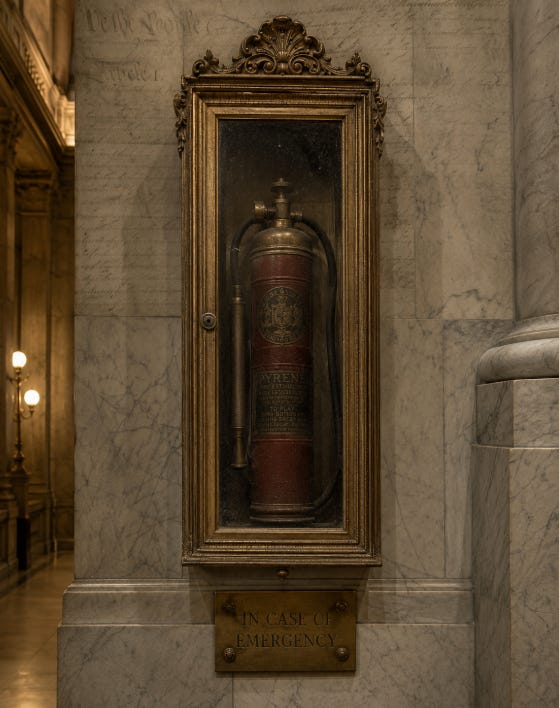
That is not a safety net. That is a fire extinguisher mounted behind glass, in a locked case, with the key held by the person most likely to be the cause of the fire.
The Case Studies: Every Time It Almost Happened
The history of Section 4 is a history of near-misses, and each one illustrates a different way the mechanism fails.
Reagan, 1981. When John Hinckley Jr. shot Ronald Reagan outside the Washington Hilton, the president was rushed into emergency surgery with a bullet two inches from his heart. He was under general anesthesia, genuinely unable to function as president, and there had been no opportunity to invoke the voluntary transfer of Section 3 beforehand. Inside the Situation Room, Cabinet members debated the 25th Amendment. Aides prepared the paperwork that Vice President George H.W. Bush and the Cabinet could have signed. The documents were never signed. Reagan regained consciousness that evening, and the crisis passed. But Birch Bayh, the amendment’s own author, wrote years later that Section 4 should have been invoked in those hours. The people in the room, faced with the reality of deposing a beloved president who might recover at any moment, could not bring themselves to do it. This is the loyalty lock operating even in a case of undeniable physical incapacity.
Reagan, 1987. In the aftermath of the Iran-Contra scandal, several senior Reagan officials grew alarmed by what they described as the president’s growing inattentiveness and disengagement. When Howard Baker took over as White House Chief of Staff in early 1987, he reportedly arrived specifically intending to assess whether Reagan was still capable of serving, prepared to consider Section 4 if he was not. Baker met with Reagan, observed him over several days, and concluded he was sharp enough. No action was taken. Reagan was diagnosed with Alzheimer’s disease in 1994, five years after leaving office. Whether the disease was already affecting him in his final years in the White House is a question historians still debate. What is clear is that the assessment was subjective, conducted by loyalists, and resolved in the president’s favor, which is the direction these assessments almost always resolve when the people making them owe him their careers.
Trump, January 6, 2021. After the attack on the Capitol, with the building still being cleared, some of President Trump’s own Cabinet members reportedly began discussing whether to approach Vice President Mike Pence about invoking Section 4. House Speaker Nancy Pelosi and Senate Democratic leader Chuck Schumer formally called for it. The case was as vivid as any in American history: a president who had, by many accounts, incited a violent assault on the seat of government while his own Vice President was inside it. And Pence refused. He would not initiate the process. Without him, there was no process. The indispensable actor declined to act, and the mechanism, faced with the clearest political emergency imaginable, did nothing, because the one person who could start it would not.
Three cases. Physical incapacity, cognitive decline, and political emergency. In every one, the people empowered to act declined, and in every one, the reason was some version of the same reason: the cost of moving against the president was borne entirely by the people who owed him everything, and they would not pay it.
Why It Is Sealed Tighter Now Than Ever
Which brings us to the present, and to the reason this essay exists.
The calls have already come. In April 2026, Governor JB Pritzker of Illinois publicly called for the 25th Amendment to be invoked over the president’s conduct regarding Iran. Even Marjorie Taylor Greene, from within the president’s own coalition, invoked the language of the amendment, describing certain administration conduct not as tough rhetoric but as insanity. House Democratic leaders have opened the door to it. The public conversation that surrounded the president’s cognitive state after the events of this summer, the gaffes at international summits, the documented episodes of apparent disengagement, has made Section 4 a live topic in a way it has not been since January 2021.
And it will not happen. It cannot happen, and the reason is everything this publication has been documenting for months.
This administration did not assemble an ordinary Cabinet. It assembled a Cabinet selected, above all other qualifications, for personal loyalty to the president. The post-Watergate norms that once gave Cabinet officers a measure of independence have been deliberately dismantled. The Attorney General’s office, once insulated from the White House, now functions as an extension of the president’s personal will. The officials who would need to sign a Section 4 declaration are, to a degree without modern precedent, chosen specifically because they would never sign it. The loyalty extraction machine, the apparatus of ridicule and threat and reward that converts reluctant supporters into enthusiastic ones, does not merely make the 25th Amendment unlikely. It makes it structurally impossible, because it has systematically removed from every relevant office anyone who might ever have acted.
The Vice President owes his entire national career to the president. The Cabinet was assembled by loyalty test. Congress is polarized past the two-thirds threshold by an order of magnitude. Every lock on the mechanism is not merely engaged but reinforced, deliberately, by an administration that understood the machinery of its own removal better than its predecessors and made certain the machinery could never turn.
The Observation
So the fire extinguisher stays behind glass.
It was placed there in 1967 by people who had watched Woodrow Wilson’s wife run the country in secret and were determined it would never happen again. They built a mechanism, and they built it carefully, and in their care to prevent its abuse they made it delicate enough that it has never once been strong enough to use. It survived Reagan’s surgery and Reagan’s decline and the sacking of the Capitol, not because those moments failed to qualify, but because the people holding the key decided, each time, that they would rather not.
The amendment assumes a class of official who will, in the final extremity, put the country above the man. It hands the emergency brake to the passengers, and then trusts that at least some of them will be willing to pull it even though the man they are stopping is the one who gave them their seats.
That was always the gamble. And in an administration that has spent every day of its existence ensuring that no such official remains anywhere near the levers, the gamble has been quietly, comprehensively lost.
The mechanism exists. It has always existed. That was never the question.
The question was whether the people it depends on would ever be the kind of people willing to use it, and the current administration has made very sure that they are not.
Thank you. I am learning a lot about history and politics! Education is power!
Very well played, Heritage Foundation!
Release the Trump/Epstein files!