


For a few weeks this spring, it looked like something had finally broken open, and then the rhythm started to falter.
On May 8, 2026, the Department of War launched a system with a bureaucratic name and a grand promise. The Presidential Unsealing and Reporting System for UAP Encounters, mercifully shortened to PURSUE, went live with roughly 160 declassified documents, photographs, and videos concerning unresolved encounters with unidentified anomalous phenomena. The material was posted to a dedicated government website, no security clearance required, and the language accompanying it was triumphant. The American people could now access the government’s UAP files instantly. The Defense Secretary promised “maximum transparency.” Officials said additional tranches would follow “every few weeks” as agencies completed their reviews, released, in the department’s own words, on a rolling basis.
For a while, the rolling was real, and it was even brisk. A second batch arrived on May 22, exactly two weeks after the first. A third landed on June 12, and it was the most striking yet, containing a report from the government’s own anomaly-resolution office describing an orange “mother orb” launching smaller red orbs over two days in October 2023, and conceding that roughly 40 percent of the reported phenomena lacked any reasonable explanation. The government of the United States, in an official document, was admitting that a substantial fraction of what it had examined could not be explained.
Two weeks between the first and second. Three weeks between the second and third. A cadence. A rhythm you could set expectations by.
And then the rhythm broke.
The Month That Went Quiet
After June 12, the releases stopped coming. Not permanently, as it turned out, but for a stretch that badly violated the promised “every few weeks.” Two weeks passed. Then three. World UFO Day arrived on July 2, the single most natural imaginable occasion for an administration eager to advertise its transparency, and the government said nothing. It did not post a tranche. It did not acknowledge the day. It did not update the public on its April commitment to work with the FBI on the so-called missing scientists cases. The machine that had been humming along on a two-and-three-week cadence simply idled.
Then, on Friday, July 10, nearly a month after the previous batch, the fourth tranche finally landed. Forty new files. Nineteen videos. And the Pentagon spokesman was careful to note that this was “not the last,” that more would come as agencies completed their reviews.
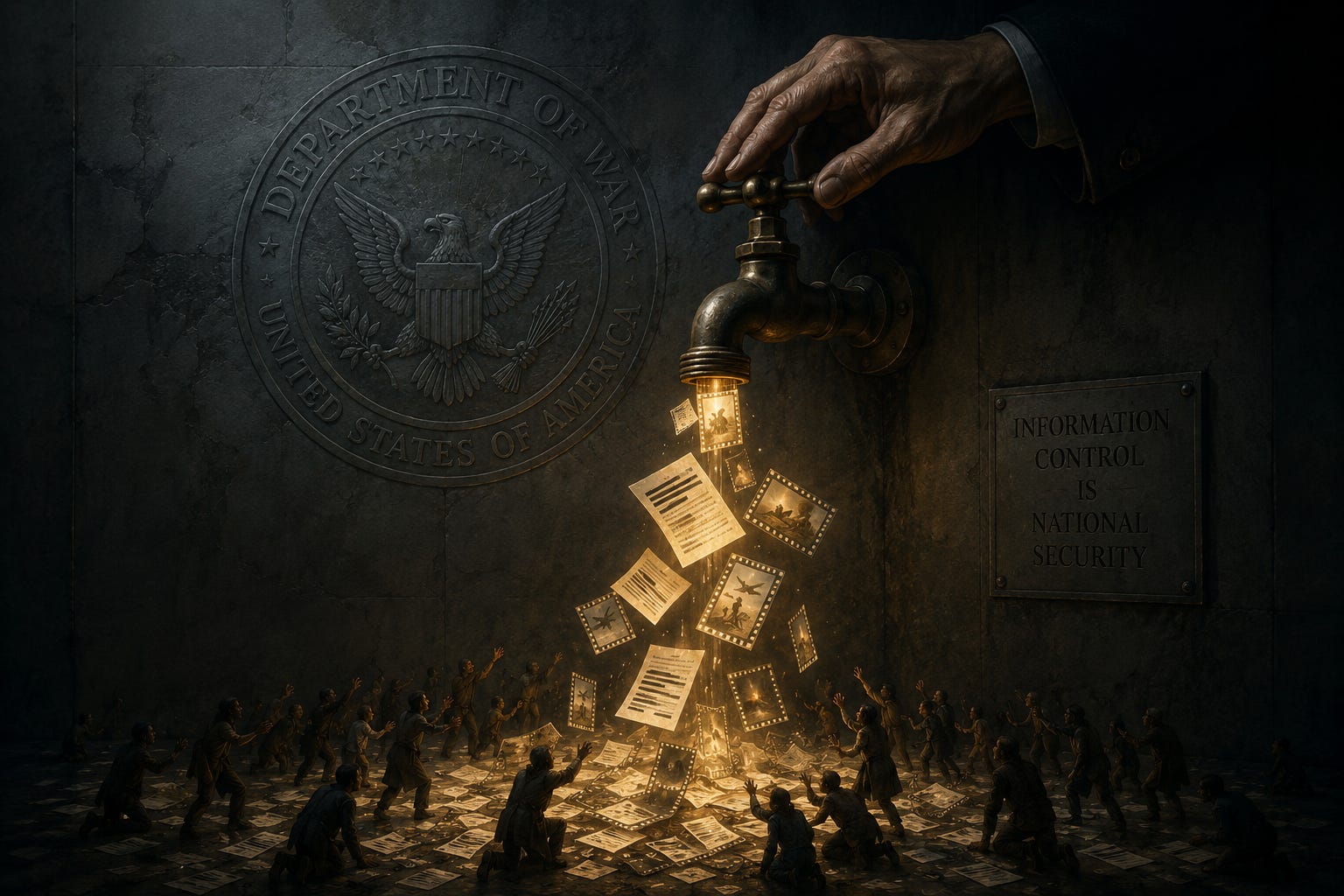
So the rollout did not stop. It paused, for nearly a month, and then resumed. And that pause is worth more attention than either a clean stop or a smooth stream would have been, because a month-long gap in a schedule that had been running like clockwork reveals the hand on the controls in a way that steady motion never could. A tap running at a constant rate looks automatic, almost natural. A tap that runs, stops for a month, and starts again reminds you that there is someone standing at the valve, deciding.
What the Fourth Batch Actually Contained
Look at what finally came out after the month of quiet, because the contents matter as much as the timing.
The centerpiece was a Department of Energy report on a September 2015 incident at the Pantex plant near Amarillo, Texas, the primary assembly and disassembly facility for America’s nuclear weapons stockpile. Security officers there placed the facility on lockdown and pursued a silent, diamond-shaped object with no identifiable propulsion system, which they could not catch and which eventually drifted off on its own. Paired with it was the transcript of a 1949 conference at Los Alamos where Manhattan Project scientists, including the father of the hydrogen bomb, failed to explain a wave of “green fireballs” over the same nuclear installations. The batch also contained the now-viral “floating brain” video from over the Atlantic, a 2019 report from a military aviator describing an object unlike anything he had seen in 28 years of service, and infrared footage from the Yellow Sea that appeared to degrade a military platform’s own sensors.
This is, by any measure, extraordinary material. The nuclear-facility thread alone, running unbroken from 1949 to 2015, is one of the most significant patterns in the entire public UAP record. I have written about it at length, and I do not want to minimize it here.
But notice the shape of it. Historical documents, decades old. Grainy infrared videos. Witness reports without accompanying high-resolution imagery. The fourth batch, released after a month of buildup and silence, was in kind exactly like the three before it: provocative, unresolvable, and visually poor. The month of waiting did not produce a leap in quality. It produced more of the same, and the sameness is itself a data point.
The Rhythm Is the Message
Here is the thing about a curated release. Its rhythm is not incidental. It is a choice, and choices carry information.
A government genuinely emptying its files as fast as it could review them would produce an irregular but generally accelerating flow, or at least a steady one, driven by the pace of the work. What we have instead is a flow that moves when it is useful and pauses when the useful moment passes. The first three batches came quickly, during the period of maximum congressional pressure and public attention, when appearing transparent had the greatest political value. The flow then stopped for a month, through the exact stretch when attention naturally flagged and Congress drifted toward other subjects. And it resumed only after that quiet stretch, with a batch of historical documents and grainy videos that broke no new ground on the question that actually matters, which is what the government has that it still is not showing.
That question is not idle speculation. Whistleblowers testifying under oath have said that high-resolution material exists, that the government holds imagery and sensor data of dramatically higher quality than anything PURSUE has posted. If that testimony is accurate, then every tranche so far, including the fourth, has been curated from a larger body of evidence, and the curation consistently selects for the deniable over the definitive. The timing and the graininess are the same phenomenon expressed two different ways. Both keep the subject alive without ever risking the substance of a real reveal. Both preserve the one thing the government has never been willing to give up, which is control over exactly how much the public learns and precisely when.
To be fair, and honesty requires it, there are mundane explanations. Declassification review is genuinely slow. The agencies may have front-loaded the easy material and hit a backlog of harder cases. The government has been consumed since June with a war in Iran and the ordinary chaos of this administration, either of which could disrupt a release schedule that was never anyone’s priority. A pause is not, by itself, proof of anything. Sometimes a delay is just a delay, and sometimes grainy footage is grainy because that is the footage that exists.
But the mundane explanations have to contend with a pattern that keeps pointing the same direction. When the timing resolves toward releasing during high-attention windows and pausing during low ones, and the content resolves toward the deniable over the clear, and both happen at once, the accumulation of those small resolutions starts to look less like coincidence and more like management.
Congress Loses the Thread
The other half of this story is that the pressure which produced the disclosure has largely dissipated, and the timing of the pause maps onto that dissipation with uncomfortable precision.
For a while, a bipartisan bloc of lawmakers kept real heat on the agencies. They demanded records. On June 9, they stood on Capitol Hill with the whistleblower David Grusch and called on the White House to grant immunity to people with knowledge of alleged UAP programs. That pressure was the engine, and the fast early cadence of releases was, to a meaningful degree, its product.
Then the bloc drifted. The task force pivoted toward adjacent topics like the decades-old MKUltra program, and observers noted that the hearing clips being produced seemed engineered more to generate social media engagement than to force specific documents into public view. The immunity requests went unanswered by the White House, and Congress did not force the issue. The energy that had been trained, briefly and effectively, on the machinery of concealment diffused into content.
And the release schedule went quiet in lockstep. Fast releases while the pressure was high. A month of silence as the pressure slackened. A resumption once the quiet had been safely absorbed. Whether or not that correlation is causal, it is exactly the pattern you would expect if the releases were responsive to political pressure rather than to the honest pace of declassification. The tap opens when hands are pushing on it and slows when they relax.
Why This Still Matters
It would be easy to slide into total cynicism here and conclude that the whole effort was theater, a managed release designed to look like openness while changing nothing. That conclusion is available, and the pattern supports a version of it, but it is too tidy, and I want to resist it.
Something real did come out, across all four batches. A government document conceding that 40 percent of examined phenomena defy explanation is not nothing. The unbroken nuclear-facility thread from Los Alamos to Pantex is not nothing. Credible whistleblowers testifying under oath about non-human biologics and multiple intelligences is not nothing. The subject has moved, in a few years, from career-ending stigma to bipartisan congressional hearings, and that shift is real regardless of how much the release schedule is being managed. The people who spent their reputations pushing for this earned those gains, and it would be unfair to pretend the gains do not exist.
But the pause is a warning, and the warning is this. Disclosure that runs on the government’s own schedule, that speeds up under pressure and slows down when the pressure lifts, is not really disclosure. It is a performance of disclosure, and a performance can be paused, redirected, or quietly wound down whenever the audience looks away. What was granted as a favor can be throttled as a shrug. The only disclosure that cannot be throttled is the kind that is compelled, through subpoena, through law, through pressure specific and sustained enough that it does not depend on the goodwill of the institutions that spent decades keeping the secrets.
The fourth batch came out on a Friday, after a month of silence, full of old documents and grainy videos, and the Pentagon promised there would be more. Maybe there will be. Maybe the fifth batch arrives on schedule and the month-long gap was just a backlog. Or maybe it comes only when the pressure returns, because that is the rhythm we have actually observed, and the rhythm has been consistent even when the cadence has not.
Watch the timing as carefully as you watch the files. The tap has a hand on it. The releases so far have told you a great deal about what is in the archive.
The pauses are telling you who is in control of it.