


On September 22, 2025, twelve days after Charlie Kirk was shot, the president signed an executive order purporting to designate “Antifa” a domestic terrorist organization. On September 25, he signed National Security Presidential Memorandum 7, titled “Countering Domestic Terrorism and Organized Political Violence.” The same day, the Justice Department announced an investigation into the Open Society Foundations.
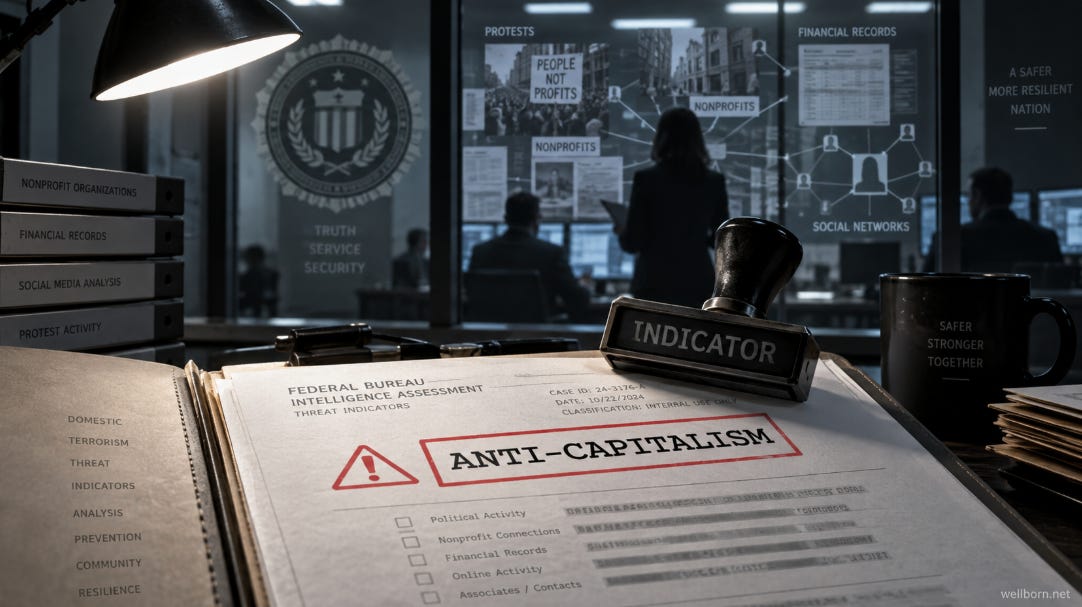
NSPM-7 is short, and it is public, at 90 Federal Register 47225. It directs the Joint Terrorism Task Forces, the Justice Department, the Treasury, and the IRS to investigate, prosecute, and disrupt individuals and organizations engaged in what it calls political violence and intimidation, and to follow the money behind them. Section 3 lets the Attorney General recommend groups for designation as domestic terrorist organizations and requires her to send the president a list. And it names the beliefs that count as warning signs: anti-Americanism, anti-capitalism, anti-Christianity, support for overthrowing the government, hostility toward what it calls traditional American views on family, religion, and morality, and extremism on migration, race, and gender.
Every item on that list is an opinion rather than an act, and the memorandum instructs federal law enforcement to treat holding one as an indicator.
What it has done in twelve months
This is the part that does not require speculation, because every step is dated and most of them were announced by the government itself.
December 4, 2025. Attorney General Pam Bondi sent an implementation memo to every federal prosecutor and law enforcement component. It repeats the ideological list, directs that suspected domestic terrorism be referred to the JTTFs, and enumerates more than twenty statutes prosecutors should apply to anything they encounter during these investigations, including the material support statute written for foreign terrorist organizations.
February 11, 2026. Under questioning from Representative Mary Gay Scanlon, Bondi acknowledged for the first time that a list of domestic terrorist organizations exists. “I know antifa is part of that,” she said. She refused to say what else is on it, how long it is, or whether Congress would ever see it. There is no mechanism for anyone on the list to learn they are on it or to challenge it, because the category has no statutory existence and therefore no process attached.
March 18, 2026. CBS News reported that the FBI and IRS were forming a joint initiative to investigate nonprofit organizations for possible links to domestic terrorism. This is the Treasury half of NSPM-7 arriving: the same agency that once targeted Tea Party groups by name, now told to map the financial networks of organizations the memorandum’s ideology list describes.
April 4, 2026. The administration’s fiscal 2027 budget request disclosed something that had not been announced. Inside the FBI’s $12.5 billion ask is funding for an operational NSPM-7 Joint Mission Center, staffed from ten federal agencies, with the stated charge to “proactively identify networks and prosecute domestic terrorist and related criminal actors.” The word doing the work in that sentence is “proactively.” A task force that responds to violence waits for a crime. A center that proactively identifies networks starts with the network.
June 2026. Fifteen members and associates of a group called Direct Action Minnesota were indicted on conspiracy and assault charges. The 94-page indictment cited, among the evidence of a criminal enterprise, a sweatshirt reading “I’m Antifa!”, possession of a bullhorn, and a devil emoji in a Signal message. Whatever those fifteen people did or did not do, that is the evidentiary standard the government was willing to put in a charging document, and charging documents are templates.
July 16, 2026. Secretary of State Marco Rubio convened what was informally called the Antifa summit, drawing representatives of more than sixty-five countries to Washington. He described anti-fascist networks as sharing infrastructure across borders and accused Iran and Cuba of bankrolling them, without offering evidence. The White House called it the start of an unprecedented global offensive against radical left terrorism. The domestic memo now has a foreign policy.
None of that is a forecast. It is a year of paperwork, and the paperwork points in one direction.
Why the design matters more than any single act
Three features of the architecture explain why civil liberties organizations across the spectrum, from the ACLU to FIRE to the Brennan Center, reacted the way they did.
The first is that “domestic terrorist organization” does not exist in American law. The foreign version does, with a statutory definition, a designation process, and a path to challenge it in court. The domestic version is a phrase in a memo. That is not an oversight. A category with no legal definition has no legal limits, and no one has standing to contest a designation that officially isn’t one.
The second is that NSPM-7 creates no new powers, only redirects existing ones, which sounds reassuring and is the opposite. The JTTFs, the IRS criminal division, the material support statute, and the grand jury system already exist and already work. What the memorandum changes is the target list, and it changes it by ideology. Every tool in the box was built to be pointed at people who commit acts. The memorandum points them at people who hold views.
The third is that it was done by memorandum. No statute, no hearing, no vote. The budget request in April was the first time Congress was formally told a mission center existed, and it was told by being asked to pay for it. A program that reorganizes domestic counterterrorism around political opinion should be the most debated legislation of a decade. It was a Thursday afternoon signing.
Three claims, sorted
The piece has to slow down at this point, because the trajectory above is alarming enough that people have started projecting it forward, and some of the projections are running ahead of what can be shown. Accuracy matters more on this subject than on almost any other, because the first inflated claim is the one the administration will use to dismiss the documented ones.
Claim one: NSPM-7 is a coordinated federal apparatus for targeting political opponents by ideology. Documented. The memorandum says so in its own text. The implementation memo repeats it. The mission center exists and is funded. The secret list exists and the attorney general has said so under oath. The Minnesota indictment shows the standard in use. There is no need to speculate about intent when the intent is in the Federal Register.
Claim two: mass indictments of activists, nonprofits, and political opponents are coming. Speculation, and not implausible speculation. The mission center’s charge is to proactively identify networks and prosecute. The list exists and is secret. The Minnesota case shows that fifteen people can be charged as an enterprise on the strength of clothing and emoji. The IRS is mapping nonprofit finances. Every component of a mass action is in place. What does not exist, as of this writing, is evidence that one has been prepared: no reporting of sealed indictments in bulk, no grand jury activity on the scale the word “mass” implies, no leaked target list. The trajectory supports the worry. The record does not yet support the claim. Those are different sentences, and the difference is the whole of this section.
Claim three: you are living through a mass murder event. That phrase is circulating, and it is ahead of the evidence. There is no documented killing carried out under this framework. Saying otherwise does not sharpen the warning; it discredits it, and it hands the people running this apparatus the one thing they cannot manufacture for themselves, which is a critic who can be shown to be wrong. The accurate description is already grave: a federal government has built a machine for treating political belief as a terrorism indicator, funded it, staffed it from ten agencies, and begun using it. That does not need to be made worse to be frightening. It needs to be stated exactly, so that it holds.
The dates ahead
September 25 is the anniversary, and administrations use anniversaries to announce expansions. The fiscal 2027 appropriations process will decide whether the mission center is funded by Congress or continues on redirected money, and that vote is the first place a legislature gets to say anything about any of this. The attorney general’s list has never been released, and whether it surfaces before November 3, and who is on it, is the single most important unanswered question in this story. The midterm election is fifty-one days away and will be administered under a framework that classifies opposition to the government as a warning sign.
Everything in this piece can be checked. That is the point of writing it this way. When the next expansion comes, and the trajectory says one will, the record of how it got here should already be public, dated, and free of anything anyone can wave away.
https://www.justice.gov/ag/media/1415691/dl
The "anticapitalists" part worries me. They are also including threats or thoughts or language against his billionaire acquantences, basically. He's not the only capitalist.
We need to make sure that the magas understand this before the midterms.