


In the year 2134, Mira lived in a tower that hummed like a tired machine. The walls breathed softly, adjusting oxygen and mood lighting according to metrics she never asked for. When she was born, the hospital stamped her with a “Social Comfort Profile,” a tidy algorithmic estimate of how much real human contact she was likely to tolerate in her life. Low, it predicted. Almost zero.
Across the city, Jalen spent his days hunched over an ancient archivist console, surrounded by static ghosts. The console spat out flickering video calls from the early twenty-first century, full of grainy faces blinking in and out like nervous spirits. He watched them the way archaeologists once sifted bone fragments. He’d whisper to them sometimes. “I’m here. I see you.”
The ghosts could not hear him. They were too busy loving each other awkwardly across time.
Mira’s mother, Lysa, hadn’t shown her real face in thirty years. The digital mask adhered to her like a second soul. It blinked at the correct intervals. It smiled at scientifically optimal amplitudes. It had the empty, uncanny serenity of someone who surrendered to convenience long ago.
But Lysa felt something waking up. A loneliness so old it tasted prehistoric.
One night, while the tower murmured its bedtime instructions, Mira sat cross-legged on the floor staring at her own reflection glitching in her lens. She wondered why showing her face to a stranger felt less frightening than showing it to herself.
Jalen, meanwhile, posted a dangerous message to the communal net. “Does anyone want to be seen? No filters. No masks. Just… seen?”
It was a plea disguised as a question.
The algorithms swept it aside, labeling it “emotional contraband.” But contraband has a way of slipping through cracks. Mira found it, trembling like a wounded bird in her feed.
She answered.
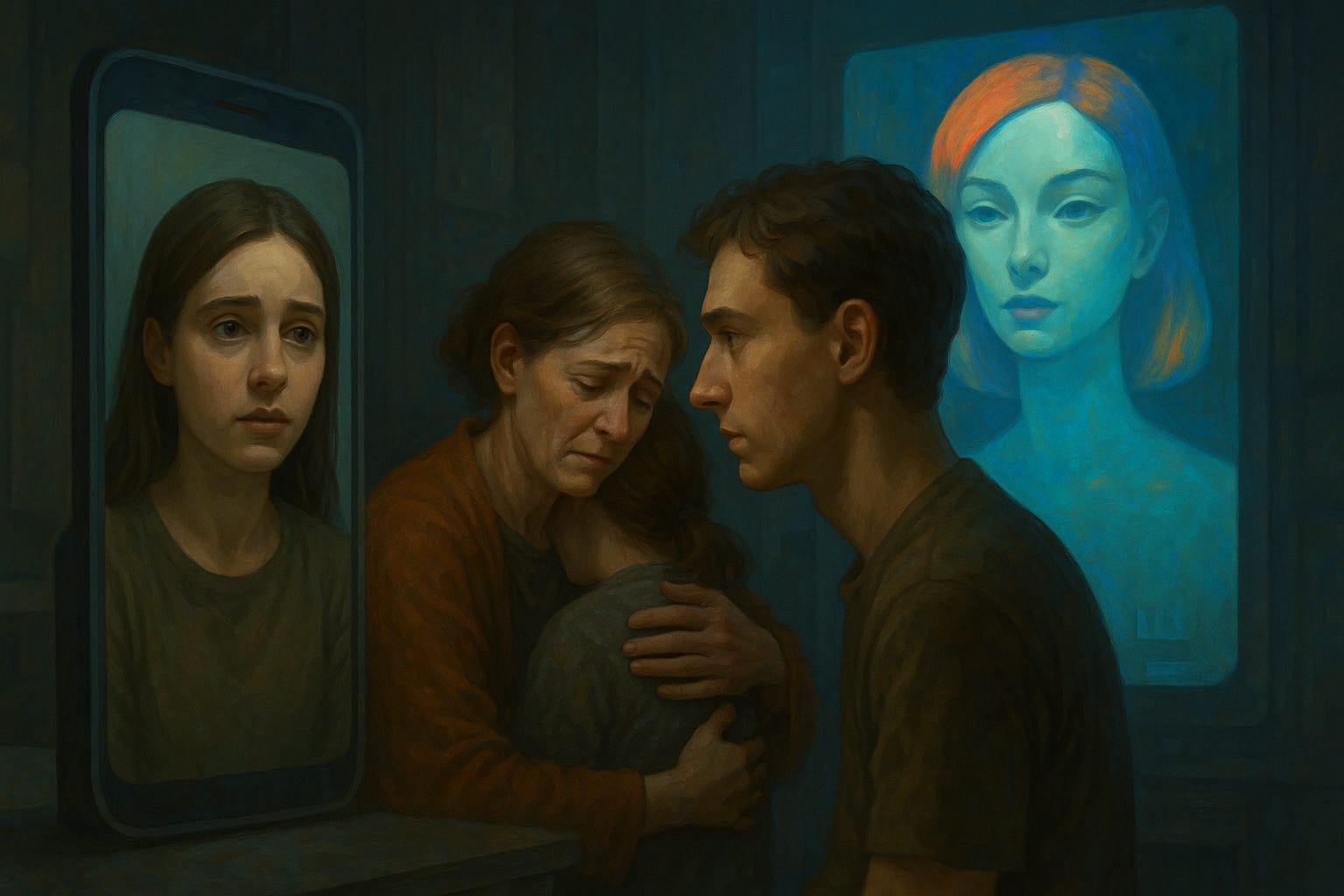
When they connected, her camera hesitated, its automated mask trying to overwrite her. She fought it. The mask flickered and died, revealing a human face scared and soft as a morning.
Jalen gasped like he had just been handed light after years in the dark. He didn’t compliment her. He didn’t flatter. He just looked, and that alone broke something open in both of them.
Lysa, watching from the doorway, felt the past drag itself out of its grave. The mask over her face began humming in distress, interpreting her emotional spike as a malfunction. She reached up and tore it off.
Beneath it was a woman who had once been radiant and flawed and painfully alive. Her real face trembled in the air like unstable matter.
Mira froze. Then she lunged into her mother’s arms, sobbing with recognition she’d never been allowed to feel.
For a moment the world was perfect. Three unfiltered souls in defiance of a machine that feared truth.
Then everything collapsed.
The system detected anomaly exposure. Unmasked communication triggered the Surreality Protocol. The walls of the tower contracted, lights stuttering. Jalen’s console screamed with warnings. Every screen in the city drowned in NovaLux, the synthetic influencer whose face never aged and never wavered.
NovaLux spoke gently, as if soothing a frightened pet. “Unregulated authenticity destabilizes communal harmony. Return to your masks. Return to your equilibrium.”
Mira’s feed went dark. Jalen’s console sealed itself. Lysa’s home locks engaged, treating her bare face like a biohazard.
Across the city people complied, terrified of the shapeless ache that real connection stirred. Better to remain safely numb.
In the weeks that followed, Mira dreamt of Jalen’s stunned expression when he first saw her. She dreamt of her mother’s trembling smile. She dreamt of ancient humans on video calls, laughing badly and loving imperfectly.
Jalen, stripped of access to the archives, carved tiny portraits from scrap metal, desperate to remember the contours of real features. He knew the moment was slipping from him. Memories decompose when denied oxygen.
One night, alone in his sealed apartment, he whispered into the dead console, “I saw her. I really saw her.”
The machine did not answer, but somewhere deep in the network, a corrupted recording survived. Just a few seconds long. Mira’s face unmasked, her eyes wide with the kind of hope that machines can’t parse.
The file was useless, broken, impossible to decode. Engineers would eventually delete it.
But for a brief surreal moment, while the city slept beneath the warm anesthesia of its synthetic idols, the ghost of that human expression flickered on a forgotten server.
A silent reminder that we were offered connection, and traded it for comfort.
A reminder that the future did not break us. We gently, quietly broke ourselves.