


Last updated September 22, 2026.
This page exists because these actions are individually reported and never assembled. Each one lands as a single day of coverage and then disappears, and the cumulative picture never gets drawn anywhere. What follows is the attempt to draw it.
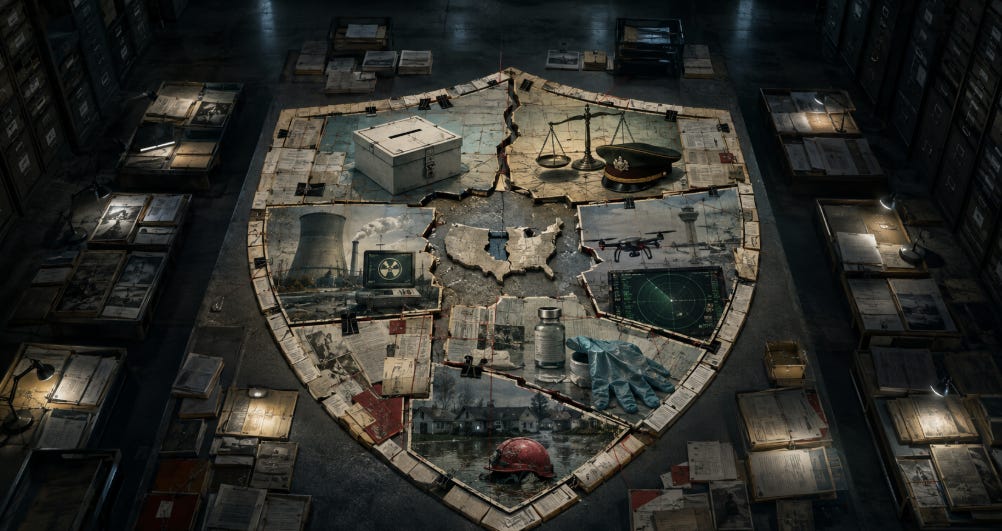
Rules for this page. Every entry has a date, a specific action, and a source. Where an action was reversed, partially restored, or blocked in court, that appears in the same entry, because a list that only records the cuts is a worse instrument than one that records what actually happened. Where the administration has offered a rationale, it is stated. Where a number is disputed, the dispute is noted rather than resolved in favor of the larger figure.
ELECTION SECURITY
February 5, 2025. Attorney General Pam Bondi disbanded the FBI’s Foreign Influence Task Force on her first day in office. The unit was created during the first Trump administration after Russia’s 2016 interference operation, and investigated covert foreign influence activity including campaigns aimed at American elections. Bondi’s stated rationale was that ending it would free resources for higher priorities and reduce the risk of politicized enforcement. The FBI confirmed the disbandment and declined to discuss personnel. CBS News
February 2025. More than a dozen CISA staffers who had worked on election security were placed on administrative leave, and the agency announced a review of its election-related work. Separately, mass firings of probationary employees cut more than 130 CISA positions. Spectrum News
March 10, 2025. CISA ended roughly $10 million in annual funding to the Center for Internet Security, which ran the Elections Infrastructure Information Sharing and Analysis Center. DHS also defunded the companion Multi-State ISAC, the primary cybersecurity information sharing network for state and local government entities generally. Euronews
Director of National Intelligence Tulsi Gabbard dissolved the Foreign Malign Influence Center. Brennan Center, House Homeland Security testimony
September 2025. CISA notified California officials it would no longer take part in a joint federal, state, and local task force supporting county election offices. In the November 2025 elections in several states the agency was largely absent from the space. As of late 2025 CISA had no confirmed director; the nomination of Sean Plankey had stalled in the Senate. OPB / AP
Cumulative. CISA staffing fell to roughly 2,500 from about 3,400 a year earlier. The FY2025 request under Biden sought about $3 billion; the FY2026 proposal sought roughly $2.4 billion and about 2,649 positions. CBS News
Midterms are November 3, 2026.
MILITARY LEGAL OVERSIGHT
February 21, 2025. Defense Secretary Pete Hegseth removed the top uniformed lawyers of the Army and the Air Force, Lt. Gen. Joseph Berger III and Lt. Gen. Charles Plummer, on the same night Trump fired Joint Chiefs Chairman Gen. C.Q. Brown Jr., Chief of Naval Operations Adm. Lisa Franchetti, and Air Force Vice Chief Gen. James Slife.
A correction worth making, since this is usually reported as three firings. The Navy’s judge advocate general seat was already vacant. Vice Adm. Christopher French had departed weeks earlier and Rear Adm. Lia Reynolds was serving in an acting capacity. Hegseth announced he was seeking nominations for all three positions, which functionally cleared the bench, but two officers were removed, not three. Military.com and Lawfare
The judge advocates general administer the Uniform Code of Military Justice and advise commanders on the law of armed conflict. Hegseth’s stated rationale was that they had been roadblocks to lawful orders from the commander in chief. Five former secretaries of defense called for congressional hearings. Don Christensen, a retired military judge and former chief prosecutor of the Air Force, said the effect was to install more compliant people in the roles. CNN
March 2025. Hegseth commissioned his personal attorney as a Navy JAG, and was reported to be preparing broader changes to how military lawyers advise on the law of war and prosecute violations of it. Lawfare
FEDERAL LABOR AND COLLECTIVE BARGAINING
March 27, 2025. Executive Order 14251, “Exclusions from Federal Labor-Management Relations Programs,” invoked a seldom-used provision of the 1978 Civil Service Reform Act permitting the president to exclude agencies from the federal labor relations statute where their primary function concerns national security and where applying the statute would compromise it. The order initially reached more than thirty agencies and subdivisions, including Defense, Veterans Affairs, Treasury, Justice, the Food and Drug Administration, the Centers for Disease Control and Prevention, and the Environmental Protection Agency.
The stated rationale is that intelligence, counterintelligence, investigative, and national security functions should not be hindered by collective bargaining. FedSmith and White House fact sheet
August 28, 2025. Executive Order 14343 extended the exclusions to further entities including NASA, the National Oceanic and Atmospheric Administration, and the National Weather Service. Across both orders the exclusions reach roughly 950,000 workers, about 85 percent of the unionized federal workforce. Economic Policy Institute and OnLabor
September 25, 2025. The Bureau of Prisons terminated the collective bargaining agreement covering roughly 30,000 corrections officers.
December 11, 2025. The House passed the Protecting America’s Workforce Act, which would repeal the exclusions, with Republican votes. It is the only measure this Congress has passed to reverse one of this president’s executive orders.
December 12, 2025. The day after that vote, DHS terminated the contract covering roughly 47,000 Transportation Security Administration officers, in defiance of an injunction issued in June.
February 12, 2026. The Office of Personnel Management issued guidance directing agencies covered by both orders to proceed with terminating or modifying collective bargaining agreements, including units where litigation was still pending, and attached a termination template instructing agencies to file decertification petitions with the Federal Labor Relations Authority. OPM clarified the following week that the direction did not reach bargaining units covered by a currently applicable court order. Congressional Research Service LSB11367 and Government Executive
February 27, 2026. The Internal Revenue Service told employees it had terminated its 2022 national agreement with the National Treasury Employees Union along with a 2025 addendum. CRS LSB11367
Where this stands in court, in both directions. The Department of Veterans Affairs cancelled an agreement covering roughly 320,000 employees; a court found the cancellation likely retaliatory and ordered it reinstated. Against that, a D.C. Circuit panel stayed and a Ninth Circuit panel vacated preliminary injunctions against the orders in February 2026, finding the government had shown the orders would have issued regardless of the unions’ speech. The administration filed its own declaratory-judgment suits seeking to void contracts, saw them dismissed, withdrew the appeals, and proceeded under the OPM guidance instead. CRS LSB11367
OVERSIGHT AND INSPECTORS GENERAL
January 24, 2025. Trump fired at least 17 inspectors general across cabinet departments and agencies in a single late-night action. The Inspector General Act of 1978, as amended in 2022, requires 30 days notice to Congress and a substantive, case-specific rationale for each removal. Neither was provided. The first group received two-sentence termination emails. None of the officials removed had been accused of ineffectiveness or misconduct. For comparison, Presidents Obama and Biden each removed one inspector general, in both cases for stated cause. The largest previous purge was Ronald Reagan’s removal of fifteen inspectors general in 1981, before any notice requirement existed.
September 2025. The administration attempted to shut down the Council of the Inspectors General on Integrity and Efficiency, the coordinating body for the federal IG community. CIGIE told Congress that the Office of Management and Budget had decided it would receive no apportionment for fiscal 2026 despite funds sitting available in its no-year account, which left it unable to operate. CIGIE runs Oversight.gov, publishes the IG vacancy list, hosts dozens of IG websites and hotlines, and trains IG staff. Senators Chuck Grassley and Susan Collins objected that the move defied congressional intent. OMB has since apportioned a fraction of the requested funding. CREW
September 24, 2025. Judge Ana Reyes of the District Court for the District of Columbia ruled the firings unlawful, writing that the violation of the Act was obvious, that Congress was not notified in advance, and that no rationale of any kind was provided. She declined to reinstate the eight plaintiffs, finding they had not shown irreparable harm and noting the president could simply re-fire them after providing the required notice. The case is Storch v. Hegseth, 1:25-cv-00415. Federal News Network and the Civil Rights Litigation Clearinghouse
October 2025. Weeks after that ruling, Trump fired the Inspector General of the Export-Import Bank, Parisa Salehi, again without notifying Congress and again without a stated rationale. Public Citizen
Cumulative, end of 2025. Another 10 inspectors general were fired or resigned after the January action. Of the 38 presidentially appointed IG positions, 55 percent were vacant. Across all 72 federal IG positions there were 29 vacancies. Overall IG office staffing is down roughly 12 percent, and by as much as 30 percent in at least one office. Some vacancies predate this administration; most do not. CREW and Public Citizen
Note on scope: the inspectors general are the mechanism by which most other entries on this page would ordinarily have been investigated.
NUCLEAR SECURITY AND OVERSIGHT
February 13, 2025. Roughly 300 to 350 National Nuclear Security Administration employees were fired, two days after the executive order directing large-scale reductions in force. Pantex, where warheads are assembled and disassembled, absorbed about 30 percent of the cuts. Acting administrator Teresa Robbins rescinded the terminations for all but 28 people late that Friday night. The Energy Department initially said fewer than 50 had been let go and described them as clerical, which was not accurate; congressional letters put the gap at 177 claimed against roughly 350 reported. Secretary Chris Wright later acknowledged the department had moved too fast. CBS News and Arms Control Today
May 23, 2025. Executive Order 14300 directed the Nuclear Regulatory Commission to reorganize with reductions in force, assigned it a DOGE team lead, required wholesale revision of its regulations in coordination with OMB and OIRA, and ordered the Advisory Committee on Reactor Safeguards cut to its statutory minimum. Reactor safety rules now pass through White House budget review. Government Executive
June 2025. Trump fired Democratic NRC Commissioner Chris Hanson after Hanson criticized the federal workforce cuts. Republican Commissioner Annie Caputo later resigned. E&E News
Spring 2026. In SRM-SECY-26-0015 the NRC cut security baseline inspection resources by roughly 50 percent. Eight of eleven security inspection procedures were retired and consolidated into two. Annualized baseline security inspection hours fall from 287 to somewhere between 149 and 170. Material control and accounting inspections move from triennial to as-needed. Cybersecurity inspections move from biennial to triennial. The force-on-force program, which simulates armed attacks on plants, was overhauled in the same action. Total reactor oversight inspection hours drop 38 percent, from 2,018 to 1,245.
The NRC’s stated rationale is that fleet performance has been consistently strong since 2000 and that some inspections consumed substantial resources while generating few findings. That argument is not frivolous and belongs in the record alongside the numbers. American Nuclear Society and Morgan Lewis
June 25, 2026. The NRC proposed replacing prescriptive security and fitness-for-duty requirements with a performance-based framework, explicitly as implementation of EO 14300. Federal Register
AIRSPACE AND COUNTER-DRONE AUTHORITY
October 1, 2025. Counter-drone authority held by DHS and DOJ since 2018 expired during the government shutdown, after the extension fell out of the stopgap funding bill. For roughly two and a half months the two departments responsible for mitigating drone threats near airports, federal facilities, and mass gatherings had no legal authority to do so. DroneLife
December 18, 2025. The SAFER SKIES Act, enacted as part of the FY2026 NDAA, restored and extended federal counter-drone authority through 2028 and opened a limited path for state, local, Tribal, and territorial law enforcement. Section 3111 extended similar authority to the Department of Energy for nuclear security. The implementing interim final rule took effect July 1, 2026. This entry belongs on the page as a restoration, not a cut. Davis Wright Tremaine
September 4, 2026. The comment period closed on the DOJ and DHS interim final rule implementing the SAFER SKIES Act, docket FBI-2026-0001. The rule has been legally in effect since July 1, 2026, having bypassed ordinary notice and comment on good cause grounds, with the departments citing the statutory 180-day deadline, the semiquincentennial events, and more than 600 drone incursions into restricted airspace around World Cup host cities. Comment was invited on certification expiration, mutual aid conditions, the civil penalty framework, and privacy safeguards. The final rule will be recorded here when it issues. Federal Register 2026-13609
Standing gap: commercial nuclear plant operators still hold no counter-drone authority of their own, plant security forces have no authority to interdict any aircraft, and drones remain outside the design basis threat the NRC requires plants to defend against, a determination the agency reached in October 2019 and has not revisited. NRC fact sheet and Arms Control Association
BIODEFENSE
August 5, 2025. HHS announced the wind-down of mRNA vaccine development at BARDA, the agency responsible for medical countermeasures against biological attack and pandemic. Twenty-two projects worth roughly $500 million were terminated, contracts with Emory University and Tiba Biotech ended, work de-scoped at Luminary Labs, ModeX, and Seqirus, and pre-award solicitations from Pfizer, Sanofi Pasteur, CSL Seqirus, and Gritstone rejected or cancelled. The award to Moderna and UTMB for an H5N1 avian influenza vaccine was cancelled. No new mRNA projects will be started.
Secretary Robert F. Kennedy Jr.’s stated rationale was that the data show these vaccines fail to protect effectively against upper respiratory infections, and that funding would move to platforms that hold up better as viruses mutate. That characterization is disputed by the evidence on protection against severe disease and death. CNN and BioPharma Dive
INDEPENDENT REVIEW BODIES
October 28, 2025. The six sitting members of the Commission of Fine Arts were removed by email from the Presidential Personnel Office, effective immediately. The commission, created by Congress in 1910, reviews designs for federal buildings, memorials, monuments, coins, and medals in the capital, and had been expected to review the White House ballroom and the proposed triumphal arch at Memorial Circle.
A correction worth making, since this is usually reported as the firing of all members. The commission seats seven. The chair, architect Billie Tsien, had resigned earlier in the year, so the seat was already vacant. Six members were removed, not seven. Washington Post, NPR, and ABC News
A White House official said a new slate would be appointed more aligned with the president’s policies. The reconstituted commission approved the White House ballroom on February 19, 2026, and later gave the triumphal arch at Memorial Circle its early approval. The Art Newspaper
The same termination language went to Biden appointees on other review bodies during 2025, including the National Capital Planning Commission and the United States Holocaust Memorial Council. CNN
FEDERAL STATISTICS
August 1, 2025. Trump fired Erika McEntarfer, Commissioner of the Bureau of Labor Statistics, hours after a jobs report showing 73,000 jobs added in July and a downward revision of 258,000 to the May and June figures. He accused her of having faked the numbers. No evidence was offered and none has emerged.
William Beach, who held the same post during Trump’s first term, told PBS NewsHour that the commissioner does not collect, organize, or handle the data, and put the likelihood of manipulation near zero. The BLS had already reduced the sample collection underpinning the consumer price index before the firing.
Commerce Secretary Howard Lutnick disbanded two federal economic statistics advisory committees.
Note on scope: federal statistical agencies produce the figures used to set Social Security cost-of-living adjustments, index tax brackets, guide Federal Reserve policy, and price Treasury securities. Degradation here is not measurable by the usual means, because the usual means are the thing being degraded.
DISASTER RESPONSE
April 2025. FEMA terminated the Building Resilient Infrastructure and Communities program, the largest competitively awarded pre-disaster mitigation funding source in the country, cancelling pending applications from fiscal 2020 through 2023 and halting the 2024 funding opportunity. The agency called the program wasteful and ineffective and said roughly $882 million appropriated under the infrastructure law would return to Treasury or be reapportioned. Flood Mitigation Assistance funding for 2025, about $600 million, was withdrawn as well. BRIC was signed into law by Trump in 2020.
Twenty states sued. On August 5, 2025 a federal judge preliminarily enjoined the reallocation of funds. On December 11, 2025 the court ruled the termination unlawful and issued a permanent injunction. FEMA said it would comply and gave no timetable for restoring the program. Congressional Research Service
August 4, 2026. GAO found that about 17 percent of FEMA’s workforce, more than 4,300 employees, separated in fiscal 2025, leaving roughly 21,000 staff as of April 2026. The agency was under a hiring freeze from January 2025 through May 2026. In January 2026 DHS declined to renew contracts for hundreds of temporary full-time Cadre of On-Call Response/Recovery Employees, the largest contingent in FEMA’s workforce; in May, after Markwayne Mullin replaced Kristi Noem at DHS, affected employees were offered their positions back. GAO found no evidence that DHS or FEMA assessed the effect of any of this on the agency’s ability to respond to disasters. GAO had already added FEMA’s disaster workforce to its High Risk List in February 2025. GAO-26-108427
CHANGELOG
Every addition and correction, dated, so returning readers can see what is new without rereading the page.
September 22, 2026. Corrections. The entry counts in the September 2 and September 9 lines below were each overstated by one: the page held 25 entries after September 2 and 34 after September 9, not 26 and 35. Reordered the Oversight and Inspectors General entries by date. Added to the January 24, 2025 inspector general entry that Ronald Reagan removed fifteen inspectors general in 1981, before the notice requirement existed. Added to the Commission of Fine Arts entry that the reconstituted commission gave the Memorial Circle arch its early approval. Thirty-four entries total.
September 9, 2026. Added two sections and one entry. Federal Labor and Collective Bargaining covers Executive Orders 14251 and 14343, the September 2025 Bureau of Prisons termination, the December 11 House vote and the TSA termination the day after it, the February 2026 OPM guidance and the IRS termination that followed, and where the litigation stands for both sides. Independent Review Bodies covers the October 28, 2025 removal of six members of the Commission of Fine Arts, with a correction on the count. Added to counter-drone authority: the September 4, 2026 close of the comment period on the interim final rule. Thirty-five entries total.
September 2, 2026. Added two sections. Oversight and Inspectors General covers the January 24, 2025 mass firing of 17 IGs, the September 2025 ruling that the firings were unlawful, the October 2025 firing of the Export-Import Bank IG conducted the same way after that ruling, the attempted defunding of CIGIE, and the vacancy figures at the end of 2025. Federal Statistics covers the August 1, 2025 firing of the BLS commissioner and the disbanding of two Commerce advisory committees. Twenty-six entries total.
August 26, 2026. Page created. Eighteen entries across election security, military legal oversight, nuclear security and oversight, counter-drone authority, biodefense, and disaster response. Correction on first publication: the judge advocate general removals of February 21, 2025 are widely reported as three officers. Two were removed. The Navy seat was already vacant.