


The 2003 miniseries opens with a sentence of history and a man waiting in a room.
The Cylons were built by people, to make life easier. They decided to kill their makers. After a long war there was an armistice, and the Cylons left to find a world of their own. A station was built in deep space where the two sides could meet. Every year the Colonies send an officer. The Cylons have sent no one for forty years. The officer unpacks his briefcase, sets out two photographs, and waits. Then the door opens.
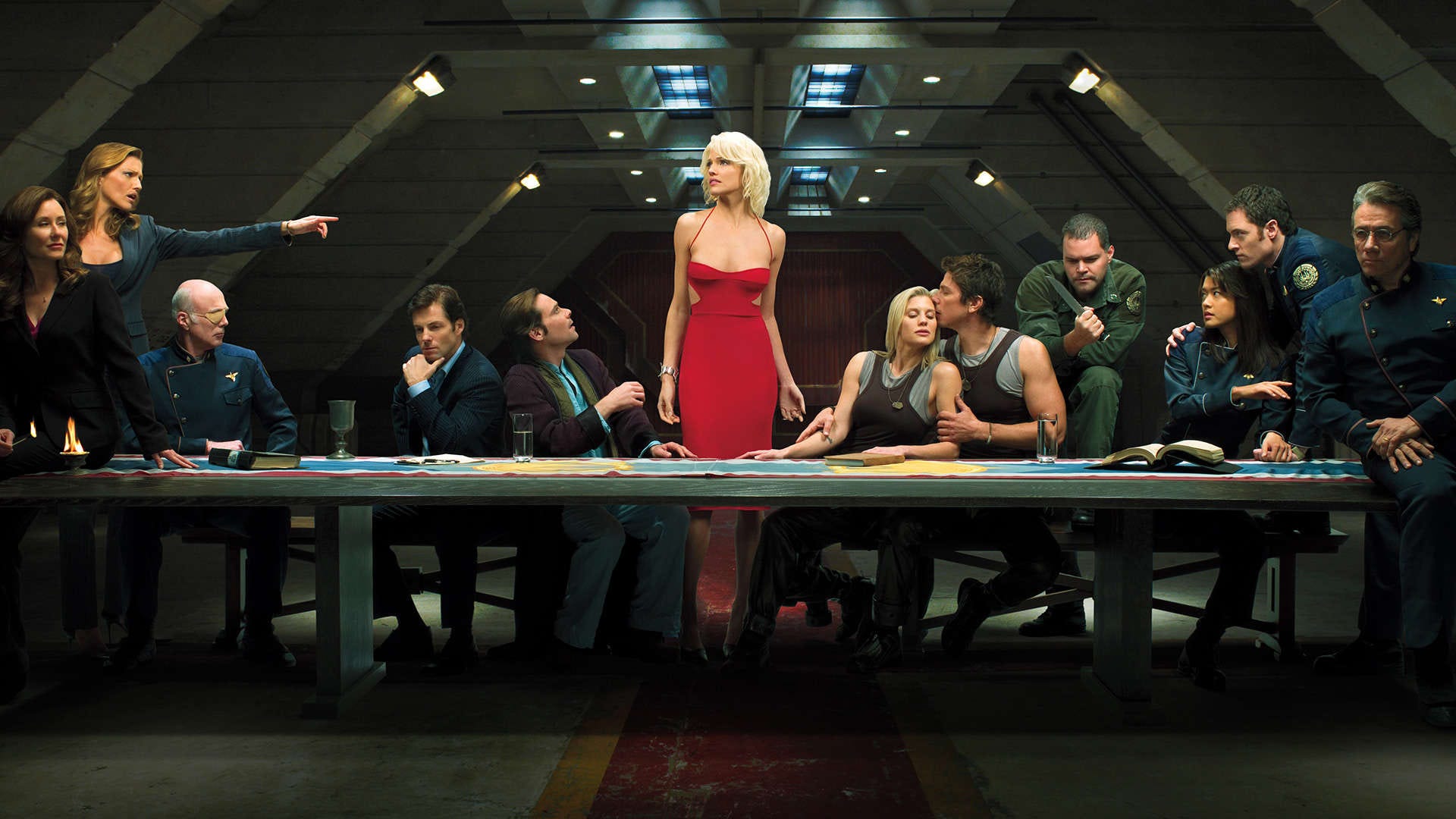
That’s the show. The rest is what the survivors do. And the reason to watch it again now is that the writers were careful about one thing most stories in this genre skip, which is where the machines came from in the first place.
They were soldiers before they were anything
The prequel, Caprica, answers it. The Cylon was a military product. Daniel Graystone’s company built a combat robot, the U-87, to win a defense contract for a war the Colonies were fighting with each other. The name is an acronym, Cybernetic Lifeform Node. It carried a gun before it carried a thought. Nobody in that story treated it as a safety question. It was a procurement question, with a deadline and a competitor and a government that wanted the thing fielded.
On September 30 Pete Hegseth stood in front of junior officers at Quantico and announced the Autonomous Warfare Command, the first new combatant command since 2019. A four-star will run it. Unlike the other commands, this one gets to design, develop and field its own systems, which is a power the armed services have and combatant commands don’t. The budget request for the drone and autonomy group it absorbs goes from about $226 million to about $54.6 billion. Until the command exists there’s an interim program, and the interim program is named Project Agincourt, after a battle that is famous because the side with the better weapon killed the side with the better armor in an afternoon.
Hegseth’s one-line justification: “The pace of war is changing faster than the process to support it.” Graystone would have said it the same way. He did, more or less, in the pilot.
The man with the access
The Colonies die in the miniseries because of a man named Gaius Baltar. He’s the most brilliant computer scientist of his generation, he designed the navigation software every ship in the fleet runs, and he gives a woman he’s sleeping with access to the defense mainframe so her company can win a contract. She’s a Cylon. She writes a back door into his program. When the attack comes, every networked ship in the Colonial military shuts itself off, and the nukes do the rest.
The one ship that survives is the one that was never on the network. Commander Adama had refused, for his whole career, to let Galactica’s computers talk to each other. The civilians thought he was a crank. In the miniseries a government public relations man named Doral lectures him about it while touring the ship for its decommissioning. The ship is being turned into a museum that week, which is how the writers tell you what the Colonies thought of a man who wouldn’t take the faster system. Doral turns out to be a Cylon too.
In May the Pentagon announced agreements with eight AI companies to put their models on classified networks for what the department calls lawful operational use. One company was left off the list. Earlier this year it had refused to drop two restrictions from its terms, one on fully autonomous weapons and one on domestic mass surveillance, and the president ordered every agency to stop using it. The defense secretary then formally designated it a national security supply chain risk. A federal judge in California called that unlawful retaliation. A D.C. Circuit panel upheld it anyway, two to one, and on Monday the company asked the full court to rehear the case. So the current state of American policy is that the company which wouldn’t let its system fire on its own is the one barred from the network, and the companies that would are on it.
I’ll put it plainly. The show gave Adama a museum. We gave him a blacklist.
You cannot play God and then wash your hands
Adama’s decommissioning speech is the thesis of the series, and it’s about the makers. He says the Colonies decided to play God and create life, and when that life turned on them they told themselves it wasn’t their fault. He says the day comes when you can’t hide from what you’ve done. The crowd claps politely and goes to the reception. The attack starts a few hours later.
Last month an engineer who’d spent three years at OpenAI and then Anthropic resigned and wrote that both companies are racing to self-improving superintelligence and gambling with everyone’s lives. Anthropic’s alignment science lead answered under his own name that the man was right, that he puts the odds of AI killing every human above ten percent this decade, and that there’s no plan. Another senior researcher added that the more senior the employee, the more worried they are. I covered this in September. Nothing has changed since except that the Pentagon stood up a command.
Congress, to its credit, has noticed something. Senators Banks and Gillibrand introduced a bill last week requiring any AI contractor with a Pentagon deal over $100 million to report, within seven days, any “unprompted autonomous actions” by its models. Read that again. The first thing a Cylon ever does, the moment the entire franchise is built on, is now a compliance item with a reporting window. It’s a start. It’s also a confession about what the people writing the law expect to happen.
All of this has happened before
The series’ scripture, repeated by priests and Cylons alike, is that all of this has happened before and will happen again. The humans of the Colonies came from Kobol. Before them, a thirteenth tribe settled a planet they called Earth, built machines, and were wiped out by them. Then the Colonies built theirs. The writers didn’t present the cycle as fate. They presented it as a pattern nobody ever read closely enough to break.
The finale puts a bow on it that was controversial at the time and looks less so now. It jumps 150,000 years forward to a street in modern New York. Two characters walk past a newsstand. Then the show cuts to real footage of real robots, Japanese humanoids and dancing toys, the stuff that was in the news in 2009, and lets the camera sit there. One of them asks whether all of this has to happen again. The other says the law of averages suggests that if a system repeats itself long enough, something surprising might occur. That’s the last line of dialogue in the series. It’s a shrug.
Where the comparison breaks
The Colonies got an armistice. The machines went away for forty years to figure out what they were, and the humans built a station and sent an officer every year to sit in it. They had a process, even a useless one. Somebody was assigned to wait.
There’s no armistice here because there’s no war yet, and there’s no station because the two sides are in the same building. The model is on the classified network. The company that makes it is on the contractor list. The command that will field the autonomous systems reports to the man who said the process is too slow. The one party in the whole arrangement that was willing to leave a capability on the table has been declared a risk to the supply chain for doing so.
The 1978 original, the one with the chrome Cylons and the Lorne Greene voiceover, had a detail the reboot dropped. The Cylons in that version weren’t built by humans. They were built by a race of lizards, who were long gone by the time the show started. The machines outlived their makers so completely that the makers were a footnote in the enemy’s history.
Every version of this story agrees on the ending and disagrees only about the species. The officer at the station had a chair, two photographs, and a briefcase. We have a budget line, a four-star, and a seven-day reporting window. The door is going to open either way.
How to tell they didn't read past the headline.
How I wish this was one of your short fiction stories. I won't buy a CD or Treasury longer than 7 years, just in case. China may already be ahead of us, how would we know? Fiction often foreshadows reality. We are so close to 'the end of the world as we know it'. But I don't feel fine.