


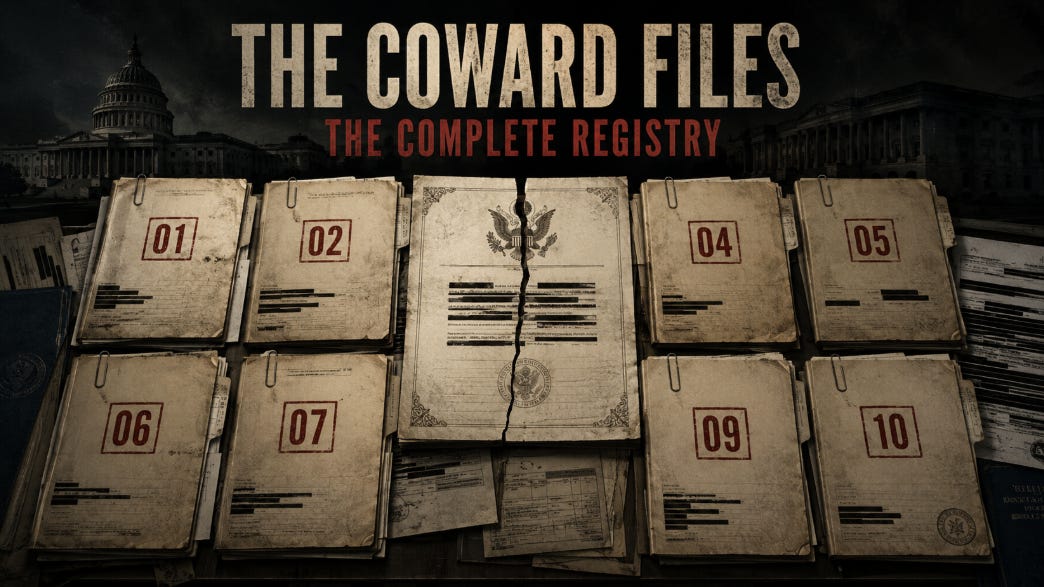
The Coward Files is a documentary series on the named Republicans and complicit Democrats who had the information, the standing, and the moment to act against American authoritarian capture, and chose not to.
This page is the Registry itself: the permanent summary of every subject, in order, as published. It is updated when a new installment appears, and the existing entries are never revised. If you are looking for a specific person, they are listed below in order of publication.
The Cowardice Test
Inclusion requires a documented betrayal of a prior stated position, principle, or sworn duty. That is the gate, and it is the only gate.
True believers and zealots fail the test. Stephen Miller, Tom Cotton, and their cohort are not cowards in this series’ sense. They are ideological actors operating consistently with what they have always believed, and consistency is not the charge here.
The Files do not cover people for being villains. They cover people for knowing better, saying so on the record, and then choosing otherwise.
This distinction is the reason several obvious names are absent. It is also the reason a few surprising ones are present.
The Registry
#01. JD Vance, sitting Vice President of the United States
In February 2016, he wrote in a private message to a Yale Law classmate that Donald Trump was either a Nixonian cynic or “America’s Hitler.” In July 2024, he accepted Trump’s nomination to be Vice President. He now serves as the credentialed intellectual cover for the regime he privately, in writing, in his own voice, identified as fascist before most of his party did.
#02. Susan Collins, sitting United States Senator from Maine
In October 2018 she cast the decisive vote to confirm Brett Kavanaugh after a Senate floor speech in which she said the nominee had privately assured her that long-established precedent was “not something to be trimmed, narrowed, discarded, or overlooked.” In June 2022 she said the Dobbs decision was “inconsistent with” what Kavanaugh had told her. She remains in the Senate and is running for reelection in 2026.
#03. Mitt Romney, former United States Senator from Utah
He was the first senator in American history to vote to convict a president of his own party, and he did it twice. In October 2024, uniquely free of any political cost and facing the binary choice, he refused to endorse the only candidate who could stop Trump’s return, saying he wanted to keep his influence in a post-Trump Republican Party. He retired three months later. The party he was saving himself for does not exist, and the man he twice voted to remove now governs without him.
#04. Todd Blanche, Acting Attorney General of the United States
He spent eight years as a federal prosecutor and then left the bar to serve as Donald Trump’s personal criminal defense attorney through the cases that ended in thirty-four felony convictions. In 2025 he took the second seat at the Justice Department and, in 2026, its leadership, and from those seats he ran the department as his former client’s instrument, recusing in form from the criminal investigation of the woman who beat Trump in civil court while signing the settlement that pays the January 6 attackers. He knew exactly what the office was for, because he had once served it.
Editor’s note, September 22, 2026: President Trump fired Pam Bondi on April 2, 2026, and Blanche became acting attorney general. The Senate confirmed him as Attorney General 50 to 49 on August 8, 2026, and he was sworn in August 10. The entry above is preserved as published.
#05. Kyrsten Sinema, former United States Senator from Arizona
She came up a Green Party activist and arrived in the Senate holding one of the fifty votes that could have set aside the filibuster to pass federal voting-rights protection. In January 2022 she delivered a floor speech defending the filibuster instead, and the Freedom to Vote Act and the John Lewis Voting Rights Advancement Act died. She left the Democratic Party that year and declined to seek reelection in 2024, and the franchise she refused to protect remains exactly as exposed as she left it.
#06. Ted Cruz, sitting United States Senator from Texas
In May 2016 he stood at a podium and called Donald Trump a pathological liar, utterly amoral, a narcissist, and a bully who had smeared his wife and accused his father of a role in the Kennedy assassination. In September 2016 he endorsed him, and on January 6, 2021, after the Capitol was attacked, he voted to object to the certification of the election Trump had lost. He produced the most accurate description of the man on record, and then he served him anyway.
#07. Joe Manchin, former United States Senator from West Virginia
He spent months negotiating the Freedom to Vote Act, attached his name as lead author, and pledged to find ten Republican votes to pass it through regular order. He found zero. When the premise of his own position failed its public test, he voted against a talking-filibuster exception that would have saved his own legislation, and the Freedom to Vote Act and the John Lewis Voting Rights Advancement Act died under the rule he chose to protect. He wrote the compromise, demanded the compromise, and then stood guard over the mechanism that strangled it.
#08. Lindsey Graham, sitting United States Senator from South Carolina
In July 2015, on camera, in his own voice, he called Donald Trump a race-baiting xenophobic bigot, unfit for office, and someone appealing to the dark side of human nature. In May 2016 he said the Republican Party would deserve to lose if it nominated Trump. After January 6, 2021, he said on the Senate floor: “Count me out. Enough is enough.” He voted to certify the election that night. Within weeks he reversed, flew to Mar-a-Lago, and spent the following four years as one of Trump’s most visible surrogates. He produced the most detailed public indictment of Trump on record and then spent eight years proving every word of it true from the front row of the endorsement.
Editor’s note, September 22, 2026: Lindsey Graham died on July 11, 2026. Governor Henry McMaster appointed his sister, Darline Graham, to the seat on July 13; a special primary followed on August 11, with a runoff on August 25. The entry above is preserved as published.
#09. Bill Barr, former Attorney General of the United States
On December 1, 2020, as sitting Attorney General, he told the Associated Press the Department of Justice had found no evidence of fraud that would have changed the outcome of the election. In his memoir he wrote that he told Trump directly, in the Oval Office, that the stolen-election claims were, in his words, “bullshit.” He testified to the same under oath before the House January 6th Select Committee. He resigned rather than continue enabling the lie. In May 2024 he endorsed Trump for president anyway. He had the evidence, the authority, the personal conversation, and the four years of watching the lie metastasize into an attack on the Capitol. None of it held when the choice came around again.
#10. Rand Paul, sitting United States Senator from Kentucky
The atypical entry in the Registry: a coward not by wholesale surrender but by selective principle. In 2016 he called Trump “a delusional narcissist and an orange-faced windbag,” said “a speck of dirt is way more qualified to be president,” compared him to Goebbels, and built a campaign on the charge that Trump was a “fake conservative,” then endorsed and enabled him. But unlike the others, Paul kept some of his spine: he voted against Trump’s emergency tariff powers, opposed the Venezuela strikes as unconstitutional, criticized the Kimmel pressure and the “lawfare,” co-sponsored releasing the Epstein files, and declined to endorse in 2024. That proven capacity for courage is what convicts him. His entire stated philosophy holds that state power must never be turned against the individual, and he abandons it completely to pursue one private citizen, Anthony Fauci, whom he has vowed for years to imprison. In July 2026 he subpoenaed the eighty-five-year-old Fauci before his Homeland Security Committee, dumped 1,100 pages of his private diaries online, and had his lawyer removed from the room when Fauci invoked the Fifth Amendment, the very constitutional protection Paul claims to revere. He has the courage to defy Trump in the cheap rooms and abandons his principles in the expensive one, and because he has proven he could do otherwise, every fold is a choice. He knows better, and has demonstrated it, which removes the excuse of weakness the other entries can at least plead.
#11. Bill Cassidy, outgoing United States Senator from Louisiana
A gastroenterologist who practiced for three decades, who voted to convict Donald Trump in 2021, and who chaired the Senate committee with oversight of the Department of Health and Human Services. In January 2025 he told Robert F. Kennedy Jr.’s confirmation hearing about an eighteen-year-old patient he had loaded into an ambulance for an emergency liver transplant, and said it was the worst day of his medical career because fifty dollars of vaccine would have prevented it. He pressed Kennedy to say that vaccines do not cause autism and Kennedy refused. On February 4, 2025 he cast the vote that made Kennedy’s confirmation certain, and pledged from the Senate floor to use his authority as chairman to rebuff any attempt to remove the public’s access to life-saving vaccines. Within four months, Kennedy had fired all seventeen members of the vaccine advisory committee Cassidy had been promised would be maintained without changes. By August 2026, the childhood vaccine schedule had been cut from eighteen diseases to eleven, and measles had returned at levels not seen since 1991, with two unvaccinated children dead in Texas. Cassidy’s exercise of his pledged authority was a social media post advising parents to disregard the executive order. He lost his primary on May 16, 2026, finishing third, and traded the one act only he could perform for a seat he did not keep.
#12. John Cornyn, outgoing United States Senator from Texas
A four-term senator, former Republican whip, and former chairman of the party’s Senate campaign committee, a man whose profession for twenty-four years was counting votes. In 2022, after nineteen children and two teachers were killed in Uvalde, he negotiated a bipartisan gun package with Democrats, and Trump condemned him by name as a RINO. On May 18, 2023, he told Texas reporters that the party needed an alternative for 2024 and that Trump’s time had passed him by, framing the objection entirely as electability and never once as fitness. Trump answered with a nickname. Cornyn spent the next three years retracting it: a late endorsement in 2024, a voting record almost perfectly aligned with the administration, and repeated public requests for a primary endorsement he told NBC News the president was not ready to give. His pinned post on the day of the runoff was a photograph of himself standing beside Trump and a note that he had voted yes on every major Trump law. It was true. On May 26, 2026, Ken Paxton beat him by twenty-eight points, and only then did Cornyn begin calling the president a liability to the party. He is the first subject to arrive at candor after the loss rather than capitulation after the criticism, and the only one whose original sin was arithmetic.
#13. Chuck Grassley, sitting United States Senator from Iowa
For four decades, the Senate’s foremost defender of inspectors general, and the author of the bill that became the Securing Inspector General Independence Act of 2022, which requires a president to give Congress thirty days’ notice and case-specific reasons before removing one. In 2020, he pledged from the Senate floor to champion inspectors general regardless of who occupies the White House, and dismissed in advance anyone who would doubt it. He had blocked an Obama nominee over a single firing and delayed two Trump nominees in 2020 over two more. On the night of January 24, 2025, seventeen inspectors general were fired by email with no notice and no reasons. He sent a letter, which went unanswered for eight months, placed no holds, held no hearings, and kept the administration’s judicial and US attorney nominees moving through the committee he chairs. A federal court ruled the firings unlawful in September 2025; another was fired the same way weeks later. By the end of that year, 55 percent of presidentially appointed inspector general posts were vacant. He never abandoned the principle. He simply stopped using the instruments, and he is the man who forged them.
How subjects are chosen
Two axes govern selection, and neither is org-chart rank.
Heat. Influence multiplied by insidiousness multiplied by current visibility. A senator who cast one pivotal vote and vanished can outrank a cabinet secretary who was simply loyal throughout, because the vote was the moment and loyalty was never in question.
Longevity. Marquee names are rationed deliberately. Rubio, Pence, and Haley are held for late rungs. Trump is the capstone and remains held. The series works through lesser names first, and a subject is pulled forward only when a live news hook forces it, as happened with Rand Paul and the July 2026 Fauci hearing.
Precedents the series has established
The selective courage variant, from #10. A subject who retains genuine independence on some fronts is not thereby exempt. The retained courage sharpens the charge rather than weakening it, because it removes the excuse of weakness that the full-reversal subjects can at least plead. This applies to any subject too independent to fit the clean template.
The distinction between fear and enthusiasm. Several entries involve people with documented reason to be afraid, including credible threats to their families after January 6. Fear explains a vote. It does not explain a flight to Mar-a-Lago three weeks later, or four years of surrogacy, or a nomination accepted. The Registry charges the distance between those two things.
The specialist’s betrayal, from #11. The subject’s professional expertise is the exact thing that gave them unique standing to refuse, and the refusal was therefore uniquely theirs to make. A physician chairing the health committee is the only person in the room whose objection could not be dismissed as partisan, which removes the excuse of ignorance.
The post-hoc candor variant, from #12. A subject whose prior position was tactical rather than moral still clears the gate, and the thinness of the original position sharpens the entry rather than weakening it. Candor that arrives after the seat is gone is filed here, not credited.
The idle-instrument variant, from #13. The subject never recants the principle. He keeps stating it and stops using the tools that enforce it, tools he built himself. The charge is the distance between authorship and use.
Status
Thirteen entries published. The Registry is permanent, and entries are never edited after publication. New installments are added to this page as they appear.
The series runs as long as the subjects supply material. They have not stopped.
The Coward Files: https://tomwellborn.substack.com/s/the-coward-files
No Michael Cohen? And even Mr. Jeffrey Epstein was on-record with an appreciation of Trumps character ...