


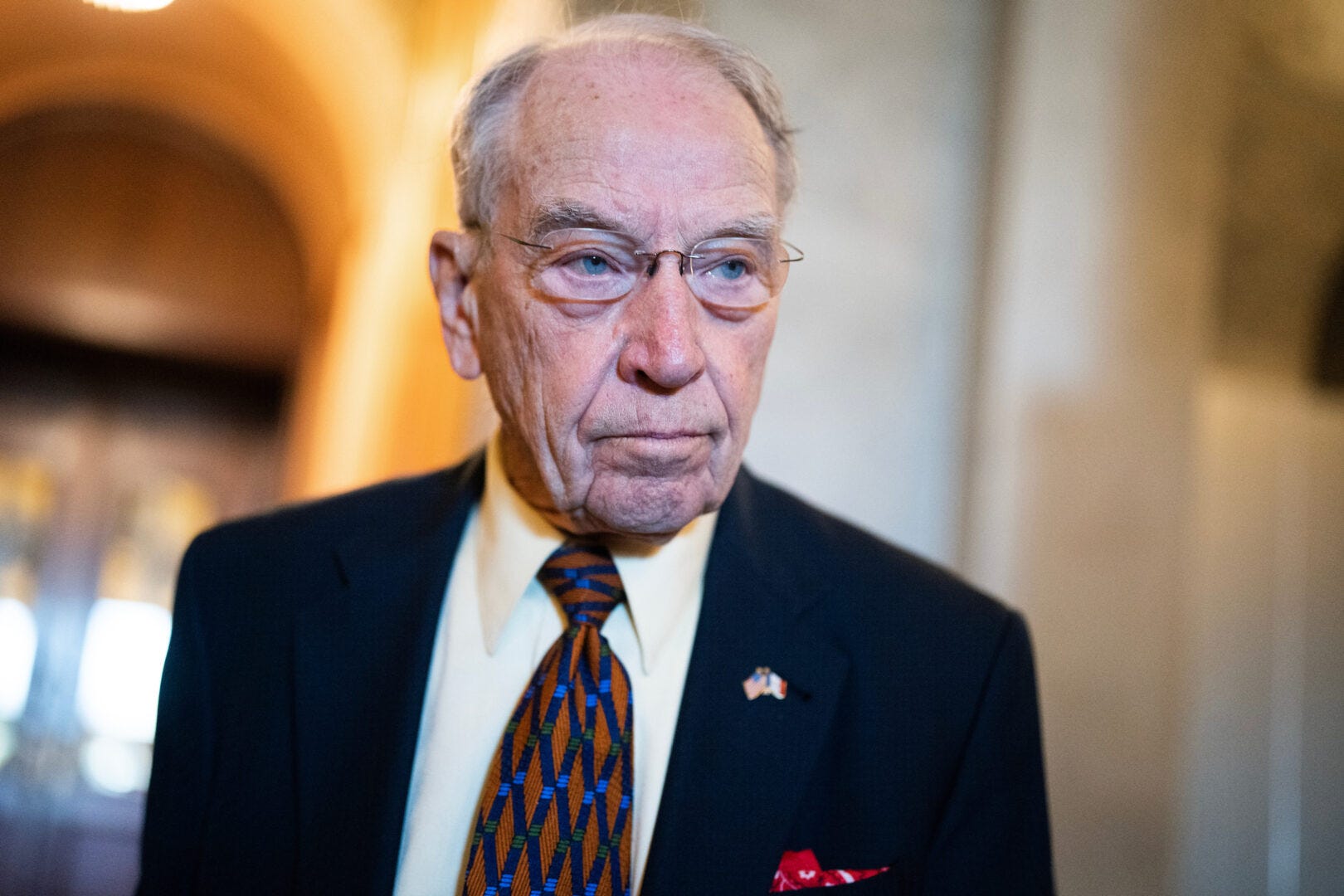
Chuck Grassley turns 93 today. He has been in public office since Eisenhower was president, has held his Senate seat since 1981, and is the longest-serving Republican senator in the history of the chamber. He is third in the line of presidential succession. From January 1975 through July 2025, he missed 51 of 15,637 roll call votes, which is three tenths of one percent, and no other entry in this Registry can claim a work ethic remotely like it.
For most of that career, he was known above all for one thing: inspectors general.
Inspectors general are the federal government’s internal auditors, placed inside each agency to find waste, fraud, and abuse, and structured to insulate them from the officials they investigate. Grassley spent four decades building the legal architecture that protects them. He played a central role in the 2008 and 2016 statutes that strengthened the community. His own bill in the 117th Congress became the basis for the Securing Inspector General Independence Act of 2022, which wrote into law the requirement at the center of this entry: that a president give Congress thirty days’ notice and substantive, case-specific reasons before removing an inspector general.
At the time, he explained precisely why it mattered. When making the decision to remove an inspector general, he said, presidents must send substantive, specific reasons to Congress in advance, explaining the actions they are taking and why.
A former chairman of the inspectors general council once called him, in print, the community’s patron saint.
The defining moment
On the night of January 24, 2025, four days into the second Trump administration, inspectors general at seventeen federal agencies received two-sentence emails informing them they had been removed. An eighteenth followed. Among the agencies were Defense, State, Veterans Affairs, and Agriculture. Congress received no thirty-day notice. No case-specific reasons were given for any of them. None of the officials had been accused of ineffectiveness or misconduct.
The law Grassley wrote was broken, in a single night, seventeen times.
His response came four days later, on January 28, in the form of a letter to the president co-signed with Dick Durbin. The letter noted that Congress was not provided the legally required thirty-day notice and case-specific reasons, requested that information immediately, and observed that this was a matter of public and congressional accountability.
The administration took eight months to respond to it.
In the interim, Grassley, as chairman of the Senate Judiciary Committee, continued moving the president’s judicial nominees and United States attorney nominees through his panel at pace. There were no holds. There were no hearings on the firings. There was the letter.
The record he set himself
What convicts Grassley here is not that he failed to stop the firings. No single senator could have. What convicts him is that he had spent forty years demonstrating exactly what he would do in this situation, in writing, on the record, and with the same tools still sitting on his desk.
When Barack Obama fired the inspector general of the Corporation for National and Community Service and offered only a general explanation, Grassley blocked one of Obama’s agency nominees until he got answers.
When Joe Biden fired the inspector general of the Railroad Retirement Board, Grassley demanded additional information.
When Trump, in his first term, fired Intelligence Community Inspector General Michael Atkinson and removed several acting inspectors general, Grassley used procedural measures to block Senate action on two presidential nominees, delivered a floor speech calling for stronger statutory protections, and then went and wrote them.
That is the pattern, and it is unbroken across three presidents and both parties: identify the violation, take a nomination hostage, extract the answer, and if the law proved too weak, strengthen the law. It worked. It is why he had the reputation he had.
And in 2020, from the Senate floor, he said the quiet part loudly and in advance. He would continue to champion inspectors general, whistleblowers, and robust government accountability regardless of who occupies the White House or has the majority in Congress. He added that no amount of shrieking from Twitter resisters or shortsighted and misguided pundits would change that.
That sentence is the gate clearance for this entry. He did not merely hold a position he later abandoned. He anticipated the accusation, named the critics who would make it, and rejected it in advance.
In January 2025, his public comment was that there may be good reason the inspectors general were fired, and that we need to know that if so.
Mark Greenblatt, the Interior Department inspector general whom Trump himself had appointed in the first term and who was among those fired, described the change in one phrase. He said he was disappointed by Grassley’s soft touch, from a man who had previously been a battering ram.
The downstream cost
On September 24, 2025, Judge Ana Reyes of the federal district court in Washington ruled the firings unlawful, writing that the violation of the act was obvious, that Congress was not notified in advance, and that no rationale of any kind was provided. She declined to reinstate the plaintiffs, noting the president could simply re-fire them after providing the required notice.
Weeks after that ruling, the administration fired the inspector general of the Export-Import Bank the same way, again without notice and again without a stated rationale. The ruling changed nothing, because nothing was attached to it.
In September 2025, the administration attempted to shut down the Council of the Inspectors General on Integrity and Efficiency, the coordinating body that runs the public oversight database, publishes the vacancy list, hosts the hotlines, and trains the staff, by simply declining to apportion its funding. Grassley objected, alongside Susan Collins, that the move defied congressional intent. The Office of Management and Budget subsequently released a fraction of the money.
By the end of 2025, another ten inspectors general had been fired or had resigned. Fifty-five percent of the thirty-eight presidentially appointed inspector general positions were vacant. Across all seventy-two federal inspector general posts, there were twenty-nine vacancies. Office staffing was down roughly twelve percent overall and by as much as thirty percent in at least one office.
One detail from the original purge deserves to be stated on its own. Phyllis Fong, the inspector general at the Department of Agriculture, was conducting an investigation into a company owned by Elon Musk when she was removed.
The forty years of architecture was ignored rather than defeated, and the man who built it declined to enforce it.
Tuesday
Which brings this to three days ago, and to the reason this entry runs now rather than later.
On Tuesday, September 15, the Senate Judiciary Committee held an oversight hearing on the FBI. Grassley chaired it. It ran nearly five hours.
Senator Cory Booker used his time to press FBI Director Kash Patel on whether the bureau had investigated Elizabeth Williamson, the New York Times reporter who wrote about the SWAT detail assigned to Patel’s girlfriend, and on Booker’s allegation that Patel had told a grand jury no journalist was under investigation. Patel did not answer. Booker pressed. Patel called him the biggest mockery in the Senate. Booker said the bureau has no director, only a lackey.
Grassley, gaveling, asked his colleague whether he was ready to shut up. He then intervened to give the witness additional time to respond, which the witness used to talk at length about leakers of classified information rather than about the question asked.
The clip traveled as a shouting match between an old man and an angry one. What it actually was is the chairman of the Senate Judiciary Committee using the chair’s authority to shield a witness from an oversight question, in the committee whose entire function is oversight, forty-eight hours before the birthday of the senator who spent his career insisting that oversight was the job.
It was also not unusual. That is the point of including it. Grassley has presided over confirmation hearings for this administration’s nominees throughout, including the appointment of the president’s former personal defense attorney to run the Justice Department, and has been a reliable vote for the caucus while doing it.
In fairness
Two arguments deserve to be answered rather than ignored, and the entry is weaker if they are left out.
The first is that Grassley still does oversight, and this is true. Current and former aides point to a continuing volume of letters, inquiries, and whistleblower work, and to the fact that he objected publicly to the attempted defunding of the inspectors general council. He is 93 years old and still showing up every day, which is more than can be said for several younger colleagues, and silence is not the charge here.
The second is that critics hold him to a standard they apply to nobody else. Very few Democrats openly defied Joe Biden, and the senators demanding that Grassley break with his president were rarely conspicuous in breaking with theirs. The point is fair and belongs on the record.
Neither argument saves him, for two reasons.
The standard being applied to Grassley is the one he wrote himself, published, and dared his critics to hold him to. He did not say he would defend inspectors general when convenient. He said regardless of who occupies the White House, and he pre-emptively dismissed anyone who would later doubt him. A man who sets his own test does not get to object that he is being graded on it.
And the tools were not theoretical. He had used them, repeatedly, against presidents of both parties, and they worked. A hold on a judicial nominee in February 2025 would have cost him something and would have been noticed. He chose the letter, and the letter was ignored for eight months, and the nominees moved through his committee the entire time.
The question nobody will ask him on his birthday
One uncomfortable matter remains, and most coverage handles it by ignoring it. The entry is dishonest without it.
Grassley was first elected to office in 1958, at twenty-five, during the Eisenhower administration. He entered the Senate in 1981. He was re-elected in 2022 at eighty-nine, by twenty-seven points, and has never taken less than sixty percent in any race but his first. He has been president pro tempore since 2025, which places him third in the line of presidential succession. Asked whether he will run again in 2028, when he would be ninety-five, he has said to ask him in a couple of years and has not ruled it out.
This publication does not diagnose people from a distance, and it will not start here. Nobody outside his family and his staff knows what ninety-three years has or has not done to Chuck Grassley, and the man’s attendance record is better than that of colleagues a third his age.
But the charge in this entry is that he chose, and choosing is what makes a coward rather than a casualty. That framing produces a fork with no comfortable branch.
If he chose, then a senator who spent forty years building the machinery of federal oversight watched it dismantled and elected to send a letter instead of doing what he had done to three previous presidents, and this entry is correctly filed.
If he did not choose, if what changed is capacity rather than will, then the third person in the American line of presidential succession, the chairman of the Senate Judiciary Committee, the man who sets that committee’s agenda and controls its gavel, is not equal to the office he holds, and the people around him have known it and said nothing.
Only he can say which one it is, and he will not be asked, because asking is considered rude and because the answer is inconvenient to a party holding a one-seat majority.
The verdict
This Registry has documented men who criticized Trump and then folded, men who folded and then criticized, and men whose professional expertise gave them unique standing to refuse. Grassley establishes a new variant, and it is the starkest one yet.
He is the architect. He did not merely hold a principle and abandon it. He translated the principle into statutory language, passed it, explained to the public what it required, and then declined to enforce it when it was broken seventeen times in one night by a president of his own party. The thirty-day notice provision exists because of him. Its violation went unanswered because of him.
He also held his position the entire time, which is the part that separates this entry from most of the others. Grassley still says he champions inspectors general, and would say so today if asked, and might even believe it. He simply stopped using the instruments, and he is the man who forged them.
Forty years of building a machine, and then standing beside it, at the controls, with the authority to run it, while it was dismantled in front of him.
He is 93 today. Fifty-five percent of the watchdog posts he spent his career protecting are vacant.
This is very disturbing. If he’s giving trump a free ride? He’s got to go. How sad that this man had such dedication and then lost it on such a blatant action. This has to stop. And he needs to go and the truth needs to be shared with everyone. WHY. Why did he do this to his country and himself
This is so vastly out of character for Grassley that the question simply must be asked. For decades, he has been consistent in his actions and beliefs ... sometimes exasperating, sometimes noble, but always consistent (and insistent).
So it must be one of two possible explanations. Either he has undergone serious diminishment in cognitive ability, or he has been somehow bought off or compromised.
Neither of those bodes well for him, and neither bodes well for our nation.