


She is the first Democrat admitted to these Files, and the admission is the point. The series does not indict a party. It indicts the people who held the information, the platform, and the decisive moment, and chose to stand aside, and a registry that could only ever name Republicans would be a partisan exercise rather than an honest one. Kyrsten Sinema earned her place on the merits, and her case happens to be the cleanest demonstration the series has yet produced of how far a person can travel from the self that started out.
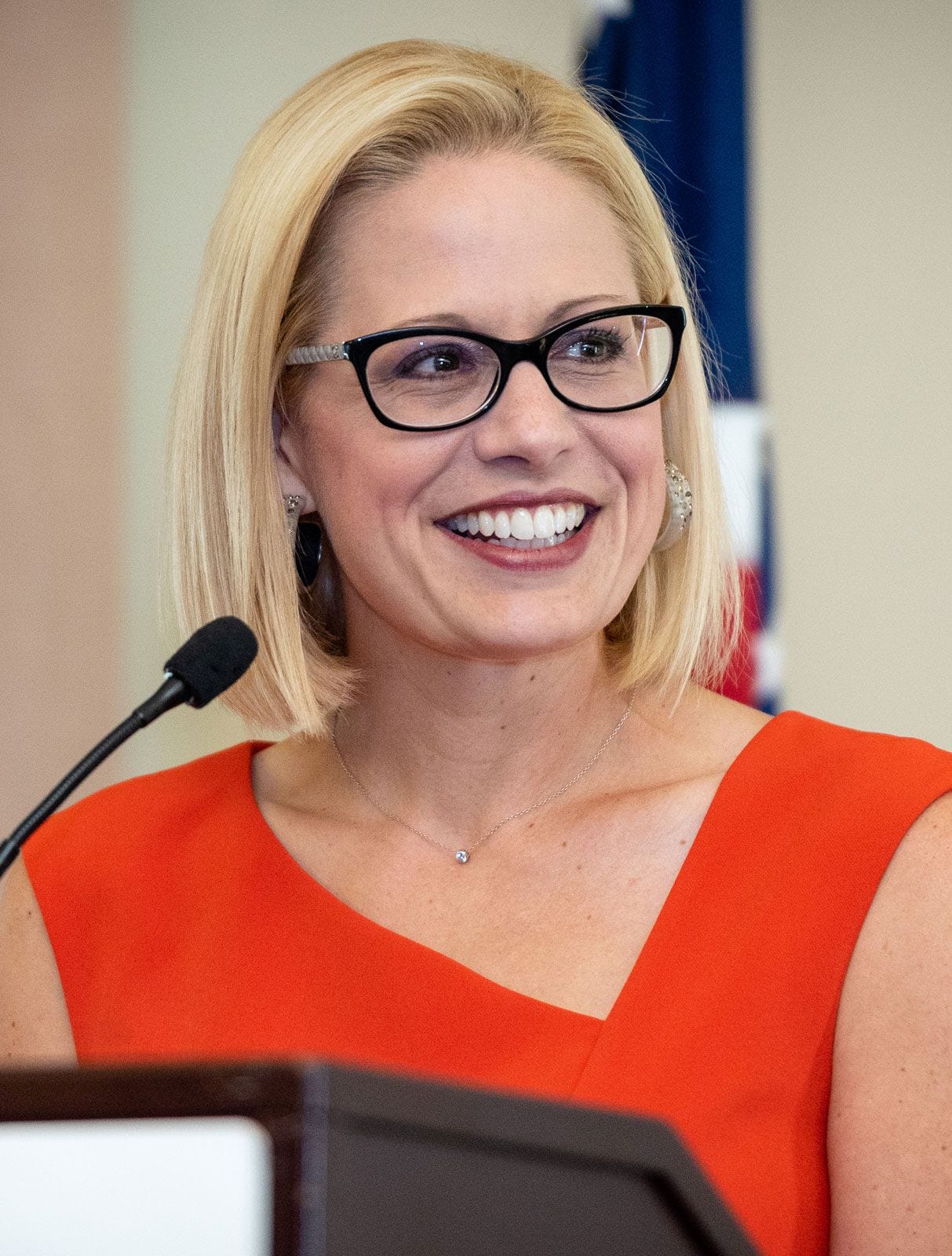
Because she did not come up through the institutions she would later protect. She came up against them. Kyrsten Sinema began her political life as a Green Party activist and antiwar protester in Arizona, a figure of the genuine left who ridiculed centrist Democrats of the Joe Lieberman variety as sellouts and worked the grassroots on climate and poverty, and the franchise. As recently as 2014, she was telling the public, in writing, that raising the minimum wage was a no-brainer, that a full-time worker earning the minimum could not clear sixteen thousand dollars a year, that the case was closed. The distance between that woman and the senator she became is the widest arc on this Registry, and the arc is the reason she is on it.
The defining moment arrived on January 13, 2022, in a Senate split fifty to fifty, where her vote was one of the two that would decide whether the chamber could set aside the filibuster long enough to pass federal protection for the right to vote. She walked onto the floor and delivered a speech defending the sixty-vote threshold, which she described as a guardrail, a tool that forces federal policy to be broadly supported before it can pass. She said she supported the voting rights bills themselves. She would not change the rule that was the only thing killing them. She delivered this to a chamber in which exactly two of her Democratic colleagues had bothered to sit and listen, and she delivered it hours before the president of her own party arrived at the Capitol to plead with the caucus for the votes she had just announced she would not provide. She had the vote. She knew precisely what it was holding up. She spent it on the rule.
The receipts run in a straight line from the activist to the obstruction. In March 2021 she walked onto the same floor to vote against including a fifteen-dollar minimum wage in the pandemic relief package, and she did it with a theatrical thumbs-down and a small curtsy that read, to the millions who watched it, as something close to glee, a performance of the no rather than a casting of it, from the same woman who had called the raise a no-brainer seven years before. On January 19, 2022, six days after her filibuster speech, the rules change failed fifty-two to forty-eight, with Sinema and Joe Manchin joining every Republican in the chamber, and the Freedom to Vote Act and the John Lewis Voting Rights Advancement Act died on a vote of forty-nine to fifty-one. Mitch McConnell, who had spent a career using the filibuster to strangle exactly this kind of legislation, rose to praise the two Democrats for their “courage.” Her own state party censured her. That summer, she went to the wall to protect the carried-interest loophole and to block an increase in the corporate tax rate, defending the tax treatment of hedge fund managers while special interests poured millions into her accounts. In December 2022, she left the Democratic Party and registered as an independent, a move that spared her a primary she was widely understood to be unable to win, and in March 2024, she declined to seek reelection at all, announcing that compromise had become a dirty word and that her approach, whatever else could be said for it, was not what America wanted.
The transformation did not occur in a vacuum, and the documentary record of who funded it belongs in the file. As Sinema moved rightward across her single term, she became, in the reporting of the period, beloved by Republican politicians and by the special interest groups who poured millions into her accounts and ran television advertisements praising her independence. Senator Elizabeth Warren would later summarize the back half of her tenure with a brutal economy, saying Sinema had spent it protecting hedge fund managers from paying taxes and blocking filibuster reform. The independence she branded as a principled refusal of party tribalism tracked, vote by vote, with the stated priorities of the donors who had found her.
The cost is measured in what died on the floor that January and in everything that has happened to the franchise since. The bills she helped kill were not symbolic. The Freedom to Vote Act would have set national standards for ballot access, banned partisan gerrymandering, protected local election officials from removal for political reasons, established automatic voter registration, and forced disclosure of dark money. All of it died, and in the years that followed, state after state moved in the opposite direction, tightening access, seizing partisan control of election administration, and leaving the right to vote precisely as exposed as it had been the morning she rose to defend the rule. She had called the filibuster a guardrail that protects the country from radical swings of power. The radical swing arrived anyway, on schedule, and the guardrail she protected guarded nothing against it, while the protections she helped destroy were among the few locks that might have slowed it. The seat she vacated went to Ruben Gallego, the Democrat she left the party rather than face, which means the only thing her stand ultimately preserved was the rule itself.
Kyrsten Sinema had traveled further to reach the right side of this question than anyone else in this Registry, and she chose the wrong side anyway. The activist who once told the country that a living wage was a no-brainer curtsied against it on the Senate floor, and the woman who came up fighting the enemies of the franchise cast the vote that left the franchise undefended at the moment it could still have been saved. She called it independence. She called it civility. She protected the rule and surrendered the right, and when the danger the rule was supposed to stop came through the door she had left open, she had already gone home.

Bought and paid for.