


Willard Mitt Romney arrived in the United States Senate in January 2019 carrying a résumé that set him apart from every other figure this series will examine. He had been the governor of Massachusetts, the man who rescued the 2002 Winter Olympics, the Republican nominee for president in 2012, and the son of a governor and cabinet secretary who had walked out of the 1964 Republican convention rather than endorse Barry Goldwater. He was wealthy beyond any need for the office. He was, by the standards of his party and his moment, a man with nothing left to prove and very little left to lose. He cultivated, across his single Senate term, the role of the conscience of a vanishing Republican center, the elder statesman who would say the thing his colleagues would not.
The distinction worth establishing at the outset is that Romney earned the role honestly. Unlike the others admitted to these Files, the gap in his case is not between a public claim and a private record. For most of his term the public claim and the conduct matched. He said Donald Trump was a danger to the Republic, and then he voted as though he believed it, at a moment when no other Republican in the chamber would. That is what makes his case the hard one, and it is why the series cannot skip him. The cowardice in the Romney file is not in the seeing and not in the saying. It is in what he did with the enormous standing that the seeing and the saying had earned him, at the one moment the standing could have mattered most.
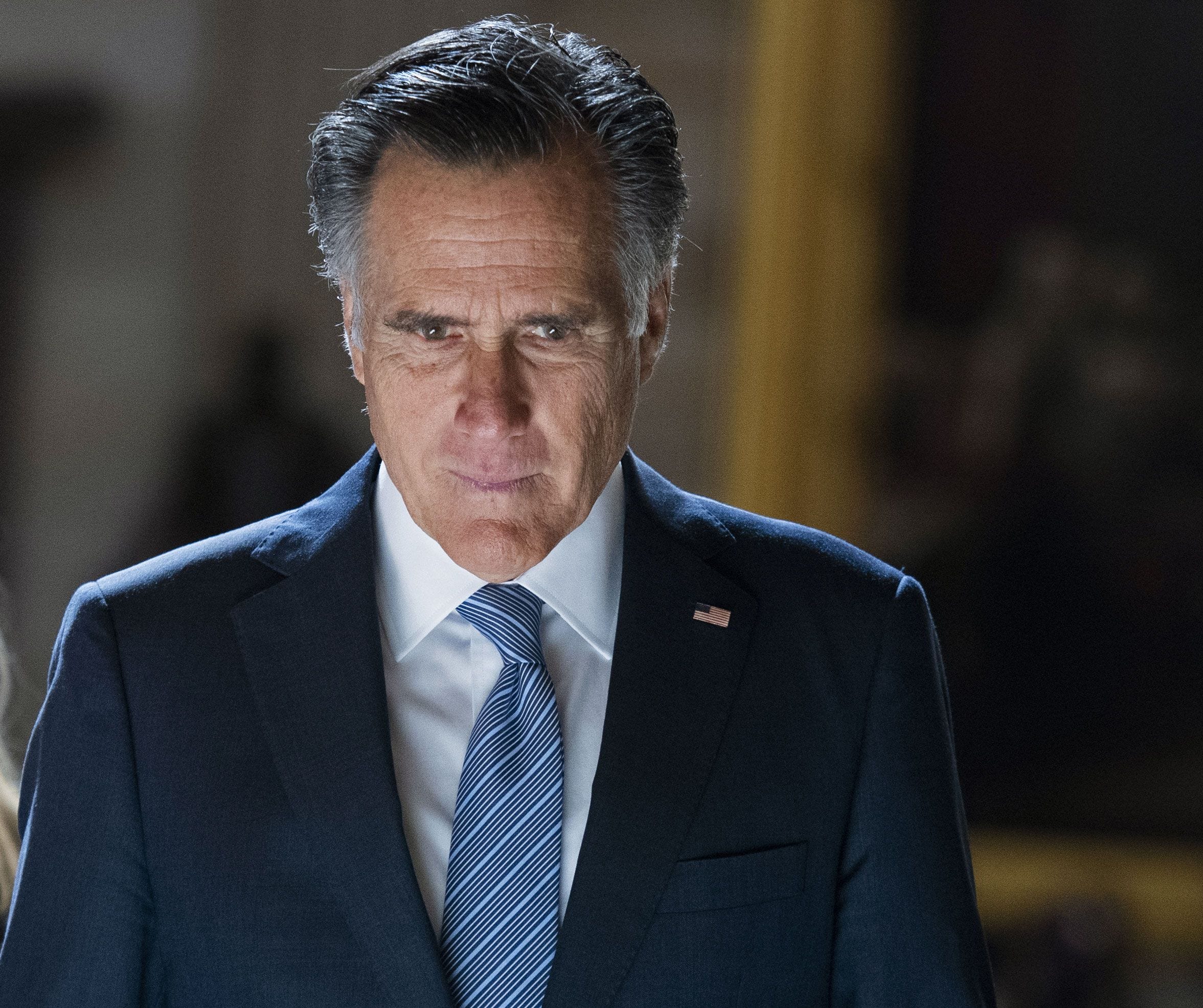
Tom Williams / Congressional Quarterly / Zuma
The defining moment is not an act of courage. It is the refusal that came after the courage was spent. On October 8, 2024, at the Hinckley Institute of Politics at the University of Utah, an audience member asked Romney directly what was stopping him from endorsing Kamala Harris, the only candidate on the ballot who could keep Donald Trump out of the office Romney had twice voted to remove him from. Romney, who was retiring and would never face another Utah primary, who held no future to protect and no donor to placate, declined. He explained the calculation in plain terms. He wanted, he said, to keep a voice in the Republican Party after the election, and he believed he would have more influence in that party by withholding the endorsement than by giving it. The most credible anti-Trump Republican alive, uniquely free of every constraint that bound his colleagues, looked at the binary choice in front of the country and chose to preserve his future standing in the party he had already diagnosed as lawless.
The receipts behind that moment are a record of genuine bravery followed by its careful rationing. On February 5, 2020, Romney became the first United States senator in history to vote to convict a president of his own party, voting guilty on the first article of Trump’s first impeachment. He delivered an eight-minute floor speech, invoked the oath he had sworn before God, called Trump’s conduct an appalling abuse of public trust, paused for eleven seconds to keep his composure, and said he would tell his children and their children that he had done his duty to the best of his ability. On February 13, 2021, he did it again, joining six other Republicans to convict Trump for inciting the January 6 attack on the Capitol. In September 2023, in an excerpt from McKay Coppins’s biography published in The Atlantic, Romney delivered the most candid diagnosis any sitting Republican has offered of his own party, stating that a very large portion of it does not believe in the Constitution. Days later, on September 13, 2023, he announced he would not seek reelection, citing his age and the need for a new generation, and saying he would leave office in January 2025. He did not vote for Trump in 2016, 2020, or 2024. He wrote in his wife’s name in 2016. And in October 2024, having seen all of it and named all of it, he weighed an endorsement that might have moved Latter-day Saint voters in the states that decided the election and concluded that his influence was better spent on himself.
The comparison that completes the indictment is with the people who did what Romney would not. Jeff Flake, the former Arizona senator, a fellow Latter-day Saint and Brigham Young University graduate, endorsed Harris outright. Liz Cheney, who had already lost her House seat for opposing Trump, campaigned alongside Harris in the battleground states. Dick Cheney, the architect of the modern Republican security state, declared that no individual in the nation’s history had posed a greater threat to the Republic, and voted for the Democrat. Each of them paid a price that Romney was spared, the loss of a seat, the fury of the base, the formal excommunication from the party. Romney, who faced none of those costs because he had already arranged to leave, decided that the better use of his freedom was to hold it in reserve. The people with everything still to lose crossed the line. The man with nothing left to lose stood on it and explained, calmly, why he would not.
The cost arrived on schedule and is now the governing condition of the country. Romney left the Senate in January 2025. His seat passed to John Curtis, a milder Republican whose less confrontational posture was widely read as a measure of how far the traditional party’s resistance to Trump had already softened. The internal opposition that Romney was uniquely positioned to anchor never formed, because the man best equipped to anchor it had retired to protect a future role in a party that no longer had room for the role. The diagnosis he published in 2023 has since been confirmed in full. The party that he said did not believe in the Constitution now governs without a single credible check from within its own ranks, and it has used the year to remake the Justice Department into an instrument against the president’s adversaries, to stand up a fund to pay the people who attacked the Capitol, and to open a criminal investigation into a woman whose only offense was winning a civil verdict against the president. Romney observes all of this as a private citizen, offering the occasional measured remark, his preserved influence amounting to nothing, because there is no post-Trump Republican Party for that influence to operate in. There is only Trump’s, exactly as he warned, and exactly as he declined to fight when fighting was free for him and ruinous for almost everyone else.
Romney saw it first and named it loudest and voted on it twice, and that is precisely why his failure is the one that should be hardest to forgive. The others on this list can at least claim they were trapped, that the primary would have ended them, that the donors would have fled, that the base would have turned. Romney faced none of those constraints and still found a reason to stand down at the decisive hour. The courage that carefully reserves itself for the moments that carry no cost is not courage. He told his children he had done his duty, and then he decided the duty was to bear witness, and he left the fighting to the people who could not afford the ticket.
Excellent article. Valid arguments I hadn’t thought of. I suppose Romney could have just misjudged the utter and complete destruction of the Republican Party.