


The comparison has been made before, but never carefully.
People reach for it at parties, in the casual way that people reach for any handy insult, and then they move on to another subject without doing the work. This is a failure of scholarship. The resemblance between Donald Trump and a slice of bologna is not a throwaway line. It is a correspondence so precise, so load-for-load exact, that one begins to suspect the deli case of prophecy.
What follows is an attempt to treat the matter with the seriousness it has always deserved.
On Composition
Bologna is an emulsion.
This is the essential fact and everything else proceeds from it. Bologna is not a cut of anything. It is an assemblage of trimmings, scraps, and what the federal regulations charmingly designate as variety meats, ground so finely that no original component can be identified by sight, taste, or laboratory analysis. There is no bologna animal. There is no part of a cow that is the bologna part. It is a substance assembled from whatever was in the vicinity and then processed past the point where the vicinity can be reconstructed.
Consider now the man. There is no fixed position anywhere in him. He has been pro-choice and anti-abortion, a Democrat and a Republican and a Reform Party candidate, an isolationist who bombs people, a populist who cuts taxes for the top bracket, a man who called for the Federal Reserve to lower rates and also to raise them, sometimes in the same week. Pick any conviction and you will find its opposite in the archive, delivered with equal certainty, and the two will not have been ground together into a synthesis. They will simply both be in there, unidentifiable, suspended in the emulsion.
Ask what he actually believes and you are asking which animal the bologna came from. The question assumes a structure that the product does not possess.
On the Word Itself
The language arrived at this conclusion long before we did.
“Baloney,” meaning nonsense, meaning empty assertion, meaning something offered as substance which contains none, entered American slang in the 1920s and has never required revision. English speakers took one look at the product, understood immediately what it represented, and assigned it to the category of confident falsehood. We have been describing him with the word for a century. We simply had not yet located the referent.
On Ancestry
Bologna descends from mortadella, which is a genuine achievement.
Mortadella is made in Bologna, Italy, under protected designation, according to methods refined across centuries, studded with pistachios and cubes of fat, cured with patience by people who take it seriously. It is a delicacy. It commands a price. It is what happens when craft is applied to a hard problem over a very long time.
What crossed the Atlantic and settled in the American refrigerator case is the descendant of that. Each generation a little cheaper. The pistachios gone. The craft gone. The name shortened. The price collapsed. Whatever discipline the original required was discarded by heirs who understood that the reputation would carry a while on its own, and it did carry, for a while, which is the tragedy of all inherited names.
At the end of that lineage is a pink disc in cellophane, bearing a proud Italian city’s name and no relationship to it whatsoever.
I decline to elaborate.
On the Casing
Every slice arrives wrapped in a thin red band.
The band is not food. Nobody eats the band. It exists to give the product a defined edge, to hold the shape, to suggest by its color a vigor the contents do not possess. It is peeled off and thrown away before consumption, and it is the only part of the object with any structural integrity.
He is orange rather than red, but the principle is identical, and the application is applied with a similar industrial confidence to a surface that has nothing to do with what lies beneath it.
On Uniformity
Cut a slice of bologna in half and examine the cross-section. It is the same pink throughout. Cut those halves in half. Same pink. There is no marbling, no grain, no interior structure, no point at which the material becomes something other than what it was at the surface. The outside is a complete and honest preview of the inside, which is the single most admirable quality bologna possesses and one it shares with the subject entirely.
He has no private self. There is no version of him that appears in unguarded moments and differs from the public product. Every memoir by every aide reports the same man in the room as the man on the podium. Depth would require a second layer, and there is no second layer, and expecting one is the error that has misled every columnist who ever wrote that this time he would pivot.
He is the same all the way through. Thinly.
And note that the slicing has gotten thinner. Every year the deli sets the blade a little finer, and the product becomes more translucent, and you can begin to see the counter through it.
On Preservation
Bologna does not spoil on the schedule that meat spoils on.
It is packed with sodium nitrite, sodium erythorbate, and a supporting cast of compounds whose function is to prevent the natural process by which organic material acknowledges the passage of time. A slice left in a refrigerator for six weeks will appear, to the untrained eye, unchanged. It is not fresh. It has simply been chemically instructed not to disclose its condition.
I have written elsewhere at length about the puzzle of a seventy-nine-year-old man who eats exclusively from paper bags, sleeps four hours, and has been documented falling asleep at his own job on at least thirteen occasions, and who nonetheless persists. I offer the bologna model as a contribution to that literature. The preservation is not health. The preservation is chemistry, applied from outside, doing the work that vitality would ordinarily do from within.
On Behavior Under Heat
Place a slice of bologna in a hot pan and it will not lie flat.
The edges contract faster than the center, and the center has nowhere to go, so it rises. It domes. It inflates into a swollen pink hemisphere that lifts away from the surface entirely and touches nothing. Cooks solve this by cutting slits in the perimeter before applying heat, which allows the pressure to escape, and if you do not cut the slits the bologna will simply puff up and refuse to make contact with the pan.
I invite the reader to consider what happens to this man under pressure, and whether he has ever once responded to it by lying flatter.
On the Bread
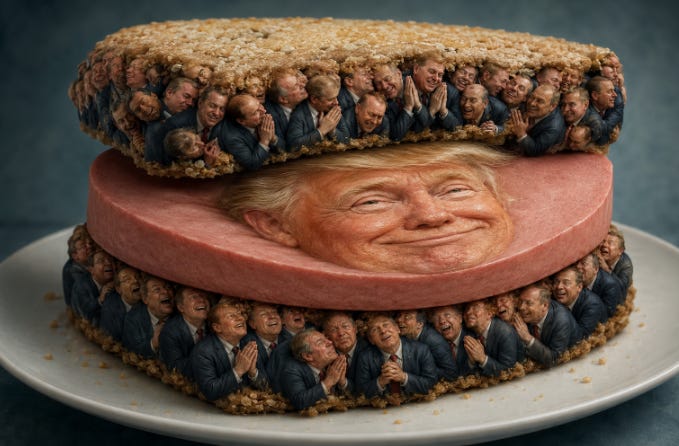
We come now to the sycophants, and to the structural question they exist to answer.
A slice of bologna, on its own, cannot be carried. It cannot be handed to anyone. It is cold, slick, and structurally incapable of supporting itself, and anyone who picks it up bare-handed is immediately confronted with the reality of what they are holding. The entire function of the bread is to solve this problem.
White bread, specifically. Not a loaf with character. Not anything with a crust worth the name or a crumb that varies from slice to slice. Mass-produced, uniformly rectangular, engineered for compliance, soft enough to compress to nothing under the slightest pressure and to spring back the moment the pressure lifts.
Observe the properties.
Interchangeability is total. Any slice may be swapped for any other slice with no effect on the sandwich. The bread does not have a name. It cannot be identified after the fact. Ask someone what bread was on a sandwich they ate last Tuesday and they will not know, and this is not a failure of memory.
Absorption is the second function. Whatever leaks out of the filling goes into the bread, and the bread accepts it, and the bread does not complain, and over time the bread becomes saturated with the character of the thing it was assigned to contain. A slice of bread that has spent long enough against bologna is no longer bread in any meaningful sense. It is a delivery mechanism that has taken on the flavor of its cargo.
Third, and most important: the two slices never touch each other. They are oriented entirely toward the filling. Top and bottom, facing inward, in identical posture, each pressed against the same pink disc, each unable to reach the other. They are not colleagues. They have no relationship. They have a shared object of attention and nothing else, and if you removed the bologna they would fall against one another and discover they had nothing to say.
Fourth, the bread does not choose. It has no input regarding what is placed on it. It is assembled around whatever is available, and its whole civic identity consists of having been selected.
And fifth: bread goes stale in position. It does not rot dramatically. It hardens, quietly, holding its shape, becoming less and less like food while remaining perfectly sandwich-shaped, until one day somebody picks it up and it cracks.
Findings
The sandwich is not anyone’s first choice.
Nobody dreams about it. Nobody orders it in a restaurant. It is eaten because it was in the house, because it was cheap, because the person eating it was not paying attention at the store and by the time they got home it was what they had. It is the sandwich of resignation, and it is defended most passionately by people who ate it as children and have decided that any criticism of it is an attack on their upbringing.
The comparison, then, holds at every point tested. Composition, ancestry, casing, uniformity, preservation, response to heat, and supporting architecture.
There is one respect in which it fails, and rigor requires me to state it.
A slice of bologna, whatever else may be said about it, cannot be handed the nuclear codes, cannot appoint federal judges, cannot order federal agents to a critic’s home, and cannot stand in the East Room and threaten to revoke a broadcast license it does not understand the ownership of.
In every other particular, the bologna acquits itself well.
And it should be said, in the interest of completeness, that somebody still has to eat the sandwich.
That part has always been us.
This is fabulous. You have perfectly captured the scientific and linguistic rigor needed to describe baloney and its bread accompaniment. I salute you.
Bravo, sir! Your baloney sandwich is the genuine article!