


Before dawn, somewhere in the western United States, in October 2023, a federal law enforcement officer pointed a spotlight into the desert.
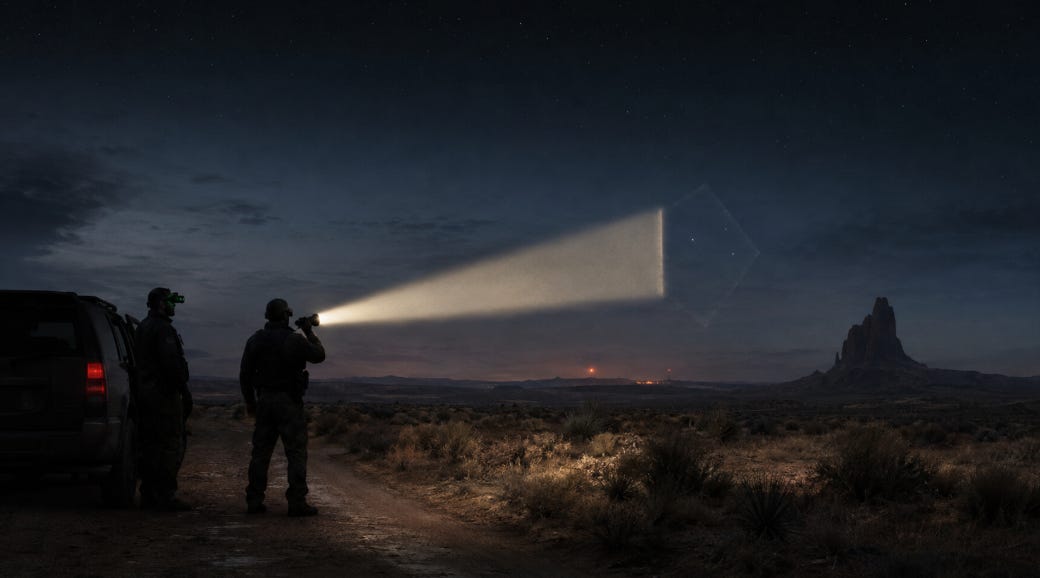
He was looking for something he and his partner had been watching for several minutes. It was kite-shaped, about six meters off the ground, canted at an angle, drifting with the wind. Through night-vision goggles his teammate could see one or two stars through it, which is why the report he later filed describes the object as somewhat transparent.
He put the beam on it.
In his own words, taken down and eventually published by the Department of War, the light went from shining far into the distance to stopping about fifty yards away on nothing in particular. It just was not projecting into the distance, and then it was.
He moved the spotlight off and put it back on the same spot a moment later. This time the beam went through and kept going, out across the desert, the way a spotlight does.
They did not reacquire the object.
That account, and six others like it, sit in a thirteen-page slide deck the Pentagon published on May 8, 2026 under a program called PURSUE, the Presidential Unsealing and Reporting System for UAP Encounters. Of the 161 records in that first release, exactly one carried a title instead of a serial number.
It is called the Western US Event, and the Department’s own assessment of it is that it is among the most compelling within AARO’s current holdings.
Who was there
AARO is the All-domain Anomaly Resolution Office, the Pentagon’s standing shop for investigating unidentified anomalous phenomena. The agents in this case are not pilots and they are not enthusiasts. They are seven federal law enforcement special agents, identified in the documents only as USPER1 through USPER7, working in three two-person teams with a seventh who joined for the last encounter.
They were operating near a sensitive national security site. The location is redacted. What can be reconstructed from the reports is that there was a road, a restricted zone, open desert, and a rock pinnacle.
Over two days they reported four distinct categories of sighting. The Department grouped them under headings that read like nothing else in the federal record.
Orbs Launching Orbs. Large, Fiery Orb. Dark Kite. Transparent Kite.
Day one, at dusk
The first category is the one the case is named for in the press, and it is the one where the corroboration matters most.
At dusk, on two separate days, three teams positioned at different locations with different vantage points independently described the same sequence.
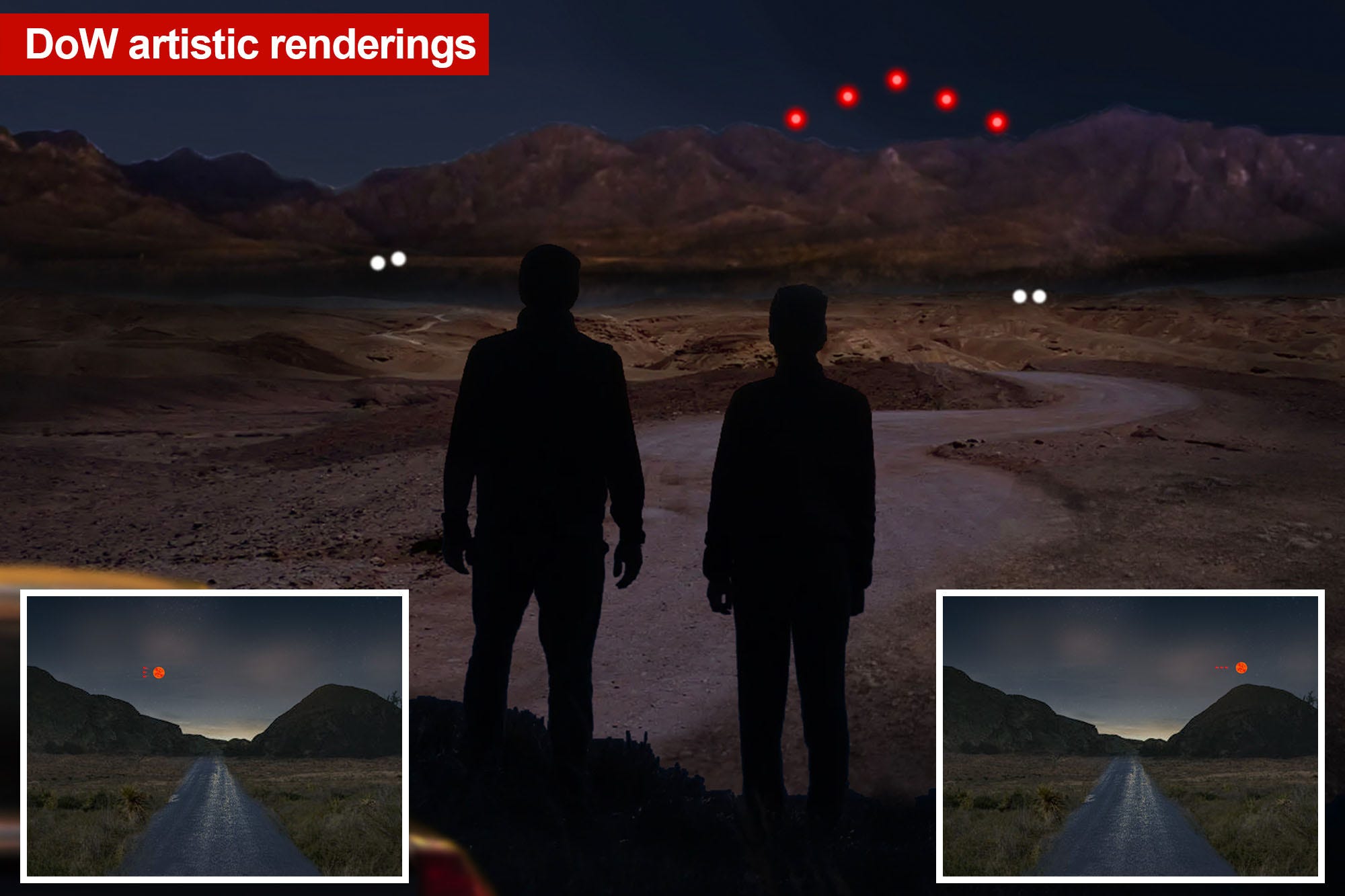
An orange orb appears. It is visible for one or two seconds. It releases a cluster of two to four smaller red orbs, and the witnesses converged on three as the typical number. Then the orange one disappears.
The red orbs generally moved away horizontally. One witness reported that occasionally one would swoop down. Another described one heading up at an angle. AARO’s own analysis notes that the reporters characterized the behavior as anomalous, with varied kinematic profiles including seemingly coordinated horizontal motion and apparent changes in altitude.
It happened one after another, multiple times, over a period of several hours.
The agents could not determine whether they were watching a single orange orb reappear repeatedly, or a series of different ones. The reports refer to it as a mother orb, with quotation marks, because that is what the witnesses called it and the Department preserved their language.
One agent’s account includes his partner turning to him and asking: are you seeing this?
The rock pinnacle
The second encounter involves two agents, USPER5 and USPER6, and a stationary glowing orange object near a rock pinnacle.
They estimated it was five hundred to six hundred meters away and roughly the size of a small helicopter cockpit. It hung there for about a minute. It made no sound.
AARO’s later reconstruction of the geometry put it at roughly 1,050 meters distant and between twelve and eighteen meters across. That is a substantial revision upward, and it is worth pausing on, because it cuts both ways. It means the witnesses misjudged the scale of what they were looking at, which is what happens to human beings estimating size at night against no reference. It also means that if the object was where AARO’s measurements place it, it was considerably larger than a helicopter cockpit.
One of the two agents, trying to describe the appearance to investigators, said it looked like the Eye of Sauron, except without the pupil. Then he offered a second comparison, and the Department wrote that one down too. Or maybe, he said, an orange Storm Electrify bowling ball.
I have thought about that sentence more than any other in the file. It is the sound of a trained federal officer, on the record, in a formal interview, reaching for two completely incompatible references because neither one is right and he knows it, and giving investigators both so they can triangulate.
That is what an honest witness sounds like. It is not what a fabricator sounds like.
The car that left the road
Pre-dawn, same area. Two agents saw what they took to be a vehicle traveling along a road inside a restricted zone. One red light, one white light, sitting two to three feet off the ground. They moved to intercept it.
At a few hundred feet, the car left the road sideways.
It did not turn. It did not change orientation. It went off the shoulder laterally, still facing the same direction, and glided out over the desert at fifteen to twenty miles an hour with what the report describes as zero resistance. It stopped about a hundred meters out. Then the lights went off.
Through night vision, the agents could see only a thin line, roughly four feet wide.
When AARO later worked through the accounts with them, investigators described the shape to the witnesses as triangular.
Thirty minutes later
The fourth encounter is the spotlight, and it happened about half an hour after the third, in the same area, after another report came in about an unauthorized object.
The transparent kite. Six meters up. Canted. Drifting. Stars visible through it in the night-vision goggles, according to USPER5. Then the beam that stopped in midair on nothing, and started working again when it was aimed at the same place a second time.
Two agents saw it. One of them was watching through NVGs while the other worked the light.
Then it was gone.
What the government did next
Here is the part that persuaded me this case is worth your time, and it has nothing to do with the orbs.
The Pentagon and the FBI did not file it.
In the third PURSUE release on June 12, the Department published nineteen additional files on this single incident. Five first-person narrative statements from the agents, in their own words rather than in summary. AARO’s updated unresolved-case analysis. A notional incident map. Two digital video recreations.
And ten FBI-prepared digital renderings.
The Bureau drew pictures of what its witnesses described. The best known of them shows an orange orb hanging over a desert road at night.
Consider what it takes for that to happen inside a federal agency. Somebody had to decide the accounts were specific enough to visualize. Somebody had to work through the shape and the color and the height until the image matched what that person remembered seeing. Somebody had to sign off on the budget line, and somebody had to approve the release.
Institutions do not commission artwork of things they have concluded were sky lanterns.
This is not a new method and that is exactly why it carries weight. When Cynthia Hind went to the Ariel School in Zimbabwe in 1994 after sixty-two children reported a craft and small figures at the edge of their playground, the first thing she did was interview them separately and have each one draw what they had seen. The drawings are why that case is still discussed thirty-two years later. Independent accounts converging on a shape is a different order of evidence than one person’s story, and investigators have known it for a long time.
The FBI just did the same thing with federal agents.
What the analysis says
AARO Director Jon Kosloski signed the updated case analysis on June 5, 2026, and it is not a document that reaches for the exotic.
Analysts compared the witness accounts against commercial and military flight logs, radar data, spatial estimates, and ADS-B transponder records. They worked through the plausible explanations in order: military aircraft, drones, United States government programs, foreign intelligence activity, environmental phenomena.
They found that military flare activity could plausibly account for a significant portion of what was reported. They assessed foreign adversary technology as highly unlikely.
And they concluded that no single explanation accounted for all of it. Roughly forty percent of the reported activity remains unexplained.
The case is unresolved as of June 2026.
The reasons to be careful
I am going to lay out the weaknesses now, in full, because a piece like this is worthless without them and because the Department itself put most of them in writing.
There is no technical data associated with this report. None. No radar track. No sensor video. No FLIR imagery. Nothing recorded by an instrument. The Department states this plainly in its own summary, and it is the single largest problem with the case.
Everything rests on the witnesses. The Department says so: the specificity of the accounts, the corroboration across teams and across two days, and what it calls the reporters’ credibility.
Sean Kirkpatrick, who ran AARO before Kosloski and who has been consistently skeptical, has made the point that unresolved cases usually stay unresolved because investigators lack enough information to reach a high-confidence conclusion, not because the phenomenon defeats explanation. That is a fair reading and it applies here. Unresolved is a statement about the evidence, not about the object.
Neither the Department of War nor AARO has concluded that any incident released through PURSUE constitutes evidence of extraterrestrial life, non-human intelligence, or alien technology. They have been explicit and repetitive about that, and they are right to be.
The flare hypothesis deserves more weight than most coverage has given it. Illumination flares released in sequence over a range, at dusk, seen from three different angles, could plausibly produce something that reads as an orange source shedding smaller descending lights. Analysts said as much.
And the size revision on the fiery orb cuts against the witnesses on the one measurement that could be checked. They were off by roughly a factor of two on distance.
What is left
Strip out everything that can be explained and here is the residue.
Seven federal law enforcement officers, working in separate teams, at separate positions, across two days, described phenomena that converged in detail. Their accounts were specific enough that the FBI could render them visually. The government examined the mundane explanations systematically, found that some of them cover part of it, and concluded that none of them cover all of it.
A vehicle that left a road sideways without turning.
A spotlight beam that terminated fifty yards out on nothing at all, and worked normally when redirected to the same point a moment later.
I do not know what happened in that desert and neither does the Pentagon, and anyone who tells you otherwise is selling something. What I can say is that this is the least dismissible UAP case the American government has ever put on the public record, and the reason has nothing to do with how strange the objects were.
It is that for the first time the witnesses are named by handle, quoted at length, drawn by the Bureau, and left in the record unresolved rather than quietly closed.
The files are at war.gov/UFO. AARO’s older holdings are at aaro.mil. Read them yourself. That is the entire point of releasing them, and it is the first time in eighty years that reading them has been an option.
One of those seven men is on the record comparing a thing he saw to a bowling ball and to the Eye of Sauron in the same breath, because he could not make it fit either one.
I believe he saw something. I have no idea what it was. Neither, after three years, does the office whose job it is to find out.
Very interesting!