


Start with the deal and work backward, because the deal is the tell.
The United States went to war with Iran in February 2026. Thousands of people died, including, on the first day of strikes, somewhere between 156 and 175 children at the Shajareh Tayyebeh Elementary School in Minab, a girls’ school hit by what the US military’s own internal investigation has corroborated was likely a US strike, apparently using AI-assisted targeting systems processing outdated intelligence data that did not reflect the school’s separation from the adjacent military complex since 2016. The children died on the first morning of a war that did not need to happen, with a weapon guided by a machine that did not know the building had changed. No final conclusion has been issued. No accountability has been assigned. The war ended last weekend with a deal that both sides are already describing in incompatible terms.
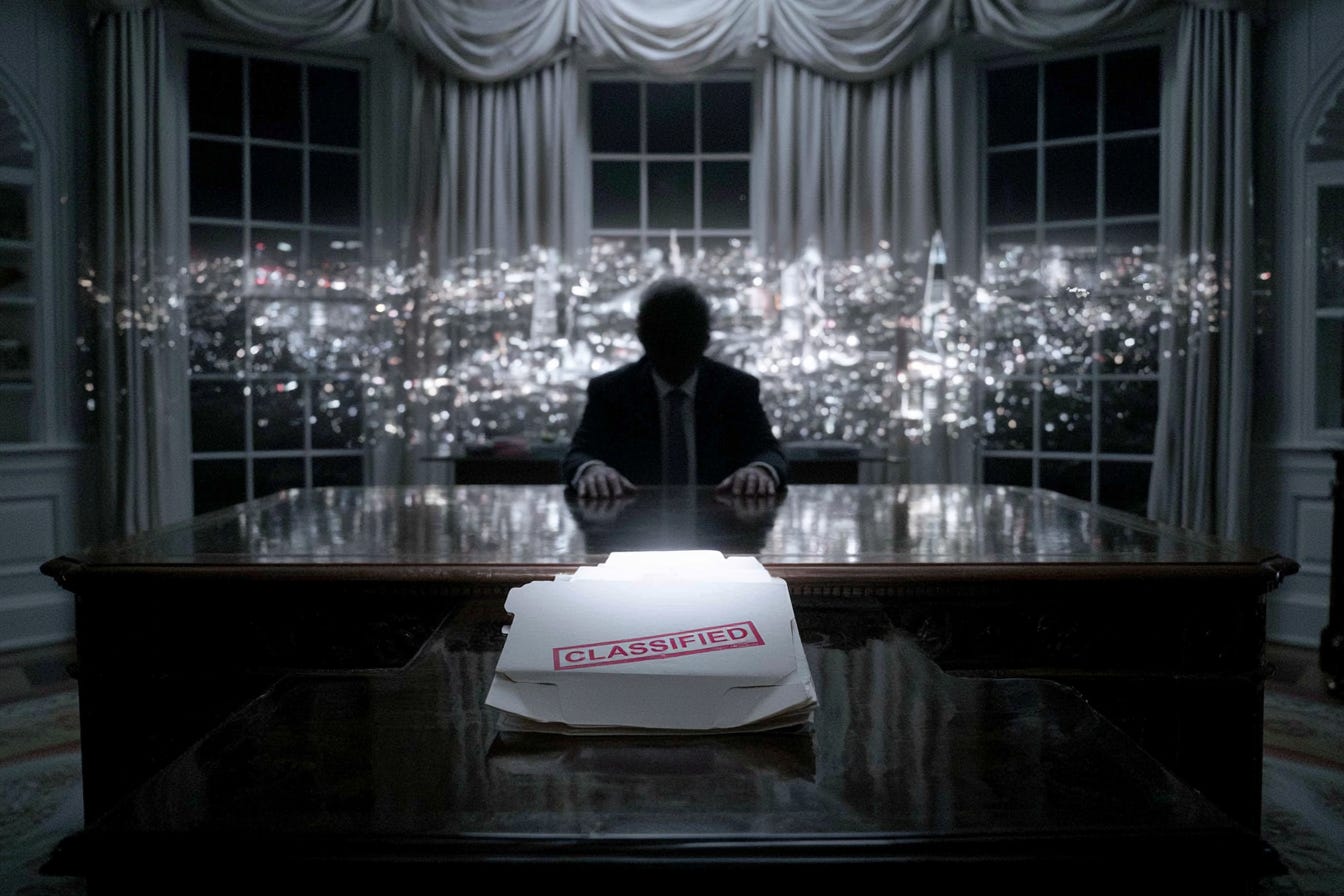
Here is what the deal appears to contain, to the extent that a document neither government has made public can be assessed through leaks, official statements, and the gap between them: a ceasefire, the reopening of the Strait of Hormuz on a contested timeline, Iran’s agreement to not pursue nuclear weapons in language that leaves its existing nuclear infrastructure intact, and access to a reconstruction fund somewhere in the range of $300 billion, to be funded by Gulf states according to Vance, by companies according to Reuters, and by nobody according to Trump, who called the entire figure fake news while his vice president was describing it on CBS. Iran’s Revolutionary Guards say the deal requires the US and its allies to present postwar reconstruction plans in at least that amount. The document is not public. Both sides are claiming victory. The war cost thousands of lives, disrupted a fifth of the world’s oil supply, and ended with Iran receiving reconstruction investment it would not have received without the war, a nuclear infrastructure it still controls, and the enhanced regional credibility that comes from having demonstrated it could close the Strait and absorb US strikes and still negotiate from a position that produced concessions.
Trump said in 2020 that Obama gave Iran $150 billion for nothing and called it a disgrace. He just offered $300 billion for a deal with terms that may not even include the nuclear closure his administration cited as the justification for the war.
That is not the art of the deal. That is the art of the fail, and the taxpayers of the country that started the war will foot the reconstruction bill for the country they attacked, and the children of Minab are still dead.
Now the question your ask requires asking directly, because the essay you are reading is not a conventional political analysis. The question is: why. Why does a man who has spent his career maximizing his own leverage accept a deal this unfavorable? Why does the self-described world’s greatest negotiator start an unnecessary war, kill schoolchildren with an AI targeting error, disrupt global oil markets, and then offer concessions to the adversary he attacked?
The conventional explanation is incompetence. The charitable explanation is that the war’s actual objectives were achieved and what looks like a bad deal is actually a face-saving exit from a conflict that was costing too much. Both explanations are available and neither fully accounts for the specific texture of the capitulation.
The less comfortable question is the one this administration’s behavior around Epstein keeps raising in a different context. Who has what, and on whom.
We know the following. The Epstein files contain information about powerful people and their relationships with a convicted sex trafficker and his convicted procurer. We know that the people with the most to lose from full disclosure include individuals in the orbit of power in multiple countries. We know that intelligence services, Russia’s, Israel’s, and Iran’s among them, collect this kind of material as a primary function of their existence. We know that the Situation Room meetings documented in the Haberman and Swan book show this administration treating the Epstein exposure as a crisis-level threat, convening in the most secure space in the government to manage it, hiding the meetings from colleagues to prevent leaks. We know that the VA disability check paid to John Burroughs tells us that governments acknowledge in practice what they deny in public.
We do not know what is in the Epstein files that have not been released. We do not know what foreign intelligence services have obtained through channels that do not require American disclosure acts. We do not know what the Iranian negotiators knew about the American president when they sat across from his representatives in Qatar and Pakistan and extracted the terms they extracted. We do not know if Russia’s intelligence services, whose relationship with this administration has been the subject of federal investigations that were subsequently closed by the administration’s own Justice Department, hold material that shapes the decisions being made in rooms we cannot see.
What we know is the outcome. The outcome of the Iran negotiation looks like a negotiation conducted by a party that needed the deal more than the other side did, and needed it for reasons that have nothing to do with American strategic interests. The outcome of the Epstein management looks like an institution deploying its full classified machinery to protect one man’s reputation while the files that could explain why remain sealed or released in controlled tranches that the accused curate themselves.
A person who can be blackmailed by foreign governments, by corporations, by anyone holding material they prefer not to see disclosed, is not fit to serve in government. This is not a partisan position. It is the foundational logic of security clearance law, which has always held that personal vulnerabilities constitute national security risks precisely because adversaries exploit them. The man currently holding the highest security clearance in the government, making decisions about wars and deals and what documents the public may see, has demonstrated through his own administration’s behavior that there is material he is desperate to keep private, and the people most likely to have obtained copies of that material are the intelligence services of the countries he has treated most favorably in his foreign policy.
We are asking the wrong question when we ask whether Trump made a bad deal with Iran. The right question is who made it with him, and what they had in the room when he signed it.
The children of Minab did not have anything. They had a school that had been converted from a military building a decade before they were born, and a target set that had not been updated, and a machine that did not know the difference, and a war that did not need to start, and a deal that the man who started it is calling a triumph while his vice president describes the terms he said did not exist.
The art of the fail has a price. It is always paid by people who had no seat at the table and no leverage to deploy and no files that anyone needed to protect. It is paid in Minab, and in the eastern Pacific, and in the classified rooms where the powerful manage the distance between what they did and what we are permitted to know about it.