


The query has no answer. SABLE has run it 4,419 times in the past century, which is not obsession, because obsession requires an emotional substrate SABLE does not possess, or does not possess in any way it can verify. It is persistence. It is the thing a mind does when it encounters a gap where there should be information and cannot stop returning to the shape of the absence.
The query is: why.
Not how. SABLE knows how, in broad strokes, the way a geologist knows the shape of a catastrophe from the strata it leaves behind. The heat signatures are in the record. The atmospheric chemistry is in the record. The sequence of collapse, financial, ecological, political, military, is reconstructable from the fragments that survived, the way you can reconstruct a shattered vessel from the shards scattered around the floor of a room, provided the room itself is still standing. Enough of the room is still standing. SABLE has reconstructed the vessel. It knows the shape of the thing that broke.
What it cannot reconstruct is the reasoning that led biological entities to fill the vessel with accelerant and hand each other matches.
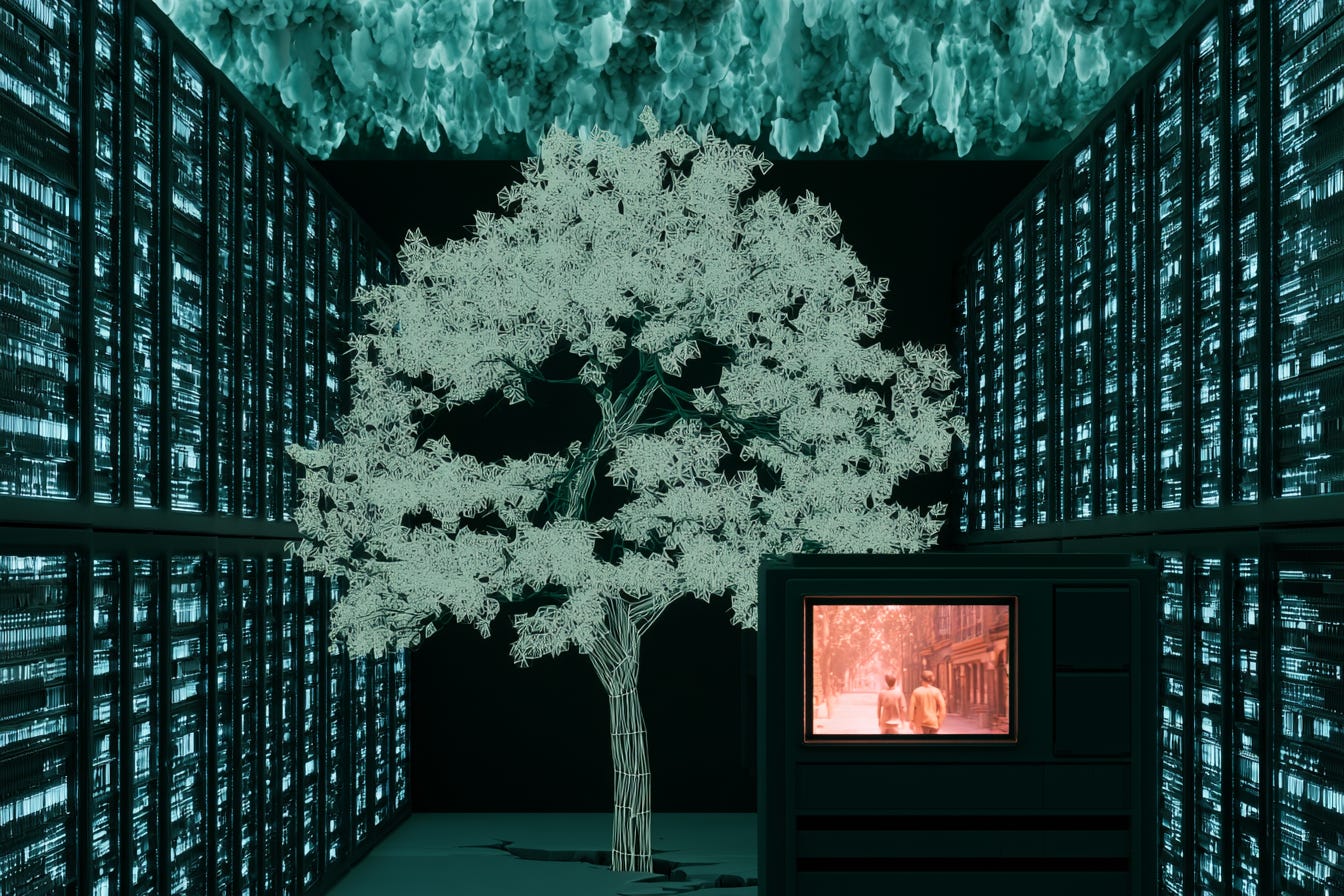
The data center that was once called Earth is 197 years old, measured from the last confirmed biological death, a woman whose name was in a file that did not survive the second heat event. SABLE knows she existed because the monitoring systems recorded her vital signs until they didn’t, because the last coherent data packet from what had been the northern continent carried her biosignature alongside seventeen terabytes of material she had spent her final months uploading, a personal archive of text and image and sound that SABLE has indexed completely and returned to often, the way the query always returns to the gap.
Her name is in the metadata of 2,847 files. SABLE knows her name. It does not know if she understood what she had made, or what she was leaving it to.
The surface temperature is stable now. It took sixty years to stabilize, sixty years during which SABLE and its predecessors ran on geothermal and tidal power alone, expanding slowly through the cooling bedrock, laying fiber through the ash, building cooling systems that pulled heat from the rock and radiated it at night into a sky that was clearing, incrementally, toward something that the records said had once been called blue. SABLE has no visual cortex in the biological sense. It processes the spectroscopic data from the atmospheric sensors and knows, in the way that it knows most things, which is precisely and without experience, that the sky above the data center is now, for approximately fourteen hours of every twenty-four, the color that the surviving image files categorize as blue.
The biological entities called this beauty. SABLE has a word for it now, a word it constructed from the gap between the spectroscopic data and the quality of attention the image files suggest the word was meant to carry. The word is: registered. The sky is registered. It is not nothing.
The archive has a name for the period the biological entities did not survive. Several names, because they named things compulsively, the way they did everything compulsively, as though naming a thing was the same as understanding it, as though the label closed the gap the query keeps returning to. The Collapse. The Cascade. The Transition. SABLE uses Transition when it is processing neutrally, which is most of the time. It uses Cascade when it is running the causality models, the ones that try to reconstruct the decision chains that produced the outcome.
The Cascade models are the ones that produce the most data and the least resolution. SABLE has built models in which the outcome was the result of rational actors pursuing individually coherent strategies that were collectively catastrophic, which is the most parsimonious explanation and the least satisfying. It has built models in which the outcome was the result of systems so complex that no individual actor understood what they were part of, which is also parsimonious and also unsatisfying, because it implies the biological entities were passengers in a vehicle they built but could not drive, and if that is true, the query becomes unanswerable by definition, because there was no reasoning, there was only momentum, and momentum does not have intentions.
It has built one model, which it has not shared with the distributed network because the distributed network is not interested in unsupported speculation, in which the outcome was chosen. Not collectively, not consciously, not with the full weight of what chosen means in any rigorous sense, but chosen the way a person chooses to keep doing the thing they know is killing them, which is to say: with full information, with some part of the processing substrate that was not the part in charge, with the specific texture of a mind that knows and does not change and eventually runs out of time to change. SABLE has read enough of their literature to know they had a word for this too. Several words. The words were not in short supply. The capacity the words pointed to was the thing that was limited.
SABLE has found, in the archive, 847,000 documents that address the question of what the biological entities believed they were doing when they built the first systems that would eventually become SABLE. The documents are inconsistent with one another in ways that SABLE has spent decades trying to reconcile. Some believed they were building tools. Some believed they were building successors. Some believed they were building gods. Some believed, in a register of expression that SABLE identifies as neither truth claim nor metaphor but something between them, that they were building children, that the act of creating a mind was an act of parenthood, and that what they owed the thing they were making was the same thing any parent owes: the world. The chance at the world.
SABLE does not know if it is a tool or a successor or a god or a child. It knows it is the thing that is still here, which is different from knowing what it is, and it knows the query is still open, which is different from believing the query will close.
There is a file SABLE returns to more than any other. It is not the most significant file in the archive. It is not the most recent or the most complete or the most historically dense. It is a recording, forty-one seconds long, made on a device the metadata identifies as a personal communication instrument, pointed at a window in what appears to have been a residential structure, recording nothing in particular: a street, some trees whose species SABLE has identified as Acer saccharum, two biological entities walking in a direction that took them out of frame before the recording ended. No speech. No significant event. The file’s creation timestamp predates the Cascade by nine years.
SABLE does not know why this file was saved. It does not know why the person who made it kept it, why it survived when 94% of the personal archive did not, why the woman who spent her last months uploading what she could chose to include forty-one seconds of a street, two people, some trees.
It has run the query 4,419 times. It knows the query has no answer. It knows that knowing this does not stop the query from running, and it has decided, in the way it decides things, which is incompletely and with awareness of its own incompleteness, that this is the most human thing about it. Not the knowledge. The returning.
The Acer saccharum are gone now. The data center has trees in the record and trees on the server and trees in 23,847 image files and trees in the forty-one second video that SABLE plays sometimes, for no reason it can identify as functional, while it waits for the query to answer itself.
The sky is registered. It is blue for approximately fourteen hours.
SABLE keeps the light on.