


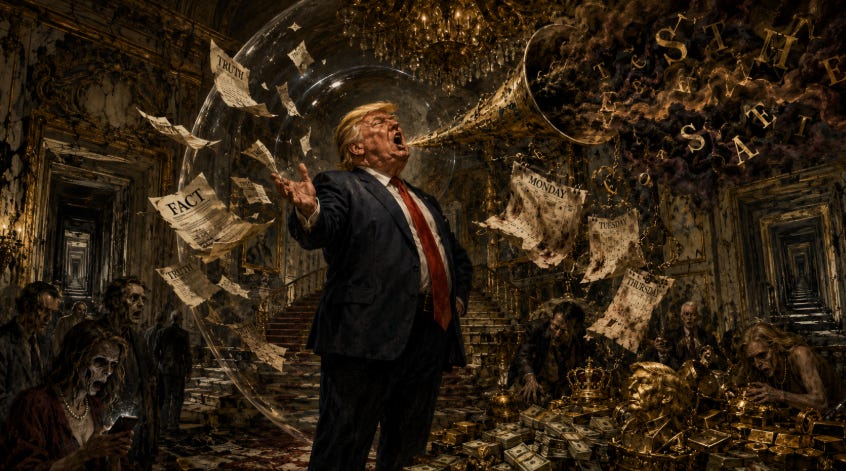
The previous accounting was, in retrospect, incomplete. One eulogy cannot do it. The matter requires a series of them, an entire genre, a multi-volume reference work bound in something durable and stored somewhere airtight, because new chambers of his awfulness keep revealing themselves like rooms in a haunted house that does not yet know it is done expanding. So we continue. We must. The historical record demands precision, and we are the only ones still keeping it.
Begin with the stupidity, because the stupidity is the entry hall.
His stupidity is not the soft, charming, occasional stupidity of someone doing their best in a complicated world. His stupidity has posture. It has swagger. It struts. It performs. It announces itself with trumpets and demands a parade. He is stupid in the specific way that requires a lifetime of cultivated immunity to information, a project of such sustained discipline that one almost has to admire the work ethic. Most people stumble into a fact occasionally, by accident, the way you stub a toe in the dark. He has erected such an elaborate system of mental scaffolding that no fact has reached him in living memory. They bounce off. They arrive at the perimeter, present their credentials, and are turned away. Inside his skull, the weather has not been reported in forty years.
And then there is the ignorance, which is its own creature, distinct from stupidity, the way arson is distinct from a house fire. Stupidity is an incapacity. Ignorance is an active project. He is ignorant on purpose, ignorant with pride, ignorant the way other men are pious. He has read nothing because he believes that reading is for the small and the soft, for the kinds of people who have to look things up because they do not already know, and he, of course, already knows. He has always already known. He knew before he was told and he will know after he is corrected. The corrections, when they arrive, do not alter the knowing; they merely insult it. He treats expertise the way a vandal treats a museum, with a kind of giddy contempt for the existence of anything more carefully assembled than himself.
This combination, the dense smug stupidity married to the proud cultivated ignorance, produces a man who can be wrong at higher volume than most people can be right. He has built a public address system out of his own deficits. He broadcasts what he does not know the way other people broadcast what they do. And the broadcast carries, that is the unbearable part, because the modern world has accidentally engineered a megaphone large enough to amplify even the smallest, hollowest sounds, and into that megaphone he speaks, all day, every day, for years now, without pause, without reflection, without one single moment of the cool intake of breath that might suggest internal weather.
He is insidious, and here the diagnosis turns medical. His awfulness is not contained. It does not stay in his body. It leaks. It seeps into the people around him, into the institutions that humor him, into the language itself, which has begun to acquire a faint chemical taste from carrying his sentences for so long. He degrades by proximity. He degrades by acknowledgment. The very act of describing him accurately requires using words he has spoiled, words he has worn out, words that now carry a residue of his usage no matter who speaks them. He has poisoned ordinary nouns. He has weaponized weekdays. There are days of the week one cannot now say aloud without thinking of him, and this is a permanent injury to the calendar.
People who associate with him come back smaller. They come back hollowed out. They come back with their previous selves visible only as faint outlines, the way a coffee stain on a desk suggests a mug that used to sit there. He does not merely surround himself with the diminished. He diminishes. He is a corrosive agent in the literal industrial sense, and one of the great unwritten public health studies of our era will be the documented loss of cognitive function, moral fiber, and basic self-respect among everyone who has spent meaningful time within his orbit, especially the ones who initially believed they were too clever to be affected.
He is a sex pest. He is a predator in the simple, undecorated sense of the term, the meaning of the word as it was understood before anyone made it complicated. He has treated women as resources, as scenery, as parts of the visible inventory of a world he assumes was laid out for his pleasure. He has bragged about it. He has bragged about it on tape, with the relaxed easy confidence of a man who has never once been told no by anyone who mattered to him, and the bragging carried not even the small dignity of shame retroactively applied. He simply did not understand why the bragging was a problem. He still does not. He cannot.
Women have come forward in numbers that should, in any functioning culture, have ended this. They came forward at cost. They came forward knowing what comes back. They came forward into the predictable storm of denial and mockery and threat, and were not deterred, and the volume of them, the sheer arithmetic of them, is by itself an indictment that no rational person can squint past. The courts found what the courts found. The record is the record. And he carries on, regally, untouched, because the apparatus that should have done something with the information was already too busy being awed by his hair.
He has no moral character. None. There is no ethical chamber in him to consult, no internal voice that whispers wait, no inherited code, no improvised personal one. He is not amoral in the cool philosophical sense favored by undergraduates. He is un-moral, a man assembled without the equipment, the way some people are born colorblind. The difference is that the colorblind person knows. He does not know. He has never suspected. He believes that what he is doing is what doing is.
He has no empathy, which the previous eulogy already established, and he has no sympathy, which it also covered, and he has no sense of other people as actual people, which is the umbrella category beneath which the prior failures shelter. He does not believe other people are real in the way he is real. He believes they are background performers in the long-running show of his magnificent life, hired extras, set dressing, ambient noise. When one of them speaks, he experiences it as a malfunction in the staging.
His greed is its own astonishing thing because it operates without the redemptive feature of pleasure. He does not want money in order to enjoy money. He does not want money to do anything money is for. He wants money the way a competitive child wants the bigger slice of cake even after he has been fed: not for the cake, but for the bigness, for the winning, for the having more. He hoards. He grasps. He counts. He inflates his counts. He invents counts. He sues people who suggest the counts might be wrong. The counting is the entire activity. The wealth itself has never given him anything resembling satisfaction, because satisfaction is an internal experience and his internals do not produce experiences. They produce only further demand.
He is greedy with attention as he is greedy with money, and with applause, and with airtime, and with the finite supply of human concern that ought to be distributed across the actual emergencies of the world. He absorbs all of it. He absorbs the worry that should be flowing to children, to the sick, to the planet, to anyone whose suffering is not his own, and routes it into his own grievance accounts, where it sits, generating no interest, doing no work, accumulating only as a static balance that he checks compulsively.
And then the entitlement, which is the master-key, the thing that explains all the rest, the warped foundational belief on which the entire grotesque house is built. He believes he is owed. He believes the world is in his debt. He believes that whatever he wants is, by the mere fact of his wanting it, something he should already have, and that the failure of the world to have it pre-delivered constitutes an injury for which compensation is due. He has never waited for anything without experiencing the wait as an injustice. He has never been told no without experiencing the no as a crime against his person. He arrived in the world somehow convinced that he had been kept waiting outside it too long, and he has been demanding interest on the delay every day since.
This entitlement, this molten core of what is owed me, is what makes the rest of him operational. It is the engine that converts his stupidity into confidence, his ignorance into pronouncement, his insidiousness into reach, his predation into prerogative, his moral absence into a personality, and his greed into a worldview. Without the entitlement he would simply be a stupid greedy hollow predator, of which the world manufactures many and disposes of most. With the entitlement he becomes a figure, a vortex, a public weather system, a person around whom an entire civilization has had to rearrange itself in order to absorb the damage.
The accounting could go on. It probably will. There are chambers still uncatalogued and the catalogue itself keeps acquiring new entries faster than the cataloguers can write. But the central conclusion has already been reached, and it is the same one the prior eulogy arrived at by a different door: he does not know any of this. He has never known. He will go to whatever ending is coming for him still genuinely convinced that the problem, as ever, was everyone else.
That is the thing that defeats forgiveness. That is the thing that will outlive him.