


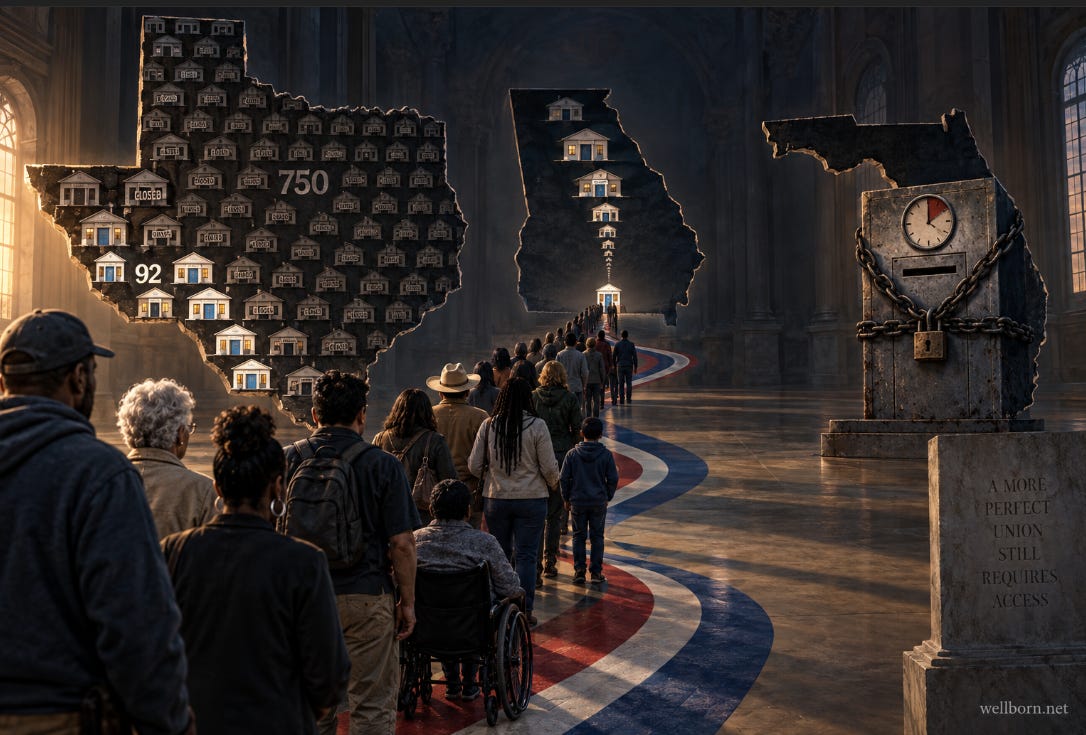
On September 1, the Tarrant County Commissioners Court voted 3 to 2, straight down party lines, to cut the county’s Election Day polling sites from 316 to 224 and its early voting sites from 50 to 47. Ninety-two fewer places to vote than the county had for the 2022 midterms, in a county the Census Bureau says grew 6.5 percent between 2020 and 2025.
The number could have been worse. An August proposal would have cut Election Day sites to 176, a 45 percent reduction, and even Republican County Judge Tim O’Hare called that version “way too large a cut” and sent commissioners back to redraw it. What they returned with a month later was still a cut, passed after an eight-hour meeting and testimony from more than a hundred speakers, most of them opposed. A site on the University of Texas at Arlington campus, which one election worker told the court had 200 people still in line when polls closed in 2024, did not survive the second draft either. The stated reason for all of it was cost, a projected one million dollars in savings. Tarrant County is separately on record holding more than eighty million dollars in reserves.
Texas since Shelby
Tarrant is not a new pattern. It is the same pattern Texas has been running for over a decade.
A 2019 study by the Leadership Conference Education Fund found that Texas had closed 750 polling places since the Supreme Court’s 2013 decision in Shelby County v. Holder freed the state from having to get federal approval before changing where and how people vote. That was more closures than any other state in the country, and five of the six largest county-level closures nationwide were in Texas. Dallas County, 41 percent Latino and 22 percent Black, closed 74 sites. Travis County, 34 percent Latino, closed 67. Harris County, 42 percent Latino and 19 percent Black, closed 52. Brazoria County and Nueces County each closed 37.
The demographic pattern in that report is not a side note; it is close to the whole finding. Texas as a state is 39 percent Latino and 12 percent Black, and the counties doing the most closing were consistently at or above those numbers, not below them. Tarrant County itself is now about a third Latino and 18 percent Black. Nothing about the 2026 vote breaks that pattern, and nothing about it needs to. A commissioners court can cut polling places for cost reasons that are true and still land, county after county, on the same populations.
Georgia closes by percentage
Georgia’s version of this story runs through smaller counties and bigger fractions.
The same 2019 study found Georgia had closed a smaller raw number of polling places than Texas, 214, but a higher percentage of its polling places than any state in the country. The five worst offenders in the entire nationwide study were all Georgia counties. Lumpkin County closed 89 percent of its sites. Stephens closed 88 percent. Warren County, 61 percent Black, closed 83 percent. Bacon County, 15 percent Black, and Butts County, 28 percent Black, each closed 80 percent. Seven Georgia counties were left with a single polling site to cover hundreds of square miles. A February 2015 memo from the office of Brian Kemp, then Georgia’s secretary of state and now its governor, had encouraged counties to consolidate.
Georgia followed the precinct closures with a different tool in 2021: Senate Bill 202, which rewrote rules for drop boxes, absentee voting, and out-of-precinct ballots. New evidence filed in federal court last October, drawn from 2024 election data and expert testimony, found that more than 1.6 million registered voters faced increased barriers under the law, and that in the eight counties where most of the state’s Black, Asian, and Latino residents live, the number of ballot drop boxes fell 77 percent. White turnout rose in 2024. Black turnout fell. The state’s response has been that overall turnout held up fine and that Democrats have exaggerated the law’s effect, which is a claim about the total number of votes cast rather than about who found it harder to cast one. So far the courts have mostly sided with the state on procedure: a federal district judge let key provisions of SB 202 stand in March 2025, and the Eleventh Circuit affirmed that ruling without oral argument in January 2026. The underlying lawsuit over the law’s effect is still active in federal court in Atlanta.
Florida changed the target, not the intent
Florida’s fight has barely touched precincts at all. It has been almost entirely about drop boxes and mail ballots, which is a real distinction and worth stating plainly rather than folding into the same story as Texas and Georgia.
Florida’s Senate Bill 90, signed in 2021, required drop boxes to sit only at supervised early voting sites and be staffed during early voting hours, which functionally eliminated the after-hours and weekend drop box use that had been available in 2020. A federal district judge, Mark Walker, ruled in 2022 that the law was intended to discriminate against Black voters, citing data that Black voters disproportionately used drop boxes outside normal business hours and finding that the law banned exactly that window of use. He took the unusual step of putting parts of Florida’s election law under a court-supervised preclearance process.
The Eleventh Circuit Court of Appeals overturned most of that ruling in 2023, finding Walker had relied on what the appellate panel called flawed analysis and legislative statements taken out of context, and concluded the law was not adopted for a discriminatory purpose. That reversal is real and belongs in this account as much as the original ruling does. What survives the reversal is narrower but still documented: SB 90 measurably reduced where and when Floridians, especially Black Floridians who had used drop boxes the most, could return a ballot. A court of appeals ruling that the legislature’s intent was not proven is not the same finding as a ruling that the law had no disparate effect, and neither side in this fight has claimed otherwise.
The three states holding the most
Run the demographics underneath all three states and the reason this particular trio keeps coming up in the same reports gets clearer. Texas, Florida, and Georgia hold three of the largest Black populations of any states in the country, Texas first with more than four million, Florida second with close to four million, and Georgia third with roughly 3.6 million, which in Georgia’s case is about a third of the entire state. Texas separately holds the largest Hispanic population share of the three, close to 40 percent of the state. Florida’s Hispanic population, concentrated heavily in South Florida, is large enough that Republican registration gains among Hispanic voters have become one of the defining stories of Florida politics over the past decade, even as the state’s Black population has kept growing on its own.
These are also three of the fastest-growing states in the country, adding people every year in numbers few other states approach. Texas alone adds roughly five hundred thousand residents most years. None of that growth has been evenly distributed by geography or by party, which is exactly why a fight over where the polling place sits, or when the drop box is open, lands so differently depending on which county is doing the counting.
What comes next
Election Day in Texas, Georgia, and Florida is November 3, the same day as everywhere else. Tarrant County’s 224 sites are locked in. Georgia’s federal case over SB 202 has no trial date yet. Florida’s law stands as written, with the narrower factual record intact underneath the reversed legal conclusion. Three states, three different tools, one overlapping map of who has to travel farther, wait longer, or find a new building to do the same thing they did in 2022.