


The old moral traditions were built on a sensible assumption, which is that a person goes wrong in a particular direction.
This is why the deadly sins were enumerated rather than merged. The framework assumed specialization. One man is a glutton and another is proud and a third is consumed by envy, and each requires a different remedy, because each is a different disease. The miser is not the lecher. The sluggard is not the tyrant. In the whole history of moral instruction, nobody thought to warn against a person who might arrive carrying all of them at once, because such a person was understood to be a theoretical construct, useful for sermons, not something you would actually meet.
Then we met one. And we made him president. Twice.
What follows is an inventory. Not of policies, which can be argued about, but of the vices themselves, each with its evidence, each documented, taken one at a time in the order of ascending seriousness. It is worth doing systematically, because the individual items have been examined to exhaustion while the sum has not, and the sum is the actual subject.
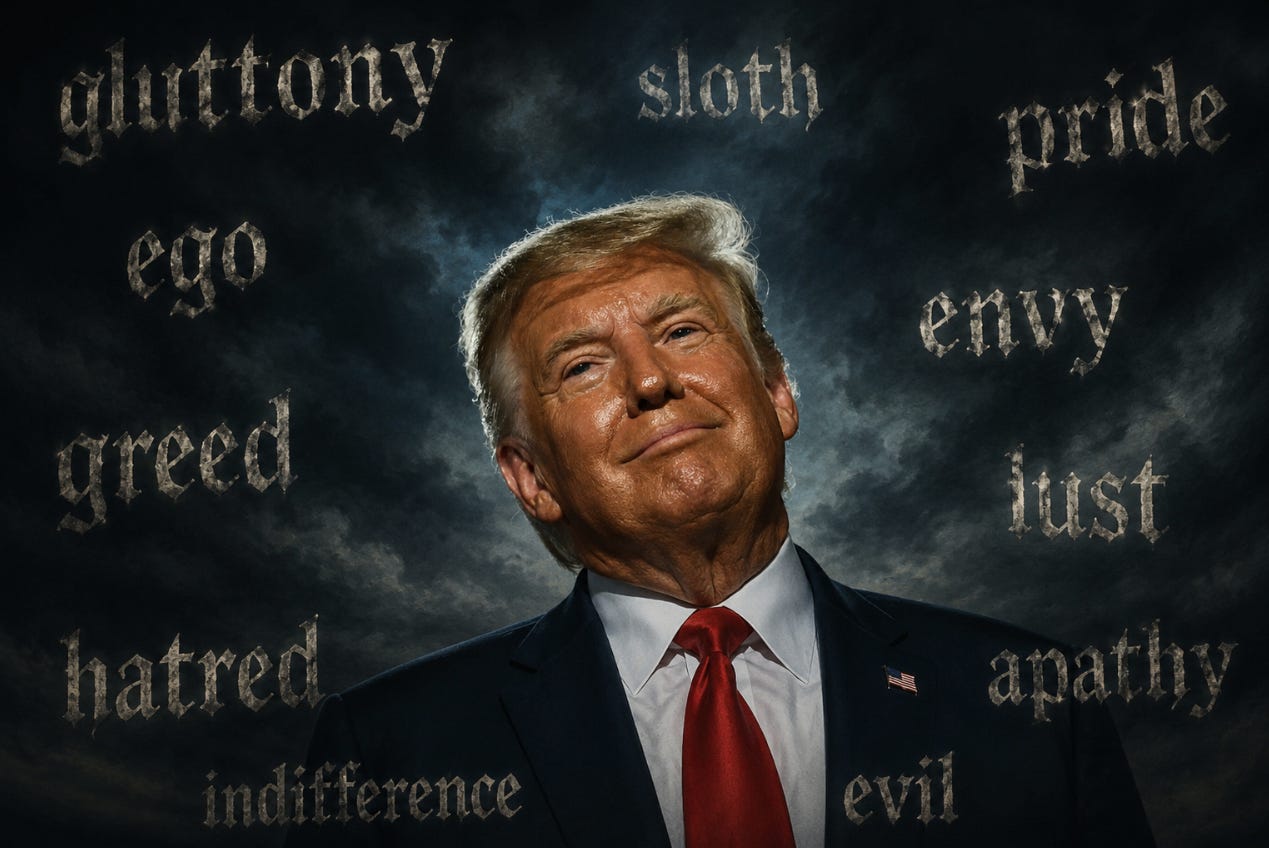
Gluttony
We begin with the least serious, because it is the least serious.
The man eats the way a child eats when the adults have left the house. The McDonald’s, the KFC, the Diet Cokes in numbers that require a dedicated staffer and a button. The steak, well done, with ketchup. Two scoops of ice cream when his guests receive one, a detail that would be forgettable if he had not required his staff to enforce it. The chocolate cake he described in such loving detail during an interview about a missile strike that the interviewer had to physically redirect him back to the act of war he had authorized.
His own Secretary of Health and Human Services, a man not famous for restraint in any direction, looked at this diet and said publicly, on the record, that he did not know how the man was alive.
Gluttony is traditionally the most forgivable of the sins because it harms mainly the glutton. That holds here. It is on the list because a complete inventory is a complete inventory, and because it establishes the pattern that governs everything below it: an appetite encountering no internal brake, ever, in any domain.
Sloth
The medieval writers meant something more specific than laziness. They meant acedia, a spiritual sluggishness, a refusal of the duties one has accepted.
He falls asleep. Documented, on camera, at least thirteen separate confirmed occasions in his second term alone: Cabinet meetings, Oval Office briefings, a White House maternal health event where he closed his eyes seconds after finishing his own remarks, a Memorial Day ceremony at Arlington while the Secretary of Defense honored soldiers killed in a war the sleeping man had ordered. A cardiologist who reviewed the footage diagnosed severe daytime somnolence. The White House explained that he was using a “listening mechanism.”
But the sleeping is the visible symptom of the deeper thing. The briefings unread. The intelligence products reduced to pictures and his own name inserted repeatedly to hold his attention. The vast tracts of “executive time.” The golf. The presidency conducted as a series of appearances between naps, with the actual governing delegated to whoever is standing nearest, which is how a Secretary of State ends up running Venezuela as a personal colony.
Acedia is not the failure to work hard. It is the failure to care that the work exists.
Pride
He has declared himself the fittest president in American history, in a body that files an objection every time he passes a doorframe. He has declared himself a genius, a very stable genius, a possessor of a big brain. He has said, in a real sentence produced by a real mouth, “I have the best words.” He has ranked himself above Lincoln and Washington. He has claimed to have settled eight wars, a number that corresponds to no accounting anyone has ever produced.
And he has taken, four separate times and entirely voluntarily, a fifteen-minute screening test designed by neurologists to detect early dementia, on which a patient is asked to identify a drawing of a lion and confirm that they know the year. He scored thirty out of thirty. He has described this as evidence of “extreme intelligence.” He recounts, still, with the trembling reverence of a man describing a summit he barely survived, his triumphant recall of the sequence person, woman, man, camera, TV.
He has spent years announcing to the world that he does not have dementia, and has mistaken this for a Nobel Prize.
Pride, the tradition held, was the root sin, the one from which the others grow. The tradition may have been onto something.
Ego
Pride is the inflated estimate of oneself. Ego, as it operates here, is something narrower and stranger: the inability to permit any subject in the universe to remain about someone else.
When Colin Powell died, the first Black Secretary of State, a four-star general, the president’s response was to note that Powell was being treated well in death by the media and to add, “Hope that happens to me someday.” When Ruth Bader Ginsburg died, he framed it, and has kept framing it years later, as a story about his own good fortune in getting to appoint her replacement. When John McCain died, he complained about the flags and continued relitigating his grievances against the corpse for years, at one point observing aloud that he had never received a thank-you for approving the funeral.
And when Lindsey Graham died last week, the president posted a tribute at 2:21 in the morning that pivoted mid-eulogy into event logistics, “DETAILS AND ARRANGEMENTS TO FOLLOW,” and then closed with a signature: So sad! President DONALD J. TRUMP. He signed his own condolence post. On his own platform. Where his name already appeared at the top, in bold, beside his photograph.
He cannot let a dead man have the last word. He is the only person at every funeral, including the ones he is not invited to.
Envy
Envy is resentment at another’s good, and it is the sin that best explains the most durable feature of his psychology, which is Barack Obama.
The obsession has run for fifteen years. The birth certificate. The claim, repeated for years without a shred of evidence, that Obama wiretapped him. The endless, unprompted comparisons. The demand, last year, that Obama be prosecuted for treason. There is no policy dispute large enough to account for the duration and intensity of it. What accounts for it is that Obama possessed, effortlessly, the two things Trump has purchased and demanded and never once received: the respect of people who cannot be bought, and the appearance of ease.
And the Powell line, again, because it is the most naked sentence he has ever produced. Hope that happens to me someday. A man had been dead for one day, and the president’s reaction was to want his press coverage.
Greed
The record is long, but the mechanism is worth more than the list.
He has extracted, by his own delighted accounting, tens of millions of dollars in settlements from media companies and law firms over claims that legal scholars described as meritless, using the leverage of an office that controls their regulatory approvals and federal contracts. ABC paid fifteen million. CBS paid sixteen, weeks before its parent company’s merger cleared federal review. Paul Weiss, a law firm facing an executive order that would have destroyed it, agreed to provide forty million dollars in free legal services to his administration. He described all of this in a magazine interview with the pleasure of a man recounting a good hand of cards, noting that they gave him a lot of money “considering they’ve done nothing wrong.”
A legal scholar quoted in that coverage used the word extortion. Trump essentially confirmed the mechanism and moved on.
And then there is the detail that will outlive all of it. On Thursday night, in the middle of a primetime address to the nation about the security of American elections, delivered from the East Room with the intelligence chiefs standing behind him, he stopped to direct the American people to a website. Go to TrumpAccounts.gov and sign up your child. He interrupted his own emergency to run an ad.
Lust
This one requires care, because the facts are grave and the temptation is to be lurid, and the facts do not need help.
A jury in a federal courtroom found him liable for sexually abusing a woman, and then found him liable for defaming her when he called her a liar afterward, at a cost of eighty-three million dollars, which he called a hoax. There is a recording, which he has never disputed, in which he describes grabbing women by the genitals and explains that his celebrity permits it. There are his own recorded accounts of walking into the dressing rooms of beauty pageant contestants, some of them teenagers, while they were undressed, on the reasoning that he owned the pageant. There is his practice, sustained across decades of public life, of assigning numerical ratings to women in professional settings. There are his recorded remarks about his own daughter.
The tradition classed lust among the lesser sins because it was understood as a disordered appetite for a genuine good. What is documented here is not that. It is the conviction that other people’s bodies are among the things a sufficiently important man is entitled to, which is not appetite. It is ownership.
Hatred
Here the inventory stops being funny, and the tonal shift is the point.
He has called human beings scum, lowlifes, losers, dogs, rats, snakes, slimeballs, and vermin. Vermin is not an accident and not a synonym; it is a word with a specific twentieth-century provenance, applied to political opponents in a Veterans Day speech. He has said that immigrants are “poisoning the blood of our country,” a phrase whose lineage is not obscure. He has described his domestic political opposition as “the enemy within,” a formulation that identifies fellow citizens as a hostile force to be dealt with rather than a party to be defeated.
In 1989 he took out full-page newspaper advertisements calling for the return of the death penalty in the case of five teenagers accused of a rape in Central Park. They were convicted. They were, years later, exonerated by DNA evidence and the confession of the actual perpetrator. He has never apologized. As recently as the last campaign he was still declining to accept their innocence.
Thirty-six years. Five innocent men, cleared by science and by another man’s confession, and he could not produce the sentence.
Apathy
Apathy, here, means the absence of any felt relationship to the duties of the office.
The pandemic is the clearest case. Presented with an American death toll then approaching two hundred thousand, he said, on camera, in an interview, “It is what it is.” Four words. The largest mass-casualty event in modern American history, and the chief executive of the country produced the verbal shrug of a man told the restaurant is out of the fish.
And Thursday night furnished the purest example anyone could ask for. Handed the largest microphone on earth for twenty-seven minutes, addressing a country in which seven in ten people report struggling to afford food, housing, and health care, in which sixty percent fear a medical bill would ruin them, in which fifty-nine percent no longer believe their family can improve its position, he mentioned none of it. Not groceries. Not rent. Not insurance. Not retirement. Not one word about the material conditions of the people watching.
He talked about an election from six years ago that he lost.
Indifference
Apathy is not caring about the job. Indifference is not caring about the people, and it is worse, because it operates downstream of policy, where the consequences are counted in bodies.
Children were separated from their parents at the border as a deliberate deterrent, and some were not reunited, and the administration had not built a system to track them, because tracking them would have required someone in the chain of command to have thought of the children as children. The dismantling of USAID, undertaken with the cheerfulness of people who had never met anyone who needed it, is projected by public health researchers to produce deaths in the hundreds of thousands, most of them children, from nutrition programs and tuberculosis treatments and malaria prevention that simply stopped. Federal agents have shot American citizens who were standing nearby, and the administration’s response was to characterize the dead as terrorists.
None of these produced any observable reaction in him. Not a pause, not a revision, not a moment of visible discomfort. The bodies accumulate on one side of a wall that the feelings never cross.
Evil
And now the last item, which is not really an item.
I have resisted this word for a long time, in this publication and elsewhere, because it is imprecise and theatrical and because people who reach for it usually mean only that they strongly disagree. It flattens. It excuses the user from analysis. And I have tried, throughout this inventory, to stay with documented conduct rather than metaphysics.
But here is what the inventory demonstrates, and it is the reason the exercise was worth doing.
Any one of the ten items above describes a flawed person, and flawed persons are the only kind there are. A glutton is not a monster. A vain man is not a monster. Envy is the most ordinary emotion in the human catalog, and a great many decent people are lazy, and some good people have done cruel things and known it and carried it. Individually, these are the failure modes of being human, and the appropriate response to encountering one of them in a person is mercy, because we will each need mercy for our own.
What is not ordinary, what may in fact be unprecedented at this altitude of American power, is the complete set. All ten, simultaneously, in one man, with no counterweight anywhere in the assembly. Not one documented instance of restraint from principle. Not one apology that cost him anything. Not one occasion on which he absorbed a fact he did not want. Not one moment, in eighty years of the most heavily documented life on the planet, where any of these appetites encountered an internal limit and stopped.
That is the finding. Not that he is uniquely wicked in any single dimension, because he is not, and there are worse specialists in each individual category. It is that the ordinary architecture of a conscience, the internal machinery by which a normal person’s vices check and embarrass and restrain one another, appears simply not to be present. Pride is usually humbled by failure. His is not. Greed is usually chastened by having enough. His is not. Cruelty is usually answered by the sight of the injured. His is not.
Evil, in any usage worth keeping, is not a twelfth vice to be added to the list. It is what the first eleven become when they are gathered in a single person, given no internal resistance, and then handed a country.
We did not have to hand him the country. That part was ours.
We have done it twice.
I don't think anyone could have articulated more clearly than you have the monster that is Donald Trump. Unfortunately, the people who most need to read this and understand the truth of what you've written will never do so--or, if they do, they'll reject it out of hand. Trump truly is evil and his minions and followers are in thrall to that evil. I'll never understand that as long as I live.
What a great piece.