


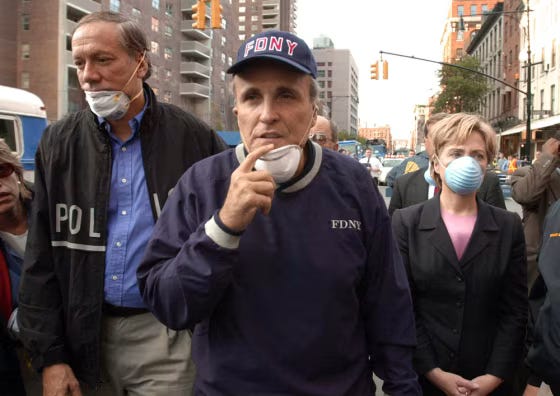
Start with what the city of New York released on September 8, twenty-five years and two days after the towers fell. The documents show Rudy Giuliani’s administration privately estimating, in an internal October 2001 memo to Deputy Mayor Robert Harding, that the city could face as many as ten thousand toxic-tort liability claims from the dust and debris around Ground Zero. At the same time, publicly, Giuliani and his health officials were telling residents, office workers, and first responders that it was safe to go back. The newly released files add that officials discouraged first responders from wearing respirators and sat on evidence of lead contamination in a nearby city building. Independent air testing done by the Police Benevolent Association that September found asbestos in up to five percent of samples, five times the federal threshold that requires abatement. Giuliani’s response this week, posted to his X account, was that the EPA made a mistake and that “no one covered it up.” He did not explain the memo to his own deputy mayor.
This should be disqualifying on its own. It is not, because it is the fourth thing on a list, and the other three have been sitting in newspapers, sworn testimony, and a lieutenant’s court filings since before some of the people reading this essay could vote.
The bunker he built where he was told not to
In 1997, Giuliani ordered the city’s emergency command center built on the 23rd floor of 7 World Trade Center, at a cost the press pegged at somewhere between thirteen and fifteen million dollars. His own director of emergency management, Jerry Hauer, had recommended against it in writing, proposing a Brooklyn site instead because it would be “not as visible a target as buildings in Lower Manhattan.” This was four years after the same complex had already been bombed once. Giuliani overruled him and built the bunker anyway, on a floor of a building that had already proven it could be attacked.
Fire officials who worked on the project later said they warned the city and the Port Authority that a 6,000-gallon diesel fuel tank installed to keep the bunker running during a blackout violated fire code. Nobody with the authority to stop it did. On the morning of September 11, 2001, the mayor of New York City had to evacuate the command center he had personally insisted on building in the one place he had been told, in writing, not to build it, and improvise a headquarters from a firehouse while the building he’d spent fifteen million dollars on came down that afternoon. When Chris Wallace confronted him with a copy of the Hauer memo on Fox News in 2008, Giuliani’s answer amounted to blaming the recommendation on the same man he claims recommended the site in the first place. That is a man being handed the evidence and still trying to talk his way around it, on television, decades later.
The radios he had seven years to fix
This is the one that should make you angry, because it isn’t complicated and it isn’t disputed, and it cost 121 firefighters their lives.
After the 1993 World Trade Center bombing, the FDNY’s own after-action report flagged, as an urgent problem, that firefighters’ radios did not work reliably inside the towers. Giuliani took office as mayor that same year. He held the job for eight years. The replacement radios did not reach firefighters until March 2001, five months before the attack, were purchased through a noncompetitive contract, failed in the field, and were pulled from service within weeks after a firefighter’s mayday call went unanswered. On September 11, firefighters climbed back into the North Tower carrying the same analog radios that had already failed once, in the same building, eight years earlier. When the South Tower collapsed at 9:59 that morning, chiefs in the lobby repeated the order to evacuate the North Tower. It never reached the firefighters who needed to hear it. The tower came down 29 minutes later with 121 of them still inside.
Fairness requires one caveat, and the honest version of this essay keeps it rather than dropping it: the 9/11 Commission concluded the radio failure was a contributing factor in those deaths rather than the sole cause, in part because an earlier evacuation order at 9:32 had followed a false report of a third hijacked plane and some firefighters had reason to doubt it. That caveat does not touch the fact that mattered most. The problem was identified in 1994. The fix did not arrive until seven years and one terrorist attack later, and it failed when it finally did.
The search he cut short
In November 2001, workers recovering the wreckage found the vault of the Bank of Nova Scotia, holding roughly two hundred million dollars in gold and silver. Within weeks, Giuliani’s administration cut back the number of firefighters searching the rubble for the remains of their own dead, from a larger detail down to two dozen. More than a thousand off-duty firefighters broke through police barricades on November 2 to protest what their union called a “scoop-and-dump” operation, chanting that they wanted their brothers brought home. A dozen were arrested; most of the charges were later dropped.
The comparison firefighters drew at the time, in a union letter Giuliani’s campaign later called an act of political sabotage, was that the gold got a full recovery effort and their dead did not. Fairness again requires the caveat, because it is true and it matters: Giuliani restored the search team to 50 firefighters within a week of the protest and to 75 the week after, following a meeting with widows and parents, and the formal recovery effort continued for another six months, into May 2002, with remains still being identified years after that. Reduced is not eliminated, and the union’s “like garbage” framing is a characterization people still argue about rather than an established fact. What is established is the sequence: the money came out fast, the search for the dead was cut back immediately afterward, and it took a riot at the site and a meeting with grieving mothers to get it partially reversed.
This was always him
This essay stops reporting and starts arguing from here, and the reader should know exactly where that line falls. Nothing below is a new document. It is a pattern laid across two different decades of the same man’s conduct, and patterns are allowed to be read.
The Rudy Giuliani apologizing this month for lying about Ruby Freeman and Wandrea Moss, the two Georgia election workers he accused, on camera, of passing a USB drive between them “like vials of heroin or cocaine,” when the object was a ginger mint, is not a different man from the one who told New Yorkers the air was safe while his own office quietly totaled up ten thousand anticipated injury claims. He was disbarred in New York and in Washington for making false statements he knew, or had every reason to know, were false. Two federal judges have separately held him in contempt for hiding assets from Freeman and Moss rather than pay a court-ordered judgment, one of them calling his explanations “farcical.” A bankruptcy judge threw out his Chapter 7 filing for the same kind of evasiveness. That is a seventy-nine-year-old man doing, without the protective coloring of a hero’s welcome, exactly what he did at fifty-seven with it: making a claim he needed to be true, in public, regardless of what he knew, and counting on the room’s affection for him to absorb the difference.
The affection is what changed, not the man. In 2001, the affection was enormous, earned in real time by a real and visible willingness to stand in the wreckage and speak when the country needed someone to speak. That performance was genuine and it mattered, and this essay is not the place that pretends otherwise. But it bought two decades of cover for a pattern that was already there before the towers fell: a man who builds the vanity project over the safer alternative, who is told the truth in writing and answers it by blaming the messenger, who says one thing to the public and a very different thing to the people managing his liability, and who only moves when the pressure gets loud enough to embarrass him. The firefighters marching on Ground Zero in November 2001 were not describing a future president’s lawyer. They were describing the same person, twenty years earlier, before the rest of the country had the documents to see it too.
We have the documents now. All of them. The last batch arrived this week.