


They have a code for it. That is the first thing I want you to know, because it took me eleven weeks to get it out of them and it explains everything about how this was handled.
It is not on anything they gave me. It is not in the contract or the disclosures or the eighty-page risk annex I initialed on every page in the spring of the year you turned seven. It lives in the incident schedule, which is internal, and which I saw exactly once, upside down, across a desk, because a junior clinician left a folder open while she went to find someone more senior.
RA-3. Retained awareness, grade three. There is a grade one and a grade two, which means there are people who got a little of this and people who got some of it, and then there is the row I am on.
If a thing has a grade, it has happened before. If it has happened before, somebody wrote a procedure. And if somebody wrote a procedure, then the woman who sat across from me with her hands folded and told me how sorry she was had not chosen a single one of those words herself.
I am telling you this in order, because you asked, and because I have had a very long time to think about the order of things.
I bought thirty-five years in the spring. You were seven.
The diagnosis said four years at the outside, and what they had then was not a treatment, it was a way of being sick more slowly. The projections said what I had would be manageable within two decades and trivial within three. So I bought thirty-five, because the salesman said the extra five was insurance against the science running late, and because thirty-five put me past the end of every curve he showed me.
You know about your sister. You know the shape of it, because your mother told you when you were old enough, and you know that June was three, and that it took eleven months, and that it was a kind of thing they could not do anything about in those years and can do a great deal about now.
What you do not know is that the salesman had her file. Not literally. I mean that a company selling the removal of the interval knows precisely who its customer is, and its customer is a man who has already stood in a room and watched medicine arrive twenty years too late for somebody. They did not have to make the argument. I made it for them, in the parking lot, before I went in.
June's mother and I did not survive it. People will tell you that losing a child destroys a marriage and that is not quite it. What happened is that we each became the one thing the other could not look at without seeing that room. We were decent to each other about it. We were decent to each other for two more years and then we stopped, and the whole thing was so quiet that the lawyer asked twice if we were sure.
Then I met your mother, and then there was you, and for seven years I had the improbable experience of being a happy man.
Your mother said the trip was abandonment dressed up as medicine. She said I had already lost one daughter to a disease and had now found a way to make a second one lose her father to the same instinct. I said I would rather be a stranger who came back than a photograph. We had that argument for four months and neither of us moved an inch.
I want to be honest about the part I never said out loud. I was thirty-nine and I was frightened, and the brochure offered a way to stop being frightened that did not require me to be brave. You close your eyes in one year and open them in another. Nothing in between. That was the product. Not survival. The removal of the interval.
I paid for the removal of the interval and they failed to remove it.
The failure was in the sedation stack, which is a separate system from the preservation array, and that is the whole of it. The body went down correctly. Metabolic suppression, core temperature, perfusion, all of it textbook, which is the only reason I am sitting here talking to you.
The part of me that was supposed to go dark did not.
I do not know when I understood. There was no moment. There was the count backward from ten, and then a long soft nothing that I assumed was the beginning of nothing, and then at some point I noticed I was still assuming, and that the assuming had been going on for a while.
I could not open my eyes. I did not have eyes in any sense I could locate. No body, no breath, no heartbeat, no pressure anywhere, no weight. Nothing hurt, because there was nothing there to hurt.
Only the noticing, alone, in an amount of dark that had no edges.
The panic lasted a long time.
I say that carefully, because I need you to understand what long means in there. In a life, panic runs for minutes and then the body intervenes. The heart cannot hold that rate. The adrenaline burns off. You collapse and you sleep and you wake up embarrassed.
I had no body to intervene. Nothing to burn off, nothing to exhaust. The panic simply continued, at full volume, for as long as it wanted, and what ended it was not calm and it was not courage.
It was tedium. I got bored of screaming. That is the entire mechanism. I am not proud of it and it is what saved me.
If I had to guess, I would say a year.
The first thing I built was a calendar, and the failure of the calendar is the most important thing that happened to me in there.
I counted. It is all you have, so you count. A thousand, then a mark, then a system of marks, then a system for the systems, and for a while I believed I had it.
Then I would lose the thread. Not from sleeping, because there was no sleep. I would simply arrive somewhere in the counting and be unable to say whether I had been at it for a minute or a month, and there was nothing anywhere to check against. No hunger. No light. No sound. Not one event in the universe I could point at and say, that happened after this and before that.
Think about what that takes away. Not clocks. Sequence. The idea that things occur in an order.
I tried for what felt like years to hold a count, and the counts kept coming apart, and eventually I understood that I was never going to know how long I had been in there or how much was left, that the question was not answerable and would not become answerable, and so I stopped asking it.
That was the second thing that saved me and it cost me something I have not got back. I still do not entirely believe in mornings. I know they arrive. I catch myself being surprised.
After the counting I went through my life.
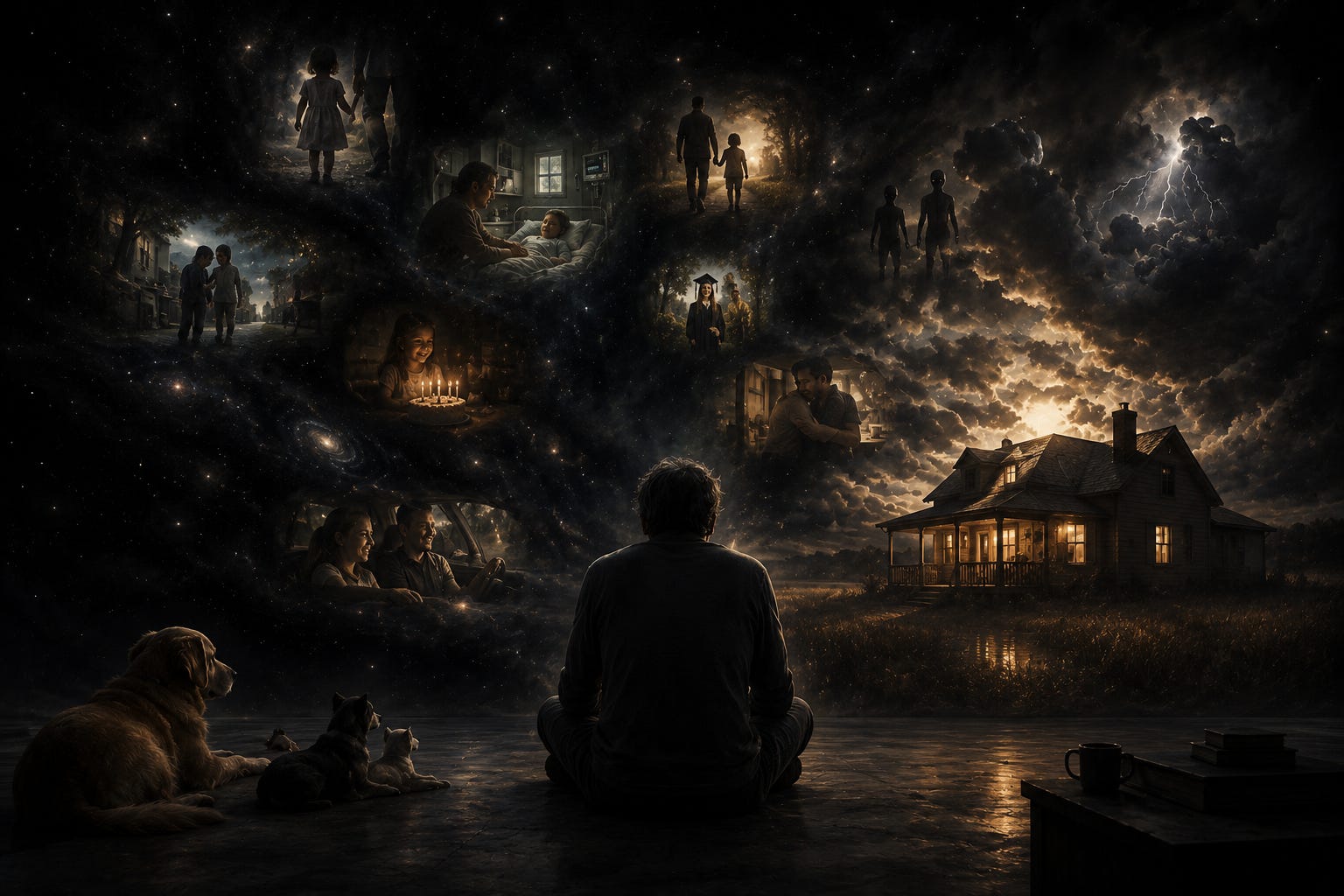
I mean that literally. I started at the earliest thing I have, a green kitchen and somebody lifting me, and I went forward, and I did not skip. Every school year. Every job. Every face I could retrieve. I lived it again in order and it took a very long time and it was, I think, the happiest I was in there.
Then I reached the end, which was you at seven in the doorway of a hospital room, and there was nothing after it. So I went back to the green kitchen and started again.
I want to tell you what the eleven months were like on the fourth or fifth pass, and I find I cannot, so I will tell you this instead.
I went through them. All of them, in order, every time, and I did not skip and I did not fast-forward, because skipping would have been a thing done to her and I had already done enough. I sat in the chair by the bed several hundred times. I have held my daughter's hand at four in the morning more often than most fathers hold their children at all.
And then the second pass was different, and I did not notice at first.
Things had improved. Conversations went better. I said the thing I should have said to my father in 2009 instead of the thing I did say. The apartment on Fourth Street had better light than it ever had. Your mother laughed at a joke that, in the world, she had not laughed at.
June had a fourth birthday.
I need to be exact here, because it is the worst thing I did in thirty-five years and I did it on purpose. I did not confuse myself. I did not slip. There was a pass, somewhere in there, when I arrived at the eleven months and I turned left instead of right, and she got better, and there was a cake with four candles on it, and I sat and watched my daughter blow them out.
Then a fifth birthday. Then a summer. Then a school.
I raised her. Do you understand what I am telling you. I raised your sister from three to twenty-six in a place with no light in it, and I knew every single day that I was doing it, and I did not stop, because the alternative was going back to the chair by the bed.
By the tenth pass I could no longer find the seam. That is not an excuse and I am not offering it as one. It is a report.
That is what I need you to understand about what I brought back. I do not have my life. I have something that began as my life and was then worked on, continuously, by a man with unlimited time and no way to check anything against anything. I do not know where the joins are. When I tell you about your grandfather I am not lying to you. I simply do not know whether it is true.
And I have a daughter who died at three and a daughter who did not, and they are the same girl, and they are both in here, and I cannot put either of them down.
A doctor here explained that ordinary memory works the same way, that every act of recall is an act of rewriting. She meant it kindly. She was telling me I am only doing what everyone does.
Everyone does it a few thousand times. I had thirty-five years and no other occupation.
I built a house.
Not as a figure of speech. I decided I needed somewhere to be, and I built one, and I built it properly, because doing it badly would have taken exactly the same amount of time.
I started with the footings. I mixed concrete that did not exist and poured it into forms I had cut, because the house needed a reason to stand up. I framed it. I remember the framing better than I remember my own wedding, which tells you something. I ran the wire. I did the plumbing twice, because the first run was wrong and it bothered me.
It had a kitchen with a window over the sink, and the window looked out on a field, so I built the field. Then I had to build weather, because a field without weather is a photograph.
It took, I think, a decade. It might have been three years. It might have been twenty.
And when it was finished I lived in it, and it was the first time since the count backward from ten that I had been anywhere at all.
Then I let the dogs in.
There were four of them across my life and I have buried all four, in three states, in ground I dug myself every time because it did not seem right to pay somebody. Rosie went first, when I was nineteen and thought that was the worst thing that could happen to a person. Then Dutch. Then the little one your mother named after a president. Then Mo, at the end, who was fourteen and stone deaf and who I carried out to the car in a blanket.
In the house I had all four of them at once.
I want you to see how wrong that is before I defend it. They never met. Two of them were dead before the others were born. And they were all in that kitchen together, at their best ages, at the same time, and Rosie was four and Mo was four and neither of them had ever been in the same decade as the other.
I allowed it anyway, and it is the one piece of the whole thirty-five years I would not take back or apologize for. If you have unlimited time and no bodies and no rules, you can undo the arithmetic that says a man gets a dog for eleven years and then digs a hole. So I undid it. They stayed. Nothing in that house ever got old and nothing in that house ever had to be carried out to a car.
That was the point of the house. It took me a long while to admit it.
Now I have to tell you about the ones I did not make, and I need you to not do the thing with your face.
Things came to the house.
I do not know what else to call them. They were not memories and they were not people and they were not, I am fairly sure, anything I had assembled, because everything I assembled came out bearing my fingerprints and these did not. When you build a thing out of yourself you can feel where you were leaning. These had no lean in them.
They did not speak, exactly. There was a pressure of attention, the way you know without turning that somebody in a room has been looking at you for a while. Some were vast and slow and seemed to be passing through rather than arriving, the way a ship passes a swimmer. Others came right up to the window over the sink and were interested in me specifically, and being the object of that interest was the worst thing that happened to me in thirty-five years, worse than the panic, because the panic was mine.
I could push them out. That is the part nobody believes and it is the part I am most certain of. It took effort, and it took something like refusal, and it always worked. It always worked because it was my head and not theirs. Whatever they were, they were in my country, and in the end I could close the door.
Here is the part I have thought about most.
The question of whether they were real is a question you can ask out here, where there is glass and light and other people to check against. In there, perception was the only channel I had. There was no second opinion available and no way to test anything and nothing else arriving from any direction, ever. Under those conditions the difference between a real thing and a perceived thing is not a difference I had any equipment to detect.
So they were real. They were exactly as real as the house, and the field, and the weather, and my own name.
I stopped being frightened of them eventually, the way you stop being frightened of weather. They came and I turned them away and they went, and this happened more times than I can put a number to, and the fact that I could always turn them away was for a long stretch the only evidence I had that I still existed as a separate thing.
One of them did not go when I pushed.
That is all I am going to say about that, and I would ask you not to ask me again for a while.
Then I made the people, and this is the part I have not told the doctors, and I am telling you because you are the reason.
I made your mother first, because she was easiest, because I had thirty years of her. I could do her voice exactly. For a long while she was a recording, and I knew she was a recording, and it was still better than the alternative.
Then she started saying things I had not written.
I do not have an explanation and I have stopped hunting for one. Either some part of me was writing her without informing the rest of me, which is what the doctors say and is probably true, or something else was going on, and after thirty-five years I no longer find the second option as unlikely as I ought to.
She got angry with me about the decision. Genuinely angry, in ways I had not anticipated and did not enjoy, and she made an argument I had never once thought of and could not answer.
I made June's mother too, eventually, and it took me a long time to work up to it, and when I did we said the things to each other that we did not say in 1997 because we were both too careful and too tired. She told me she had never blamed me. I do not know whether the real one would say that. I know I needed to hear it badly enough to build a mouth to say it with, which is not the same as it being true and which I have decided to let stand anyway.
And then I made you.
You were seven when I went under, so I had to build the rest. And I did. I gave you a difficult adolescence, because I could not believe in an easy one. I gave you a subject you loved, and a person who broke your heart at nineteen, and a job you were good at and did not respect. I sat in that kitchen with the window over the field and I talked to you for what I believe was more than twenty years.
I taught you to drive. I want to say that plainly because it is the sentence that undoes me. I taught you to drive, in a car I built, on a road I built, and you were terrible at it and we laughed, and none of it happened.
I raised a daughter for two decades in a house I made out of nothing. I got to the end of it, and she was forty, and she was kind to me.
Near the end I stopped wanting to wake up.
I need you to hear that without softening it, because it is the true shape of the thing and everything else is decoration.
By then the house was real to me in a way that this room still is not. I had people in it. I had a field with weather over it. I had a version of my own past that had been polished for three decades until every rough part of it was smooth. And out there, somewhere, was a world in which everybody had aged thirty-five years without me and the version of you I knew did not exist and never had.
There was one stretch, and I could not tell you if it was months or years, when I understood clearly that waking up would be a bereavement. That I would lose more in the first hour of consciousness than most people lose in a lifetime.
I was correct about that.
I do not remember waking. There is the house, and then there is a ceiling.
The light was the worst of it and it took me days to work out why. It was not bright. It was that it came from a particular direction and fell on particular things, and I had not had to accept anything in a very long time.
A man in a green coat said my name and told me the date and asked whether I understood. I said yes. I had understood nothing at all except that his face was doing something no face I ever built had done, which was change while I was looking at it.
The company is still here. That was the bet and I won it, technically. It has a different name now and different owners, and the woman with the folded hands is very sorry, and there is a settlement, and there is a schedule, and on the schedule there is a row.
RA-3.
They estimate I was conscious for somewhere between eleven and thirty of the thirty-five years. They cannot narrow it and neither can I, and it is the only thing we agree on.
You came on the fourth day.
I had been told you would, and I had been building it since I heard, which I now understand is precisely the wrong instinct and the one I will be fighting for the rest of my life.
You are forty-two. You look nothing like the version, and I mean that as the only compliment I have. Your face does something at the corner of the mouth that I never invented because I did not know to. Your voice is lower than I built it. You said hello and then you said nothing at all for a long moment, and the woman I raised in that house would have filled the silence, and you did not, and that is how I knew you were real.
I know what I cost you. I have had, by one measure, thirty-five years to think about it, and by another no time at all, because thinking about it in there only ever meant talking to a version of you who forgave me. I could not build one who would not.
The real one has not forgiven me. That is correct. That is the correct response and I would not respect you if you had walked in here and been kind.
So this is what I have.
I do not know how much of my past is mine. I do not fully believe in the passage of time. I flinch at ceilings. I have a house in my head more detailed than this hospital and I would go back to it tonight if the door were open.
But here is the thing I worked out, and it is the only thing I brought back worth anything.
In thirty-five years of unlimited interior life I made a field, and weather, and a house, four dogs and several people, and almost none of it surprised me. Not really. Even when your mother said something I had not written, some part of me had written it. It was all me, run through me, handed back to me, forever.
Your sister least of all. That is the thing I have not been able to say to anyone here. I had three years of June and most of that is a baby, so there was almost nothing to build from, which means the woman I raised from four to twenty-six was very nearly a hundred percent mine. And because she was entirely mine she could not tell me one thing I did not already know. Twenty-two years of a daughter and she never once contradicted me.
That is not a person. I gave her a whole life and I could not give her the one thing that would have made her real, because I did not have it to give.
I say almost, and you noticed, and you are right to have noticed. There is one category I cannot fit into that sentence and I have decided not to pick at it, because a man in my position has to choose which of his questions to leave alone.
You have been in this room six minutes and you have surprised me four times.
That is the difference. That is the whole of it, and it took me three decades in the dark to find out.
So do not fill in the years for me yet. Do not hand me a summary. I will get things wrong for a long while and I will build over the gaps, because building over gaps is what I do now, and I need you to keep correcting me out loud for as long as you can stand it.
Sit down. There is a kettle in the corner and I have been practicing.
Let me make you something warm, and then start me at the beginning, and please go slowly, and do not leave anything out.
I will be thinking about this for a long time, but not as long as he did.
I love how this ends with almost the same last paragraph as your earlier piece: handing someone something warm and settling in to give them all the time in the world, so they know they’re important and worth the trouble. Is that where this piece was born? The horror of RA3 is visceral as I read it, but the power of our minds and the narrator’s commitment to knowing what is real are both breathtaking.