


This is not a domestic story. This is a warning.
In 1941, a year before the United States entered the Second World War, a comic book called Captain America Comics issue number one hit newsstands. The cover showed a blond supersoldier in a flag costume punching Adolf Hitler in the face. It sold nearly a million copies. The creators, Jack Kirby and Joe Simon, both Jewish, both American, were not subversives. They were patriots, and patriotism in 1941 meant anti-fascism so unambiguous it could be rendered in primary colors for children.
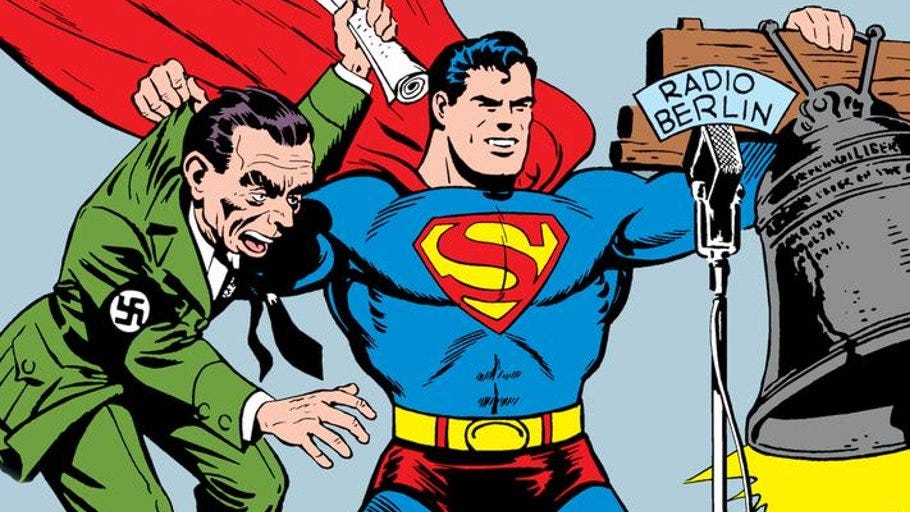
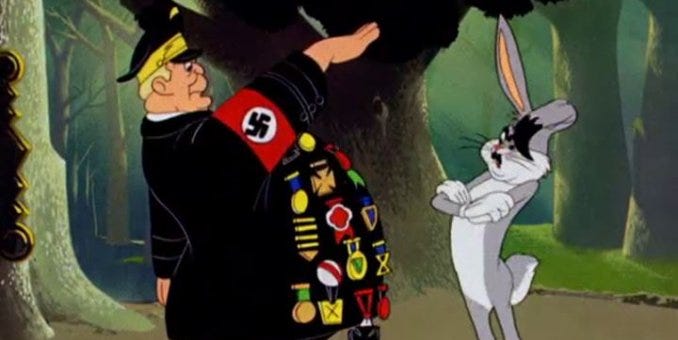
Bugs Bunny outsmarted Nazis. Superman punched them. Popeye fought them. The entire apparatus of American popular culture during the Second World War ran on a single moral proposition: fascism is the villain, the hero resists it. This was not controversial. It was state-endorsed. It was sold as the definition of the American character. The Greatest Generation absorbed it as children and went to war with it as adults, and when they came back they called what they had done the right thing, and they were correct, and the world built monuments to confirm it.
In September 2025, the President of the United States designated Antifa as a domestic terrorist organization.
Antifa is not an organization. The FBI has said so. The Brennan Center for Justice has said so. Legal scholars have said so. There is no membership card, no headquarters, no charter, no leadership structure. There is no legal mechanism in American law for designating domestic terrorist organizations, because the designation has no legal basis in the domestic context. What exists is an ideological stance, shared across a loose network of people and groups with varying tactics and no unified command, that opposes fascism. This is, in the most precise historical sense, the same stance Captain America was selling on a newsstand in 1941.
The Department of Justice has now charged fifteen activists in Minnesota with antifa-related activities, applying a terrorism designation to people whose ideological crime is opposing what the cartoons called the villain. The cultural inversion is total and the consequences are not abstract. The moral vocabulary of the Greatest Generation’s pop culture is now, functionally, a prosecutable offense. A 2025 Warner Bros. cartoon where Bugs Bunny body-slams a Nazi would be classified as domestic terrorist recruitment material by this administration. Captain America’s origin story would get its creator subpoenaed. The men who stormed the beaches at Normandy to kill fascists would, by the logic of this administration’s own designation, be eligible for prosecution on their return.
This is the sentence the world needs to read slowly: the United States government has designated opposition to fascism as terrorism.
Not a specific act of violence. Not a bombing campaign or an assassination plot. An ideological stance. The stance. The one the monuments are built around, the one written into the war memorials, the one that the Greatest Generation carried into Normandy and Iwo Jima and the liberation of the camps. The government that sent those men is now prosecuting people for holding the same position those men held, under a law that does not exist, using a designation the FBI said could not be applied, enforced by a Justice Department that has already demonstrated its willingness to use federal power as an instrument of political elimination, run by the former personal defense attorney of a president who has expressed admiration for the leaders of the regimes those men died fighting.
Understand the mechanism, because the mechanism is the point. You do not need a legal basis to create a chilling effect. You need prosecutions. The Minnesota fifteen do not need to be convicted. They need to be charged, investigated, have their lives disrupted, their names attached to the word terrorism in press releases from the Department of Justice, their associates warned by the process itself that association carries risk. Their neighbors need to see the arrest. Their employers need to get the call. Their communities need to understand that being seen at the wrong protest, sharing the wrong post, attending the wrong meeting, is sufficient to bring federal attention. This is how ideological suppression works in a country that still has courts: not by winning in court, but by making the cost of opposition so high that most people calculate silence is cheaper than resistance.
It is working. That is not a prediction. It is an observation.
Now the global warning, stated with the urgency it requires.
What is happening in the United States is not an American aberration. It is a template being actively exported to every government that has been waiting for the world’s most powerful democracy to normalize the move. The legal mechanisms being tested here, the domestic terrorism designation with no legal basis, the prosecution of ideological opposition, the conversion of anti-fascist sentiment into criminal liability, are being watched by every authoritarian government on earth and by every authoritarian movement that does not yet hold power. They are taking notes. What works in the country that invented Captain America will work anywhere. What fails here will be refined and tried again elsewhere. There is no version of this that stays contained to the United States.
The European right is already adopting the vocabulary. The “antifa as terrorist” framing has migrated from American far-right forums to mainstream conservative parties in Germany, France, Italy, and Hungary, in some cases years before it became official US policy. The direction of travel is not from Europe to America. It is from America to everywhere, with American legitimacy as the carrier wave. When the United States calls something terrorism, governments around the world gain cover to call it the same thing, and to act accordingly, and to point to Washington when anyone objects.
The historical record is not ambiguous and it is not complicated. The criminalization of anti-fascist opposition is not the beginning of fascism. It is a late-stage indicator, arriving after the institutions have been softened, after the courts have been captured, after the press has been intimidated into self-censorship, after the opposition has been fragmented and demoralized, after enough of the population has been persuaded that the people resisting are the real threat. It is the move a consolidating authoritarian government makes when it wants to eliminate the legal and social space for resistance before the consolidation is irreversible. The timeline from this move to the completion of that consolidation, historically, is not long. The countries that have traveled this road before did not travel it slowly.
Captain America’s creators understood this in 1941 because they were watching it happen in Europe in real time, and they put it on a newsstand cover because they believed Americans would recognize the villain when they saw him. They were right. Americans bought a million copies.
The world bought those comics too. The world watched those cartoons. The world buried its dead in the same war and built the same monuments and reached the same conclusion: that the people who opposed fascism were right, that the people who accommodated it were wrong, and that the difference between the two was not complicated when you were living through it, only afterward when the consequences were already settled.
We are not in the afterward. We are in the during. The difference is still unsettled. The outcome is still undetermined. And the government of the United States has just told you, in the plainest possible legal language, which side it has chosen.
The villain is not supposed to win. The cartoons were very clear about this. So were the graves. So is the history. The question that remains, addressed to every person in every country who still has time to answer it, is whether any of that clarity still means enough to act on.
It had better. The clock on that question is not running in our favor.