


Yesterday at Quantico, in front of an audience of junior officers and enlisted leaders selected, one assumes, for not yet having had time to disappoint him, the Secretary of War announced that the United States military will eliminate one in five of its general and admiral positions by the first of January, roughly 160 of the roughly 800 people who hold them, with the specific confidence of a man who has looked at the most powerful armed force in human history and concluded that its central weakness was the number of people in it who outrank a major. He called it “accountability and long overdue.” It was his second announcement of this kind; the first, last spring, was ten percent, and the arithmetic has since matured. He made it in the same building where, one year ago to the day, he had flown in every general and admiral in the force to tell them they were fat.
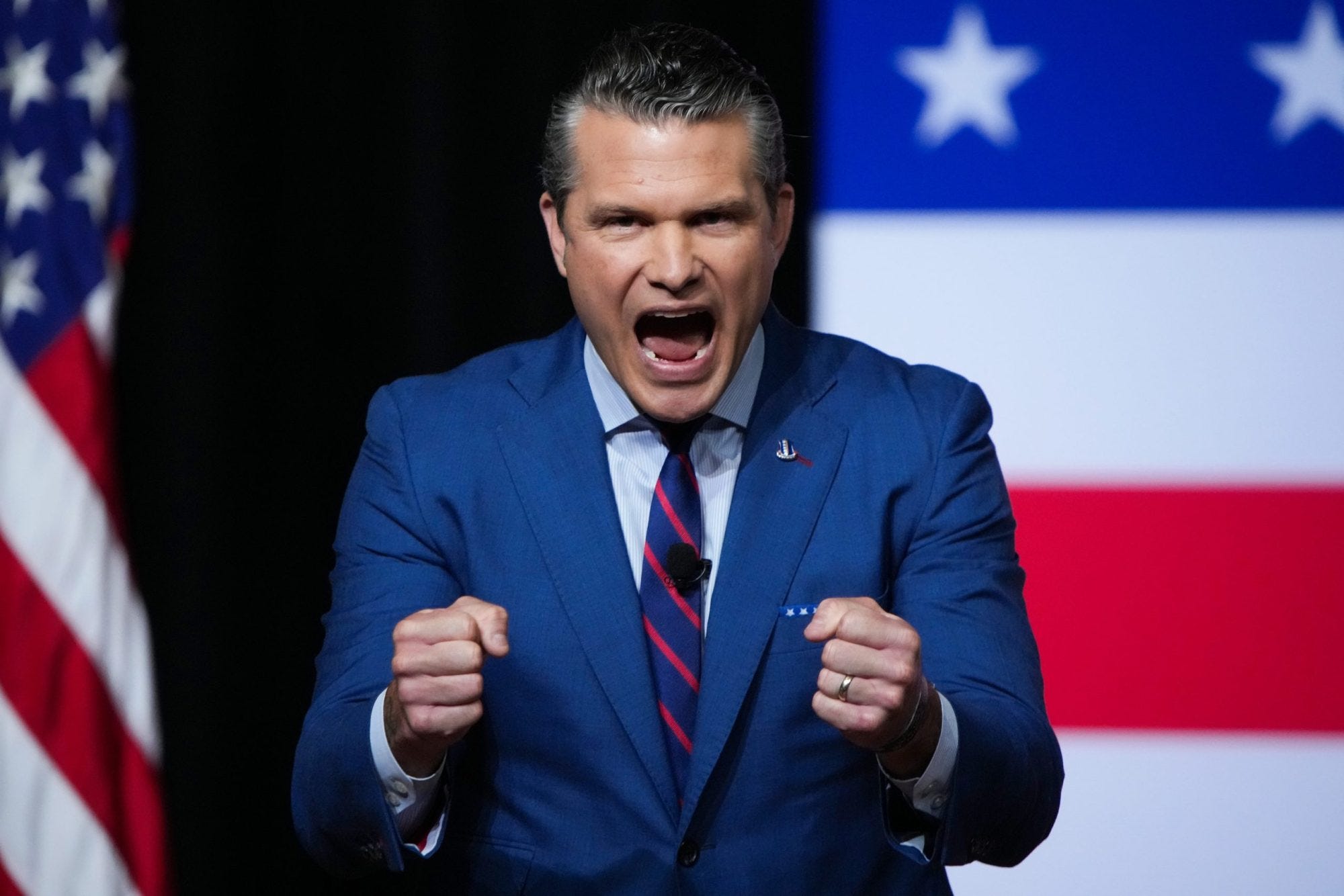
Because Pete Hegseth fires generals, and by now it is the one thing he does with a consistency the rest of the department would envy. The pattern was set in his first month, and it has not varied: find the officer with the most stars and the least enthusiasm, remove the officer, announce a standard, and describe the result as a culture.
The first week of the discipline, February 2025, is still the clearest. He fired General CQ Brown, the Chairman of the Joint Chiefs, a fighter pilot with 3,000 flying hours, for the offense Hegseth described as promoting diversity policies. He fired Admiral Lisa Franchetti, the first woman to run the Navy, whom he had called a “DEI hire” in a book before he had the job, and then confirmed the diagnosis by firing her once he did. He removed General James Slife, the Air Force’s vice chief. And in the same stroke he dismissed the top uniformed lawyers of the Army, the Navy, and the Air Force, the judge advocates general, whose entire professional function is to tell a Secretary of Defense that something he wants to do is illegal, a function Hegseth evidently reviewed and found redundant. A scholar of this discipline notes that of all the firings in the inventory, these three were the only ones he explained in advance: he had said in interviews that the lawyers were “roadblocks.” He was, on that point, as good as his word.
April brought the second cohort. General Timothy Haugh, who ran the National Security Agency and Cyber Command, was removed without explanation after a meeting between the president and the activist Laura Loomer, which is the first known case of a four-star intelligence officer being dismissed on the recommendation of a woman best known for chaining herself to a Twitter office. Vice Admiral Shoshana Chatfield, the U.S. representative to NATO’s military committee, went the same month. In Hegseth’s own front office, three of his political aides were walked out of the building over a leak investigation that followed his sharing of strike plans in a Signal group chat that included a magazine editor, which is to say the Secretary responded to his own security breach by firing the people nearest to it who were not him.
August was the busy month. Lieutenant General Jeffrey Kruse, the director of the Defense Intelligence Agency, was fired after his agency produced an assessment of the Iran strikes that the president disliked, and no one in the department has offered a second reason since. Vice Admiral Nancy Lacore, chief of the Navy Reserve, and Rear Admiral Milton Sands, who ran Naval Special Warfare, went the same day. Lieutenant General Douglas Sims, the director of the Joint Staff, was pushed into retirement. General David Allvin, the Air Force chief, was asked to retire early and did. In October Admiral Alvin Holsey left Southern Command a year ahead of schedule, in the middle of a campaign of boat strikes in the Caribbean whose legal basis he had, by every account, asked about. That month the Secretary also, in a related innovation, fired the press: new credentialing rules required Pentagon reporters to sign a pledge not to seek unauthorized information, which is the job, and nearly every major news organization turned in its badge and left the building rather than agree.
This year he reached the civilians. The Secretary of the Navy, John Phelan, was out in April after what the reporting delicately calls an icy relationship. General Randy George, the Army chief of staff, was told to go the same month, more than a year early. General Christopher Donahue, who commanded the Army in Europe and Africa, left in July after Hegseth declined to extend him. General James Mingus, the Army vice chief, was retired against his wishes. And on August 31 the Secretary of the Army, Dan Driscoll, resigned, citing the relationship and, reportedly, the state of the Army, which is a thing the Secretary of the Army is positioned to know. By the count of one tally this fall, at least twenty-five senior officials have been fired, forced out, or have resigned under him in nineteen months, a rate that in any other department would be called a collapse and in this one is called a plan.
Then there is Quantico, the first time. On September 30 of last year, Hegseth ordered every general and admiral in the United States military, plus their senior enlisted advisors, roughly eight hundred people, to abandon their commands on every continent and fly to a base in Virginia on a few days’ notice, at a cost nobody has itemized, so that he could stand in front of them and say the following things. That they “kill people and break things for a living.” That the department had “become the woke department” and was “done with that” and a word the networks bleeped. That there would be no more “fat troops” and no more “fat generals and admirals,” and a second annual fitness test to prove it, and tighter rules on beards. And that if the words he was speaking were “making your heart sink,” then “you should do the honorable thing and resign.” He paused there for applause. Eight hundred of the most decorated people in the country sat in a silence that was, by every report in the room, complete. Then the president took the stage and told them America’s cities should be used as training grounds for the military, and named Chicago.
Which is the context for yesterday. A year after inviting every general whose heart sank to resign, he has moved to the generals whose hearts did not, and will be removing a fifth of them regardless, on the grounds of accountability. In the same speech he announced a new four-star command for drones and autonomous systems, and a study of the future of warfare to be led by Elon Musk, Newt Gingrich, and Palmer Luckey, which is a rocket salesman, a former Speaker of the House, and a man who got rich selling virtual-reality headsets, so that the department which has spent nineteen months shedding its most experienced strategists has replaced them, for purposes of planning the next war, with three people who have never been in one. He also announced an Office of Religious Affairs, a plan for the first new base in forty years, with all fifty states invited to bid for it like an Amazon headquarters, and, in the line that led France 24’s report of the speech, that the force would have “no fatties, no trannies,” which is the standard the Secretary of War has set for the people he will send to die, delivered in the vocabulary of a middle-school hallway.
A scholar of this discipline is obliged to note the credential behind it. The man who has removed a Joint Chiefs chairman, two service chiefs, two intelligence directors, and the better part of the Army’s senior leadership held the rank of major in the National Guard, and the largest unit he ever commanded was a platoon. Civilian control of the military is the whole point of the system, and a Secretary need not have outranked the officers he oversees, so the credential disqualifies nothing. It is simply worth holding next to the fitness test. The generals were told to run faster by a weekend television host.
The inventory’s consequence is the one the specialists keep repeating. Walter Ladwig, of King’s College London, said this week that the pattern incentivizes officers to “censor themselves rather than provide candid professional military advice,” and that this “produces ineffective militaries in dictatorships.” Mark Kelly, who flew combat missions before he was a senator, called the cuts a purge and said the military “doesn’t need more testosterone; it needs better leadership.” The DIA director was fired for an assessment the president did not like. The SOUTHCOM commander left after asking about the legality of strikes. The lawyers went first. Every officer still wearing stars this morning has watched all of that happen and has drawn the only conclusion the evidence supports, which is that the job survives by agreeing, and the United States is seven months into a war with Iran being run by the people who agreed. That is the force Pete Hegseth has built by subtraction. It is leaner, as promised. What it has lost is the thing a general is for, which is to be the person in the room who says no, and the Secretary has made sure, one firing at a time, that there is nobody left in the room to say it.
Fire his ass! Now!
Hegseth should be arrested for treason. He is a traitor and he is systematically destroying our military. He's weakening their ability to defend our country. ARREST HIM!!!!!!!