


Two things need saying before anything else, because this subject arrives pre-loaded.
The first is that Operation Paperclip has nothing to do with unidentified aerial phenomena. The claim that German wartime research produced antigravity craft, that the foo fighters were Luftwaffe prototypes, that a device called Die Glocke was recovered and flown to the American southwest, is fabricated. Nearly all of it traces to a small number of books published in the 1990s working from sources that cannot be checked, and it circulates today in company that should tell you what it is for. This piece makes no use of it.
The second is that Paperclip is nonetheless the most instructive case in the American record for anyone thinking about disclosure, and it is instructive for the opposite of the usual reason. It is normally invoked as proof that the government can conceal something enormous for decades. The record shows something worse.
It was in the newspapers.
The Joint Chiefs established Operation Overcast in July 1945. By September the first seven rocket engineers had arrived at Fort Strong in Boston harbor. Reporters interviewed several of the scientists before the end of that year, despite the secrecy the program was operating under.
Truman signed the secret directive expanding the program in September 1946. News media revealed it that December, roughly three months later. On December 30, 1946, a protest telegram went to the president from the Council Against Intolerance in America, endorsed by a list of signatories that included Albert Einstein.
So within eighteen months of the first arrivals, the program had been reported, and the most recognizable scientist alive had put his name to an objection delivered directly to the White House.
Nothing happened.
What was actually hidden.
The concealment in Paperclip was narrower and more specific than the popular version, and it is the part that matters.
Truman’s September 1946 directive contained an exclusion. Nobody was to be admitted who had been a member of the Nazi Party and more than a nominal participant in its activities, or an active supporter of Nazism or militarism. That was the rule, and by any honest reading of the files it disqualified a substantial share of the men the military wanted.
The Joint Intelligence Objectives Agency conducted the security screening. Brian Crim’s study of the agency, Our Germans, published by Johns Hopkins, describes what the screening actually consisted of: JIOA assessments set aside most of the derogatory material in the dossiers and treated Nazi Party membership as a formality that people had been obliged to accept. Arthur Rudolph, who joined the party in 1931 and served as operations director of the Mittelwerk factory supplied with labor from the Dora camp, came through that process assessed as not an ardent Nazi.
Samuel Klaus, the State Department’s representative on the JIOA board, objected. He reviewed the first batch of dossiers in February 1947 and concluded that the men in it were ardent Nazis, and the visa requests were denied. The agency’s response to him was not a counterargument. Crim documents that Klaus was subjected to antisemitic abuse inside the JIOA and characterized as obstructing national security by flogging a dead Nazi horse. He was removed from the board in the spring of 1947. In 1950 he was investigated during the McCarthy hearings, and survived it because he had kept his own notes.
Linda Hunt’s Secret Agenda, built on documents she obtained through the Freedom of Information Act, and Michael Neufeld’s biography of von Braun both document the rewriting of individual security evaluations between 1947 and 1948, in which men previously assessed as security threats acquired files stating that no derogatory information was available.
That is the actual secret, and it was the vetting rather than the program itself.
The accounting.
More than 1,600 people came to the United States under Paperclip and its successor arrangements between 1945 and 1959.
One of them was ever tried for a crime. Georg Rickhey was returned to Germany in 1947 to stand at the Dora trial, where he was acquitted. No Paperclip scientist was ever found guilty of anything, in the United States or in Germany.
Walter Schreiber was accused by the Boston Globe in 1951, weeks after arriving, of involvement in human experiments at Ravensbrück. He emigrated to Argentina with the assistance of the American military.
Arthur Rudolph, who by then had helped design the Saturn V, came under investigation in 1984. He renounced his American citizenship and moved to West Germany, which granted him citizenship on arrival. He was never prosecuted anywhere.
The rewards.
In 1969, the year of the moon landing, the NASA Distinguished Service Medal, the agency’s highest honor, went to four Paperclip men: Kurt Debus, Eberhard Rees, Arthur Rudolph, and Wernher von Braun. Ernst Geissler received it in 1973.
Two craters on the moon are named for Paperclip scientists, one for Debus and one for von Braun.
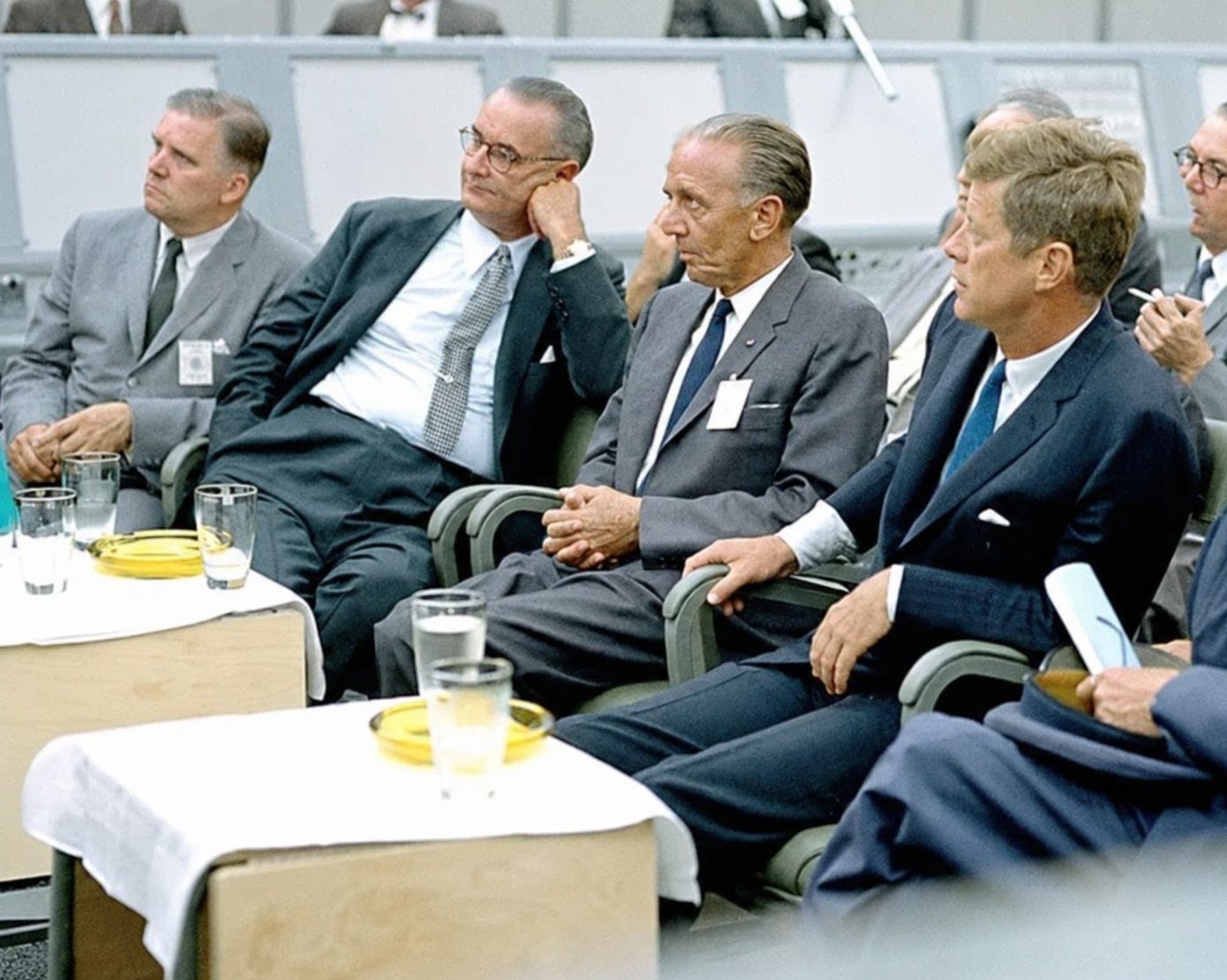
There is a photograph from 1962 of a briefing at Cape Canaveral. Debus, a former V-2 engineer and SS officer, is seated between President Kennedy and Vice President Johnson.
And for fifty years, from 1963 to 2013, the highest award given by the Space Medicine Association was named for Hubertus Strughold, called the father of space medicine. It was retired in October 2013, ten months after the Wall Street Journal published Lucette Lagnado’s account of his connection to wartime human experimentation. Strughold had been inducted into the International Space Hall of Fame in 1978 and was removed in 2006.
Fifty years. The information required to make that decision had been available, in one form or another, for most of them.
The mechanism.
Here is what the case actually establishes, and it is the reason it belongs in a section about disclosure.
The thing that protected Operation Paperclip was never secrecy. Secrecy failed early and repeatedly. It failed in 1945 when reporters got to the scientists, in 1946 when the press reported the program, in 1946 when Einstein signed the telegram, in 1951 when the Globe named Schreiber, in 1985 when Hunt published in the Bulletin of the Atomic Scientists, in 1987 and 1991 when the books came out, in 2012 when the Journal ran the Strughold piece, and in 2014 when the New York Times reported that American intelligence agencies had used roughly a thousand Nazis as spies and informants.
Every one of those was a disclosure, each accurate and each published in a serious outlet, and the cumulative institutional consequence across eighty years amounts to one acquittal, one voluntary departure, one award renamed, and one hall of fame membership rescinded.
What protected the program was the discovery, made early and never unlearned, that a government can tell the public a genuinely shocking thing and the public will absorb it. The information arrives. It is true. It is reported by people with credentials. And then the news cycle completes, and the institution that was supposed to respond has quietly established that it will not, and the absence of response becomes the precedent for the next time.
This is a more durable protection than a classification stamp, because it costs nothing to maintain and cannot be defeated by a leak.
Why this matters now.
I have spent this month reading government releases on unidentified aerial phenomena, and the pattern is the same one.
Five tranches of PURSUE files have come out since May. Each landed, generated roughly a day of coverage, and dispersed. The fifth was assembled around a single substantive document, with the rest of the material selected from archives that required almost no work to pull, and three files vanished silently from a numbered sequence the government itself had assigned. Nobody has asked about the three files. There is no particular reason to expect anyone will.
The same shape is visible in the Epstein document fight, where a court has ordered production, the department has declined, and the department’s most recent filing concedes it may lack the standing to appeal the order it is appealing. It is visible in the federal capacity that has been dismantled since January 2025, every item of which was reported on the day it happened and none of which has been assembled anywhere until now.
The disclosure community spends most of its energy on the question of what is being withheld. Paperclip suggests the more useful question is what happens on the day it stops being withheld, and the historical answer is close to nothing, reliably, for eighty years.
One last detail.
The public encyclopedia entry on Operation Paperclip has a section headed controversy and investigations. It carries a maintenance flag, dated February 2026, noting that the section needs expansion.
Eighty-one years after the first seven men landed in Boston harbor, the part of the record that deals with consequences is still the thinnest part, and somebody has noticed, and left a note.
"...a government can tell the public a genuinely shocking thing and the public will absorb it. The information arrives. It is true. It is reported by people with credentials. And then the news cycle completes, and the institution that was supposed to respond has quietly established that it will not, and the absence of response becomes the precedent for the next time."
**The absence of response sets precedent.** Keep being loud; never stop asking for the answers.