


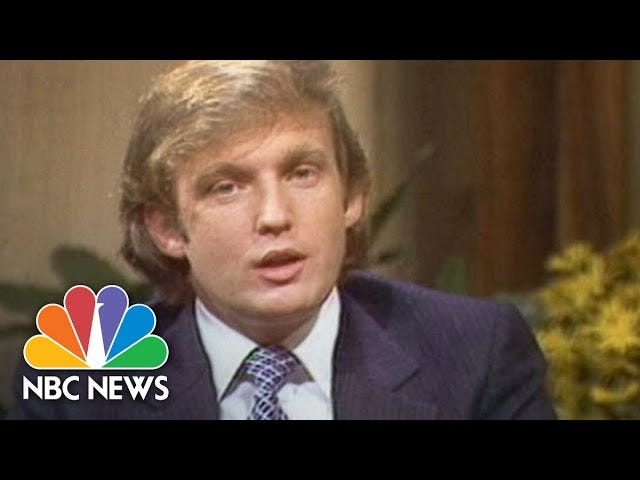
In November 1992, an NBC crew spent about thirty-six hours filming Donald Trump.
He was forty-six, newly divorced from his first wife, a year from marrying his second, and the network was making a profile of him for a talk show called A Closer Look, hosted by Faith Daniels. The subject was Trump’s lifestyle. They followed him around and they filmed a party at Mar-a-Lago.
The party was full of Buffalo Bills cheerleaders, in town for a game against the Dolphins. They gave the camera warm testimonials about their fun-loving host.
Twenty-seven years later, in July 2019, days after Jeffrey Epstein was arrested on federal sex trafficking charges, NBC went into its archive and released about one minute of that footage.
Here is what is on the minute.
Trump walks down a corridor to greet Epstein and two other guests. Come on in, he says. Go inside.
Later, Trump and Epstein stand together watching women dance. Trump points out the NBC camera to Epstein. Then he gestures toward a woman on the floor and appears to say, look at her, back there, and then a phrase reported as she’s hot. Epstein smiles and nods.
Elsewhere in the same minute, Trump takes a young woman by the waist, pulls her backward into him, and pats her behind.
That is the minute.
The arithmetic
Thirty-six hours is two thousand one hundred and sixty minutes.
The public has seen one of them.
We have been shown roughly one twenty-two-hundredth of the footage a television network shot of this man during the period when he and Epstein were, by both of their later accounts, merely acquainted.
There is a bad version of this argument and it is the one currently going around.
The bad version says the released minute is a random sample and therefore the other thirty-five hours are presumably worse. That does not follow. The minute is not a random sample at all. It is the opposite of one. NBC had producers go through the archive in 2019 with a specific question in mind, which was whether anything in there involved the man who had just been arrested, and they released what they found.
So you cannot reason from the sample to the whole.
What you can say is narrower and I think it is more interesting. A news organization reviewed thirty-six hours of tape, looking for what mattered, and this is what a professional judged the story to be. And having released it, they said nothing further about what the rest contains, and neither has anyone else in the seven years since.
What he said about it
When the tape surfaced in 2019, Trump had already given his account of the relationship. He said he had not spoken to Epstein in fifteen years. He said, I knew him like everybody in Palm Beach knew him. He said, I was not a fan.
In 2002, in New York magazine, he had said something different. He said he had known Jeff for fifteen years, that he was a terrific guy, that he was a lot of fun to be with, and that it was even said he likes beautiful women as much as I do, and many of them are on the younger side.
Both of those statements are his. The second one was made while the friendship was current. The first was made after Epstein had been arrested for trafficking children.
The footage sits between them, in an archive, and it is from 1992, which is seven years before the fifteen-year friendship he described in 2002 would even have begun by his own count.
Where it is
Nobody has said.
It was shot by NBC, for an NBC program, and one minute of it was released by NBC News. The reporting that resurfaced this week, by Tommy Christopher at the Jim Acosta Show, notes that what happened to the rest of the tapes is unknown.
That is a strange sentence to be able to write about a major American broadcaster’s own material. Networks keep archives. Archives have catalogs. Somebody, presumably, could walk into a room and find out.
I have no evidence that anyone destroyed anything or hid anything, and I am not going to imply it. The likeliest explanation is the dullest one, which is that thirty-five hours of unused B-roll from a 1992 lifestyle segment sat on a shelf for three decades because nobody had any reason to think about it, and that the institutional memory of where exactly it went has simply decayed the way institutional memory does.
That is probably what happened. It is also not an answer.
The shape of this is familiar
Consider what else is currently sitting in an archive that the public has been shown a fraction of.
Congress passed the Epstein Files Transparency Act in November 2025, requiring the Justice Department to release its unclassified records within thirty days and barring any withholding on grounds of embarrassment, reputational harm, or political sensitivity. The Department missed the deadline. It then released more than three million pages in January and the deputy attorney general described that as the final word on what existed.
It was not. The journalist Katie Phang sued. Judge Emmet Sullivan found that the Attorney General had conceded he was in violation of the Act, ordered ten specific documents unredacted, was refused, and in July ordered the unredacted originals delivered to his chambers for private review. Blanche hand-delivered them on July 30, thirty-two minutes before the deadline.
At a hearing on August 13, Sullivan pressed Justice Department lawyers on whether they had complied with his previous orders, including the requirement to publish justifications for the redactions. A department official told him he was not in a position to commit to a timeframe, that it was out of his control, and that the information would be forthcoming. Sullivan reminded the room that he has held lawyers in contempt before.
Among the withheld material are FBI interview notes concerning a woman who says Epstein introduced her to Trump and that Trump sexually assaulted her when she was a teenager. The Bureau reportedly found her credible. The allegations are uncorroborated and Trump has denied all wrongdoing related to Epstein.
The Department released the summaries of those interviews. It withheld the notes.
One minute, three million pages, ten documents
The pattern is the same at every scale and it does not require anyone to be conspiring.
There is a large body of material. A small portion of it is made public. The small portion is bad. The remainder stays where it is, not because anybody announced a decision to keep it there, but because releasing it is somebody’s job and nobody has made it their job, and the people who would have to do the work have other priorities, and the person the material concerns is the President of the United States.
Eighty-five percent of Americans, including eighty-four percent of Republicans, told YouGov they believe powerful people helped Epstein target girls. That number is not a partisan artifact. It is close to unanimous, and it exists because people can see the shape of this without needing anyone to explain it to them. You do not have to know what is on the tape to notice that you have been shown a minute of it.
The one minute we have seen is a forty-six-year-old man welcoming Jeffrey Epstein into his house, standing beside him at the edge of a dance floor, and pointing at a woman.
There are two thousand one hundred and fifty-nine minutes that nobody has looked at, or nobody will say they have looked at, and there is no particular reason to think they contain anything at all.
That is the honest position and it is not a comfortable one, because the alternative to knowing is not innocence. It is just not knowing, indefinitely, on purpose or by neglect, which from the outside look exactly the same.
His continued strenuous efforts to avoid the release of material can frankly only have one logical underlying reason.
The evidence might be delayed, but it is not going away. It will come out.
Thank you Mr. Wellborn. The tawdry oral history deteriorates over time as people who were actually present throughout pass away, or cannot be located, etc.
That is a factor in criminal charges having a statute of limitations. The accused cannot confront an accuser who is deceased.
Put another way, “Dead men tell no tales.”
Given the long collective stupor of the party in power, proof positive of Trump’s many felonies and horrific sexual assaults against both minors and adults for decades cast a long shadow over all and sundry who have covered up, lied, enabled, or failed to act in the face of all of it