


Let us begin with the calendar, which Mike Johnson discusses in the manner of a man describing weather.
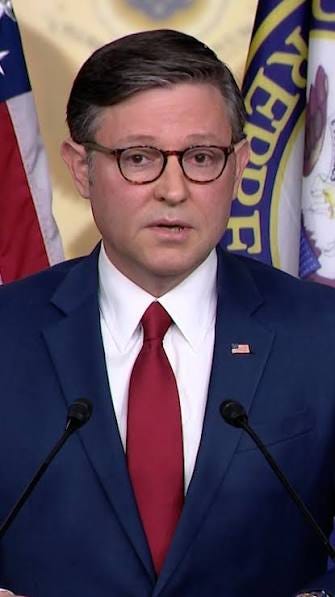
The House, in his telling, goes into recess the way a river floods. It returns when it returns. Sessions occur or fail to occur according to forces that are simply out there, moving around, doing what they do, and the Speaker of the House of Representatives is a fellow standing at the window with a mug, observing developments in the schedule and reporting them to the press with the calm resignation of a man who has decided that the legislative calendar is a thing that happens to him rather than a thing he sets, which it is, and which he does, and which is in fact the single most direct and unambiguous power the office confers.
This is the whole technique and everything else follows from it.
The Epstein files discharge petition needed 218 signatures to force a floor vote, and it had 217. Johnson, asked repeatedly whether he would obstruct it, said no, and said it clearly, and said it more than once. He told reporters that if it hit 218 it would come to the floor, and added, in case anyone had missed the principle, that this is simply how the thing works. He denied any intention of blocking the measure. He was, by every available account, telling the truth.
He then declined for fifty days to swear in the 218th person.
The 218th person.
Adelita Grijalva won a special election in Arizona’s 7th district on September 23, 2025, for the seat her late father had held, and announced almost immediately that she intended to sign the petition. This was not a secret and she did not treat it as one. She said it in interviews. She posted that there was no reason the Speaker could not swear her in during a pro forma session. She eventually posted the words swear me in now, in capital letters, tagging him directly, which is a sentence that has never previously appeared in the history of American parliamentary procedure and which I include here for the archive.
Johnson explained that she would be sworn in when the House returned to session.
The House had not returned to session because Johnson had adjourned it, and had then extended the adjournment, and had then extended it again, with the specific serenity of a man who has decided that a decision he made personally, alone, in writing, is best characterized as a circumstance.
The reasons, in order of appearance.
The first reason was that the House was not in session, which was addressed by pointing out that he had personally sworn in two Republican members during pro forma sessions earlier that same year, at which point the first reason was quietly retired.
The second reason was that it had nothing to do with the petition at all. This was offered flatly and without elaboration, in the tone one uses to decline a second helping.
The third reason was that he would schedule her swearing-in whenever she wanted. Johnson delivered this with an interposed “I guess,” which is a remarkable thing to place inside a sentence about the constitutional representation of eight hundred and thirteen thousand Americans, and which suggests a man not entirely convinced by his own offer even while making it. It was also untrue in a way that required no research to detect, since the person in question had spent two weeks publicly demanding exactly that, in writing, at him.
The fourth reason was that it was a scheduling issue. The two Republicans had been sworn in promptly, he explained, because their swearing-ins had already been scheduled and their families were in town.
The architecture of that is genuinely impressive. The seating of a duly elected member of the United States Congress, and with it the ability of nearly a million citizens to have anyone at all answer a phone on their behalf during a government shutdown, was determined by whose relatives had booked flights. Not by law. Not by precedent. By whether Grandma was already in the District.
The fifth reason was that he was willing and anxious to seat her, and hoped to do it on the first day the House came back to legislative session, a day whose selection was, as previously established, an act of God.
The lawsuit.
Arizona’s attorney general eventually filed suit in federal court in Washington against the House of Representatives, on the grounds that the residents of the 7th district were being deprived of representation. That is where the matter arrived: a state’s chief legal officer suing a chamber of Congress to compel a man to perform a ceremony that takes under a minute and involves no equipment.
Johnson’s position throughout remained that he was not blocking anything, which was correct. He had not blocked anything. He had simply never once arrived at the moment where blocking would have been required, and had spent fifty days not arriving at it with a diligence that would be admirable if applied to almost any other task.
The method.
What Johnson has worked out, and it is the only genuinely novel contribution he has made to the office, is that a person never has to refuse if he can prevent the question from being asked.
Refusal is costly. Refusal is a quote, a clip, a vote count, a thing with your name attached that people can hold up later. But a schedule is nobody’s fault. A recess is a condition. A pro forma session is a technicality. Grandma’s travel plans are a logistical reality outside the control of any one man, and by stringing enough of these together, back to back, for seven weeks, you can arrive at an outcome identical in every particular to the one you would have produced by simply saying no, while retaining the ability to look a reporter in the eye and observe, accurately, that you never said no.
He never said no. Nothing happened. Both statements are true and he has built an entire speakership in the space between them.
And the thing at the end of it.
The subject of the petition was the Epstein files.
Two hundred and seventeen members of the House of Representatives, from both parties, had signed a document requesting a vote to compel the Justice Department to release its records concerning a man who trafficked children. The vote was one signature short. The signature was standing in the Capitol, in person, on multiple occasions, asking out loud to be allowed to provide it.
Nobody obstructed it. Nobody blocked it. The calendar simply did not permit it, for fifty days, according to the man who writes the calendar.
He is currently touring thirty-four congressional districts, telling voters that his party made promises and kept them.
"He then declined for fifty days to swear in the 218th person." Without repercussions. Continuing the tradition of providing zero representation for anyone but themselves.
The mouse version of Mitch McConnell.