


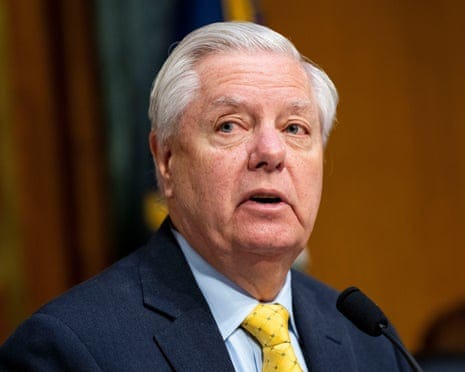
Lindsey Graham died on a Saturday night in July, at seventy-one, of an aortic dissection, having flown home days earlier from his tenth wartime visit to Ukraine. The suddenness of it caught everyone off guard, including the man who is scheduled to eulogize him this afternoon, and who is reportedly nearly a decade older and has spent the days since his friend’s death, according to the Washington Post, musing aloud about aging and fate, unsettled that Graham went first.
As I write this, Graham is lying in state in the Capitol Rotunda, where the Vice President and dozens of lawmakers from both parties gathered this morning to mourn him, his sister Darline among them, before the procession to Washington National Cathedral for the funeral this afternoon. Two days of mourning. A towering figure of the Senate, they are calling him, and the bipartisan warmth of it is real, and I do not doubt a word of the grief in that Rotunda. He was liked. Genuinely, across the aisle, by people who disagreed with everything he stood for, which is not nothing, and which is in fact rather a lot, and we will come back to what it was made of.
I want to write about Graham honestly, which for a man being canonized this afternoon means saying the parts the Cathedral will leave out. He was, by many accounts, warm and funny in private, a loyal friend, a man who rose from real hardship on his own steam. And he was also a three-decade advocate for war, a man whose politics curdled into open xenophobia, and the clearest study available in American public life of what happens to a person who never possessed a center of his own, and so spent his whole career borrowing one from whichever powerful man would lend it. The private warmth is real. It is also not what a public life is judged by, and the public life is the one we are burying.
Seneca, and the Long Climb
He came from Central, South Carolina, a town of a few thousand people, and he came from almost nothing, and this part deserves to be said plainly because it is the part he earned with no one’s help.