


Ken Paxton has been under felony indictment for securities fraud since 2015. He has been the subject of an FBI investigation into bribery and abuse of office since 2020, one serious enough that his own top deputies walked out of the agency to report him to federal law enforcement.
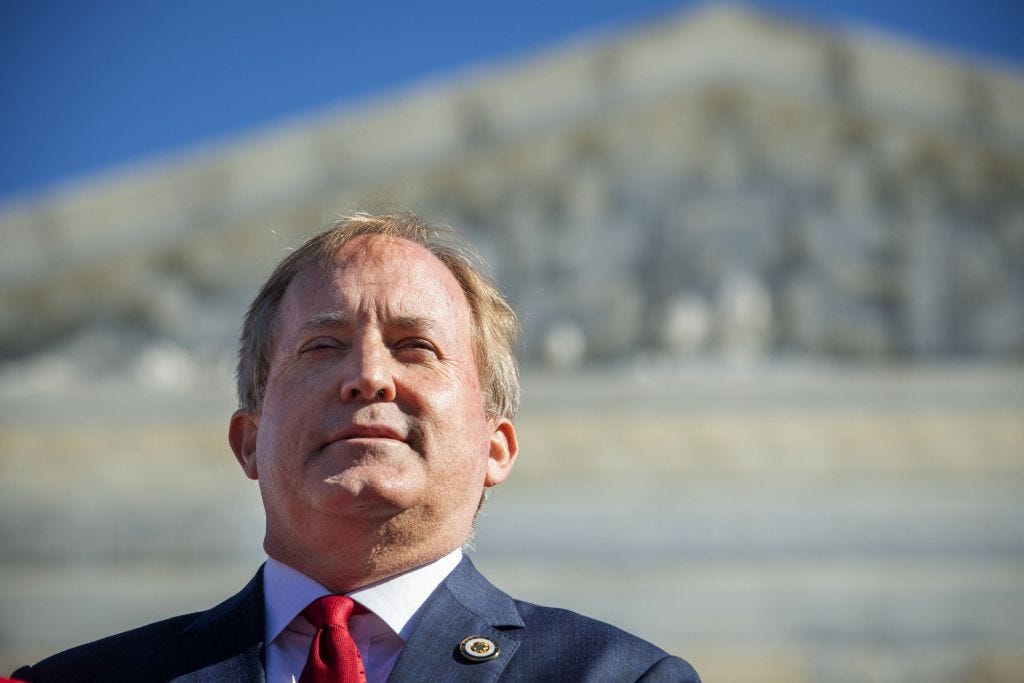
He was impeached by his own party’s supermajority in the Texas House, 121 to 23, on twenty articles including bribery and obstruction. He survived the Senate trial anyway, acquitted on every article that came to a vote, and went back to being attorney general of Texas as though the preceding fourteen months had been a rumor. For a decade, Ken Paxton has treated legal jeopardy the way other men treat a bad commute: an inconvenience to be endured on the way to somewhere he was always going to end up. He is very good at surviving. What he has never been good at, and what is finally catching up to him now that he needs Texans who aren’t already partisans to like him, is being watched.
Start with the disclosure forms, because Paxton did not have to file them dishonestly. Financial disclosure is the most survivable paperwork in American politics, a form filled out once a year, checked by almost nobody, punished almost never. Paxton owns seven homes. Six of them are rented out. On the disclosure forms he is required to file as a candidate for the United States Senate, he reported zero rental income from any of them, a discrepancy ProPublica and the Texas Tribune surfaced in early September. He also failed to disclose roughly $1.3 million in mortgages on Utah condominiums, and a parcel of land he had valued at fifteen to fifty thousand dollars in one filing jumped, in the next, to a valuation of one to five million dollars, with no purchase, sale, or improvement on the public record that would explain the difference. Craig Holman of the watchdog group Public Citizen put it plainly: the numbers make no sense unless someone is either extraordinarily bad at arithmetic or extraordinarily uninterested in getting it right. Paxton’s campaign response, when asked, was dismissive. It did not include an explanation.
None of this required lying under oath. It required checking a box honestly. Ken Paxton, a man whose entire professional identity for a decade has been enforcement, election integrity, government accountability, the AG’s office as the last line against corruption everywhere except the mirror, filled out his own disclosure forms the way a man fills out a form he assumes nobody reads. He was probably right for most of his career. He is finding out in real time what happens when someone finally reads it during a competitive Senate race, in a state where the Senate Ethics Committee hasn’t sanctioned a single member for a financial disclosure violation in nineteen years, which is precisely the kind of impunity that turns careless into standard operating procedure. Nineteen years of nobody getting punished explains why Paxton assumed he could skip them; it says nothing about whether the disclosures matter.
Then there is the campaign that was supposed to fix his youth problem, because somebody on Paxton’s team correctly diagnosed that a sixty-three-year-old career prosecutor was hemorrhaging support among voters under thirty-five and decided the answer was a program called Students for Paxton, launched in late August with the kind of confidence that suggests nobody in the room had spent time around an actual twenty-two-year-old lately. Seven weeks later, the numbers moved, just not in the direction the program was built to produce. His Democratic opponent, state representative James Talarico, saw his support among voters under thirty-five climb from fifty-nine percent to seventy-six percent over that stretch. Paxton’s own support in the same bracket fell from twenty-nine percent to eighteen. A campaign spent money and staff time on the one demographic problem it could see coming, aimed directly at it, and made the problem measurably worse in under two months. Call it what it actually is: a candidate whose career has been financial improprieties, an affair he confessed to inside his own marriage, and abuse-of-office allegations from his own hand-picked staff asked young voters to take a second look at him, and they did.
Which brings us to Angela Paxton, who filed for divorce from her husband in 2025 on biblical grounds, specifically citing adultery in the petition, and who stood up on September 22 in front of the Texas Federation of Republican Women in Round Rock and told the room to vote Republican in November “even if we’re mad at them,” because “it’s not the people, it’s the seat.” She did not say her husband’s name. She did not have to. A sitting state senator, whose own divorce filing accuses her husband of the affair he already admitted to years earlier, standing up to ask a room of Republican women to separate their anger at a specific man from their vote for his party, in the same election cycle in which that specific man is on the ballot, amounts to a marriage’s private collapse pressed into service as a stump line, delivered by the one person alive with the most reason to refuse and the least room to say so directly. Paxton did not write those remarks. He is, however, the reason they had to be written at all, and the reason his own estranged wife is the one doing the work of separating the seat from the man currently disgracing it.
Set all of that against the map. Texas has not sent a Democrat to the United States Senate since Lloyd Bentsen won reelection in 1988, thirty-eight years and counting, a streak longer than most of the state’s voters have been alive. Two independent polls in August put this race at a dead heat: Emerson had Paxton up one point, forty-seven to forty-six, and the University of Texas’s own Texas Politics Project had Talarico ahead by three. A hundred million dollars in Republican super PAC money moved into the state this month to defend a seat that, by every historical pattern of the last four decades, should not require defending at all. A Republican former state lawmaker, Glenn Rogers, cut an ad this week saying he will never support Paxton, a sentence that would have been unthinkable from a Texas Republican a decade ago and is now simply Tuesday.
Paxton has spent ten years being told that none of it would stick, because in Texas, for him, none of it ever had. An indictment did not stick. A whistleblower complaint from his own deputies did not stick. A House impeachment did not stick. What appears to be sticking, for the first time, is nothing as dramatic as any of that. It is a rental income line left blank on a form. It is a youth outreach program that moved the number it was built to move, backward. It is a wife who no longer has to defend him, only the letter after his name, and did that much in public. Paxton did not get caught doing something uniquely worse than the last decade of his career. He got caught doing the same thing he has always done, at the one moment Texas was finally paying close enough attention to notice.
It ain’t Kenny-time that’s for sure!