


Not a book about a wizard. Not a book that happens to contain a wizard in a supporting capacity, showing up around chapter nine to move the plot along and then retiring gracefully into the margins. A book in which the author himself appears, in illustrated form, as a wizard named Kash, in robes, dispensing magical counsel to a monarch called King Donald regarding a realm beset by the schemes of a woman named Hillary Queenton and a shapeshifting menace called Comma-la-la-la.
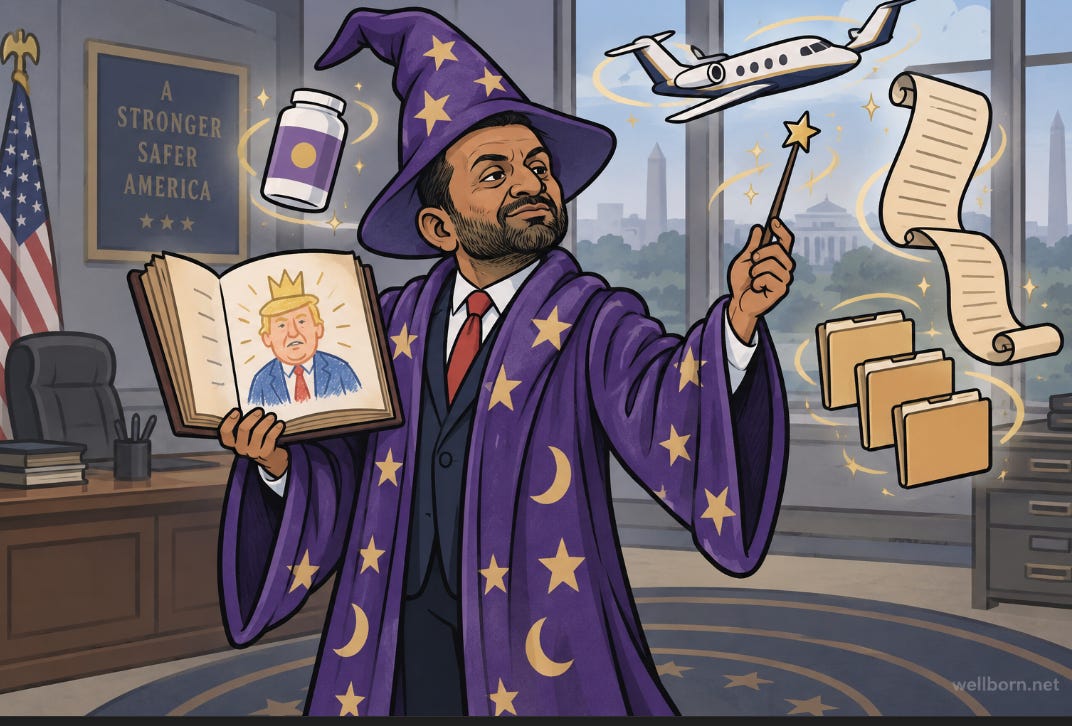
There are three of them. It is a trilogy. Which means that at some point in the production of the first book, a grown man held the finished object in his hands, looked at the cover, looked at his own face rendered as a sorcerer, and concluded that the material had not yet been exhausted.
This is the person who now oversees roughly thirty-eight thousand federal employees and the investigative apparatus of the United States government.
I want to be careful here, because a piece like this can slide into the merely rude, and rudeness is cheap. So everything below is documented, and every item is something the man did, sold, said, signed, or flew. No exaggeration has been applied, because none is available. The comedy is in the inventory itself.
The Goods
Before the Bureau, there was the store.
He sold apparel bearing his own name, stylized with a dollar sign in place of the S, which is a decision that would get flagged in a middle school yearbook and which he made as a man in his forties who wanted to run federal law enforcement. He signed his own merchandise. Not merchandise about something he did, or a book he wrote, or an office he held. Merchandise about him, autographed by him, sold by him, to people who wanted a shirt with his name on it.
He had custom Nikes made with the monogram. He wore branded apparel to a joint event between the FBI and the Ultimate Fighting Championship, which is a sentence that took several attempts to write down without stopping to reconsider the whole project.
He also sold supplements.
I am going to state this plainly because plainness is the only register that survives it. Kash Patel promoted a product line that claimed to reverse the effects of the COVID-19 vaccine. The pitch involved the spike protein and the idea that it could be undone by capsules. He was a paid promoter. He appeared in the advertising. People who had received a routine immunization were told, by a man who would later swear an oath to enforce federal law including the statutes governing fraudulent health claims, that they could purchase their way back out of it.
When this surfaced during his confirmation, a congressman who had accepted his endorsement quietly deleted it. That is the level of scrutiny the supplements could not survive: an endorsement swap, performed in silence, by a politician.
The List
In 2023 he published a book for adults called Government Gangsters, and in the back of it he printed a list.
The list contains roughly sixty names. It is titled in the manner of an appendix, as though it were a bibliography or a glossary, some neutral scholarly apparatus for the reader’s convenience. It is a list of people he believes to be part of a conspiracy against Donald Trump, and it includes Cabinet secretaries, prosecutors, generals, intelligence officials, and a former attorney general appointed by a Republican.
It also includes Christopher Wray, the man Patel replaced.
Something is required to put your predecessor’s name on an enemies list in the back of a book, and then take his job, and then move into his office, and then continue to be the kind of person who would do both. Most people, arriving in a building they spent years describing as a criminal enterprise, would experience some flicker of hesitation at the elevator, and there is no evidence anywhere in the record that such a moment occurred.
The Airplane
In 2023, Patel criticized Christopher Wray for using a government aircraft. He was specific about it. He treated it as evidence of institutional rot, an elite helping himself to the taxpayer’s hospitality, the precise sort of thing a reformer would come in and stop.
He then became the director and began using the government aircraft.
Congressional Democrats, examining flight records, found trips that did not obviously correspond to Bureau business. There was a flight pattern that lined up with visits to his girlfriend, a country singer, including one occasion involving a professional wrestling event at which she was performing. There were vacation destinations. There was a $60 million Gulfstream, which is what the FBI’s aircraft costs, moving a man across the country to hear someone sing at a wrestling match.
He was, by several accounts, furious that his own political allies did not defend this more vigorously. That is the part I keep returning to. Not the flights. The expectation that the flights would be defended, and the injury when they were not.
He has also assigned FBI personnel, including tactical operators, to accompany the girlfriend, which is a use of the SWAT-qualified workforce that does not appear in any organizational chart I have been able to locate.
The Building
The FBI is headquartered in the J. Edgar Hoover Building, a monument to a director who kept files on his political enemies, ran surveillance on Americans he disliked, and used the Bureau as an instrument of personal grievance for nearly half a century.
Patel has spent his public career arguing that the FBI is a politicized instrument of personal grievance, and he arrived at this building, which is named after the man who made it one, carrying his own list of sixty enemies, and got to work.
The plan under discussion involves relocating the Bureau to the Ronald Reagan Building, a federal complex that also houses a food court. I have no joke for this. The food court is simply there, in the record, waiting.
The Files
For years, Patel was among the loudest voices insisting that the Jeffrey Epstein files contained explosive material being deliberately withheld by a corrupt federal apparatus. He said so on podcasts. He said so on television. The withholding was the point; the cover-up was the crime; the American people deserved the truth and were being denied it by the very institution he intended to lead.
He then led it. He had the files. He had the authority, the staff, the access, and every incentive in the world.
And the position of the Bureau, under his direction, became that there was nothing there. No client list. Nothing warranting further disclosure. The man who spent years as the chief prosecutor of the cover-up examined the evidence he had promised would vindicate him and produced, in the end, a shrug.
There is a particular kind of person who can do this without any apparent internal event occurring. Who can spend four years describing a locked door, receive the key, open the door, find a broom closet, and walk away without ever once revisiting the four years.
The Hearings
He has now appeared before Congress multiple times, and the pattern is consistent enough to be called a method. Asked a question with a documented answer, he disputes the premise. Asked about the jet, he attacks the questioner. Asked about hiring standards, he delivers a speech about the previous administration. Asked about the Epstein material he spent years promising, he expresses irritation that anyone would bring it up.
In September he sat for several hours of this. Senators read his own words back to him and he told them the words were being taken out of context, which is the defense available to a man whose words have context and not the defense available to a man who wrote them down in a book and sold the book.
The Thesis
What makes this more than a list of embarrassments is the pattern underneath it.
Every single item in this inventory is an act of self-description.
The wizard books tell you he believes in a kingdom with a rightful king and a loyal magical advisor, and that he is the advisor. The merchandise tells you he understands public office as a personal brand with a product line attached. The supplements tell you he will sell a thing he cannot possibly believe if the audience wants to buy it. The enemies list tells you what he thinks the Bureau is for. The airplane tells you that the criticism was never about the airplane. And the Epstein collapse tells you that the years of accusation were a performance he was willing to abandon the instant the performance became inconvenient.
None of this was hidden. He published it and sold it and signed it, and he put his face on the cover in wizard robes and shipped it to warehouses. The country had every opportunity to read the material, and the Senate had every opportunity to enter it into the record, and the trilogy was available for purchase the entire time.
He told us exactly what he was, in a book for children, with pictures.
And we made him the director.
Excellent read, Tom. This may be why we are living in the Land of Oz!
Is a Lizard- fixed it-
This time in history- call me cheap and rude( anomaly required)