


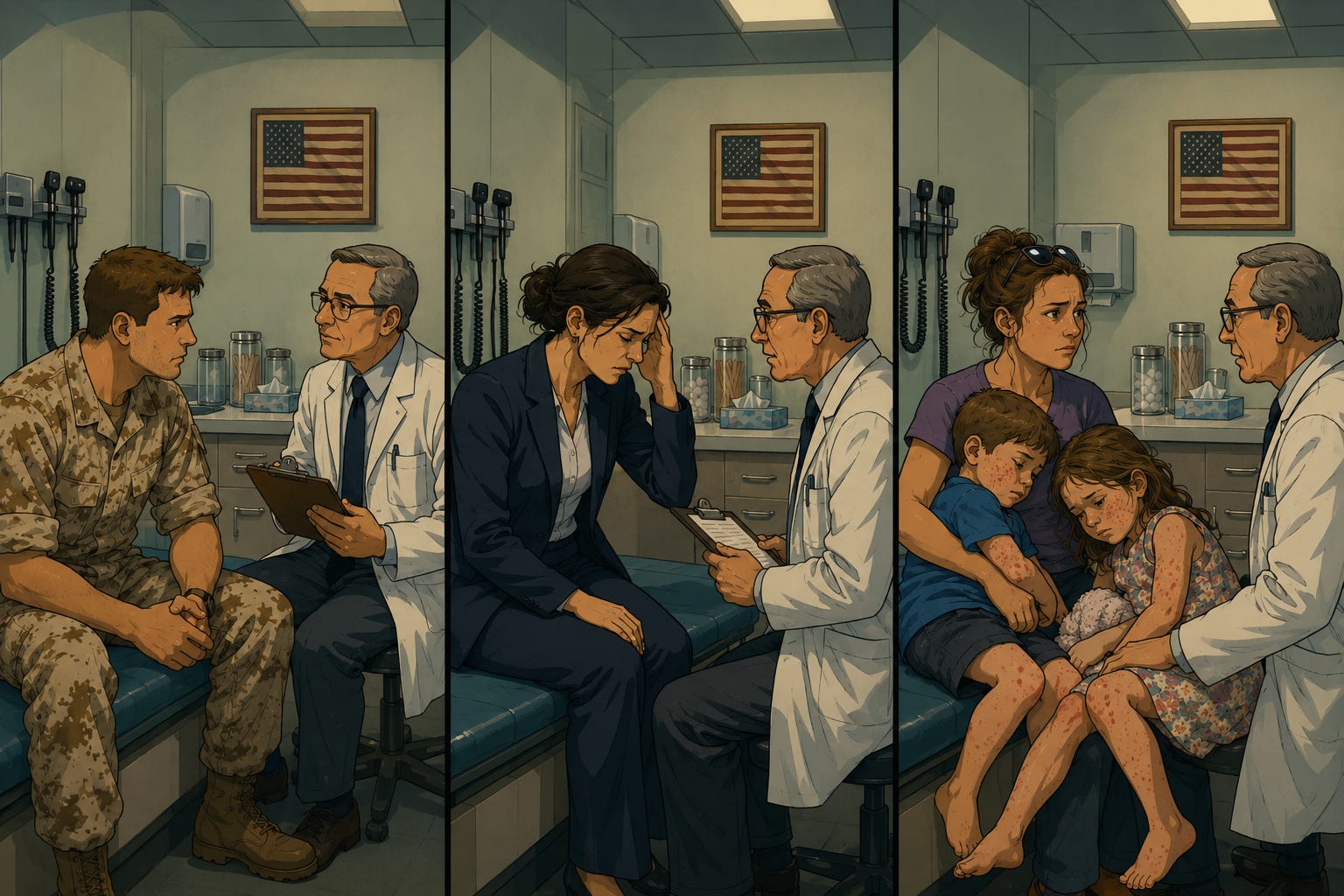
A soldier sits in a VA exam room in 1994 and describes the fatigue, the joint pain, the fog that has settled over his thinking since he came home from Kuwait. He is thirty-one. He was a mechanic. He is told that war is stressful and that the mind does remarkable things to the body.
A foreign service officer sits in a State Department medical office in 2018 and describes the pressure in her skull, the vertigo, the way sound arrives wrong now. She is told that overseas postings are stressful and that the mind does remarkable things to the body.
A Navy spouse sits in a clinic outside Pearl Harbor in 2022 and describes the rashes on her children, the vomiting, the smell of fuel that came out of the tap for weeks. She is told the water has been tested and meets standards, and that stress can produce physical symptoms.
Same room, roughly. Same sentence, roughly. Thirty years apart.
None of these three people knew each other. They were not in the same war, the same agency, the same decade. What connected them was not their injury. It was the response, which arrived in each case with a smoothness that suggests it was not being invented on the spot.
Because it wasn’t. There is a procedure. Nobody published it, nobody signed it, and I doubt any single person could tell you where it came from. But it exists, it runs the same way every time, and once you have seen it execute you cannot stop recognizing it.
The Procedure
It goes in stages, and the stages are stable.
First, the report. This is the part that ought to matter most and matters least. The people who report these injuries are, almost always, unusually credible witnesses. Pilots, mechanics, intelligence officers, diplomats, career military. Trained observers with security clearances and everything to lose by inventing an illness. Their credibility is never the issue. It is simply set aside.
Second, the conversion. This is the crucial move and it happens fast. A physical question, meaning what substance or energy entered these bodies, becomes a psychological question, meaning what is wrong with these people. The conversion is rarely announced. It shows up in what gets studied. Once the research budget is aimed at the mind of the complainant rather than the environment of the complaint, the outcome is set, because you will always find stress in a soldier and anxiety in a diplomat, and finding it will feel like an answer.
Third, the delay. Panels are convened. Studies are commissioned. The studies take years, and their findings recommend further study. This is not necessarily malicious, which is part of what makes it hard to fight. Careful science is slow. But the clock has a second function nobody puts in writing, which is that complainants age and die, and a claim dies with the claimant.
Fourth, the burden. The sick person is required to prove causation individually. This sounds fair and is, in practice, impossible. You must demonstrate that a specific exposure at a specific time produced a specific disease in your specific body, decades later, without access to the records that would establish where you were standing and what was in the air. Failing that, you are not denied because you are lying. You are denied because you cannot prove it. The paperwork is scrupulously polite about this.
Fifth, the eventual concession. It comes, usually. It comes twenty or thirty years on, framed as compassion rather than admission, structured so narrowly that a large share of the affected still do not qualify, and announced by officials who had nothing to do with the denial and can therefore accept credit for the reversal.
Sixth, and this one is invariable: nobody is named. No individual is ever found to have made the decision that a generation of injured people should be told they were imagining it. There is a decision, plainly. There is never a decider.
Act Three: Kuwait
Roughly seven hundred thousand Americans deployed to the Gulf in 1990 and 1991. Something on the order of a third of them came home with chronic symptoms: exhaustion that sleep does not touch, memory and concentration failures, joint and muscle pain, gastrointestinal disorders, skin eruptions. Two hundred thousand people, give or take.
The official position through the nineties was psychological. Combat stress. Post-traumatic reaction. The pattern of symptoms was described as too diffuse to represent a single organic illness, which is a scientifically respectable thing to say and which also happened to be the cheapest available conclusion.
What was in the environment, meanwhile: pyridostigmine bromide tablets, issued to troops as a pretreatment against nerve agents. Organophosphate pesticides, used heavily. Smoke from hundreds of burning oil wells. Depleted uranium. And a munitions depot at Khamisiyah, demolished by American forces in March 1991, which turned out to have contained chemical weapons. The Defense Department denied any chemical exposure for five years. In 1996 it acknowledged that as many as a hundred thousand troops may have been in the plume.
In 2008, a federally chartered research committee concluded what the sick had been saying for seventeen years: the illness is real, it is organic, and it is associated with pyridostigmine bromide and pesticide exposure. Not stress.
The men and women who had been told otherwise were by then in their forties and fifties. Some had spent the intervening years being treated for anxiety disorders they did not have. Some had been separated from service on psychiatric grounds. Compensation followed, eventually, unevenly, hedged with conditions that excluded many.
This is what the completed arc looks like. Not vindication. Attrition.
Act Two: Havana
The second case is further back in the procedure, which is why it is still contested.
Beginning in late 2016, American diplomats in Cuba, and later personnel in China, Russia, Austria, Colombia, and elsewhere, reported an abrupt onset of symptoms consistent with brain trauma. Vertigo, splitting headaches, cognitive impairment, and in many accounts a distinct sensation of directional pressure or sound that seemed to originate inside the head.
The National Academies of Sciences examined the evidence in 2020 and identified directed, pulsed radio frequency energy as the most plausible mechanism. That is a finding that points at a device.
The intelligence community’s published assessments moved the other way. By 2023 it could not connect any case to a foreign adversary. In January 2025 the assessment held that it was very unlikely a foreign actor had used a novel weapon or prototype device against U.S. personnel. One agency dissented at roughly even odds and was outvoted into a footnote.
Michael Beck was the first to report the symptoms that would eventually acquire a name. He filed for workers’ compensation in 2014 citing hazardous conditions and was refused. He had been diagnosed with Parkinson’s at forty-five. He died this past January at sixty-five, inside an official finding that his injuries were very unlikely to have been inflicted by anyone.
And then, in the last weeks of 2024, undercover agents from Homeland Security Investigations bought a weapon from a Russian criminal network for roughly fifteen million dollars of Pentagon money. Backpack-sized. Silent. No heat signature. Emits pulsed radio-frequency energy, penetrates drywall and glass, effective at several hundred feet, remotely operated. A military laboratory has been running it on rats and sheep for more than a year, and according to sources who spoke to CBS, the injuries it produces match the injuries reported by the humans.
So the assessment that a novel weapon was very unlikely to have been used remained the government’s public position while the government had the novel weapon in a laboratory, under a Pentagon budget line, producing the wounds on livestock.
I cannot tell you those two facts were known to the same people. The compartmentalization is real and the ignorance may be sincere. What I can tell you is that both were true at once, in one government, and that the public was informed of exactly one of them, and not by the government.
Act One: The Water
The third case is at the very beginning of the procedure, which is what makes it useful. You can watch the machine start up.
Firefighting foam used on American military installations since the 1970s contains PFAS, the class of fluorinated compounds that do not break down in the environment or in tissue. More than seven hundred installations are confirmed or suspected to have contaminated water. By some estimates roughly four in five bases are affected, exposing something on the order of six hundred thousand service members and their families through the tap.
The associated diseases are not vague: kidney cancer, testicular cancer, thyroid disease, ulcerative colitis, preeclampsia.
Reporting by the Guardian and Watershed Investigations established that 3M understood the hazards of these compounds for decades while marketing the foam as biodegradable and safe. The Pentagon’s explanation for continued use, given to KFF Health News, is that eliminating PFAS would compromise military readiness. Which is an argument that the injuries are acceptable, not that they are imaginary, and represents a novel variation worth watching.
And here is stage four, running right now, in the present tense: the VA does not list PFAS exposure as a presumptive condition. A veteran with testicular cancer who drank that water for six years must individually establish causation. Meanwhile the federal government has moved to have itself dismissed as a defendant in the consolidated foam litigation.
Sick from the water on the base. Required to prove it. Opposed by the entity that supplied both the water and the records.
At Red Hill in 2021, jet fuel from a Navy storage facility entered the drinking supply at Joint Base Pearl Harbor-Hickam. Thousands of residents reported water that reeked of fuel and children who were vomiting. Officials told them it was safe to drink. More than forty-six hundred claims followed.
If the procedure holds, and I have no reason to think it won’t, we can forecast the next thirty years with some confidence. Extended study. Narrow presumptive lists arriving in the 2040s. A named piece of legislation carrying the name of somebody’s dead child. Officials not yet in office accepting credit for correcting a decision nobody made.
The Part That Should Actually Frighten You
The temptation is to call this a conspiracy, and I want to argue against that, because the truth is bleaker and the wrong diagnosis produces the wrong remedy.
A conspiracy has authors. It can be exposed, prosecuted, ended. What is operating here has no authors. It is what emerges automatically when you combine an institution that must fund its own liabilities, a burden of proof that runs against the individual, a research apparatus that answers whichever question it is paid to ask, and a timeline longer than a human life. Nobody sat in a room and decided that Gulf War veterans should be told they were anxious. The system simply had no pathway that led anywhere else. Every actor behaved reasonably within their role and the aggregate output was three decades of medically abandoned people.
Which means there is nobody to arrest. You cannot fire the procedure. It will run again, on the next group, and it is running now.
And the specific injury it inflicts, underneath the medical one, is the thing worth naming plainly. These people were not merely denied money. They were informed that their own experience was not evidence. That the body they live inside does not have standing. A woman whose skull is ringing is told the ringing is not happening, in a letter, on official stationery, and the letter outranks the ringing, because the letter is in the file and the ringing is only in her.
That is a kind of power we do not have a good word for. It is not the power to hurt someone. It is the power to determine, after the fact, whether the hurt occurred.
Three groups of Americans. Three decades. One sentence, delivered with real kindness by people who believed it.
There will be a fourth. There is always a fourth. The only variable is whether we recognize the shape of it early enough to say so out loud while the people it is happening to are still alive to hear it.
See also
The Weapon They Said Didn’t Exist

There is a security camera video, and it is classified, but it has been described to reporters by people who have seen it.
Goddamn Tom, you can write my Brother!