


It is 2026. The man has been in office. The excuse is still that the last guy did it. The economy is somehow always inherited and never owned, the failures are always residual contamination from a previous regime, the scandals are always frame jobs, and somewhere in the background a phantom Biden is held responsible for things that happened during a Trump cabinet meeting last Tuesday. Everyone watching can see it. Even the supporters can see it. They repeat it anyway.
The obvious question is why a grown political movement keeps faithfully reciting a line it does not actually believe.
The short answer is that the line was never meant to be believed. It is doing different work than that.
The Ego Has to Eat
Psychologists have a tidy name for what every cornered toddler already understands: external attribution. Good outcomes belong to me, bad outcomes belong to circumstances, enemies, weather, sabotage, and especially predecessors. Politicians of every flavor do this on autopilot. What separates Trump and his orbit is that the whole brand is built around a single load-bearing claim of permanent winning. Admit one real failure and the brand cracks. So the failure cannot be admitted, ever. It has to be exported somewhere. The “past administration” is a convenient and permanent dumping ground, conveniently incapable of fighting back from inside the news cycle.
The Scapegoat Slot Never Empties
Layer on the older and uglier tradition of scapegoating. Theodor Adorno’s authoritarian personality research and Gordon Allport’s work on prejudice mapped how movements with fragile self-images require a defined enemy to absorb collective shame. Bob Altemeyer’s more recent studies on right-wing authoritarian followers update the picture without contradicting it. The enemy is functionally necessary. If one enemy dies, another is conjured within days. Biden, the deep state, RINOs, immigrants, trans kids, university professors, the FBI on alternating Tuesdays. The roster rotates. The slot never empties.
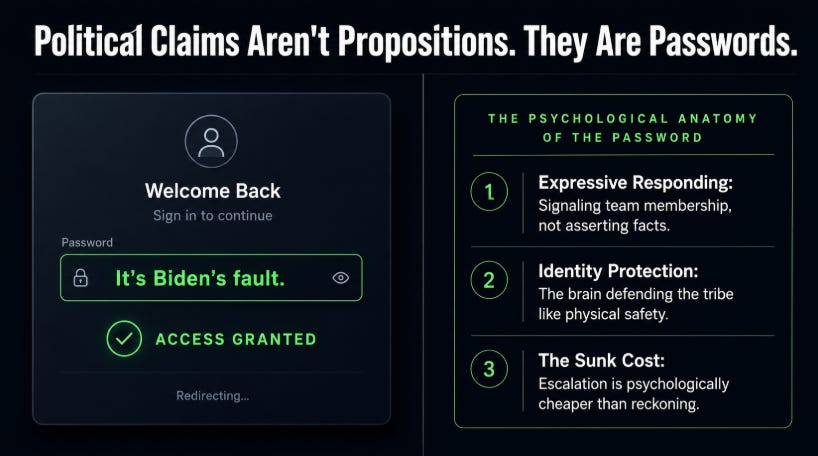
Expressive Responding, or, The Password
Here is the part that answers the real question. Political scientists like John Bullock and economists like Matthew Gentzkow have run a clever experiment many times over. Ask partisans factual questions where the answer is politically loaded. Then offer them a small cash reward for getting the factual answer correct. The partisan gap shrinks immediately, sometimes dramatically. The conclusion is uncomfortable but consistent: a meaningful slice of partisans, when polled or when chatting at a backyard barbecue, are not asserting facts. They are signaling team membership.
The technical name is expressive responding. The everyday name is a password.
The claim “Biden caused this” is not a proposition to be evaluated. It is a verbal handshake confirming that the speaker is still inside the tribe. Whether the speaker privately believes it is irrelevant, and the speaker often knows it is irrelevant. That is the part that looks insane from the outside and feels obvious from the inside. You are not watching deception of you. You are watching identity maintenance, performed in your direction by accident.
Identity-Protective Cognition
Once a claim is functioning as a password, an entirely different cognitive system takes over. Dan Kahan at Yale calls it identity-protective cognition. The brain treats threats to group identity the way it treats threats to physical safety. Inconvenient facts get batted away before they reach the part of the mind that would have evaluated them.
Counterintuitively, the more educated and information-rich the partisan, the better they are at this. They have more rhetorical machinery to deploy in defense of the tribe. The myth of the gullible rube is comforting and wrong. The college-educated MAGA accountant is not a sucker. He is a sophisticated defender of an identity he refuses to lose, equipped with better arguments than his less-credentialed cousin and exactly the same emotional incentives.
The Megaidentity
Lilliana Mason has spent a decade documenting how partisan identity in America has fused with religious, racial, geographic, and cultural identity into one stacked megaidentity. Defending the politician stopped being a policy stance years ago. It is now defense of the self, defense of the church, defense of the town, defense of the family at Thanksgiving, defense of every previous Facebook post you ever made.
The content of the claim has become almost beside the point. The function is everything. If tomorrow the leader declared the sky to be plaid, the password would update by Wednesday and the gap between private knowledge and public assertion would be papered over by the same expressive machinery that has been running for a decade now.
The Sunk Cost Nobody Mentions
There is also a brutal sunk-cost dynamic that nobody likes to talk about. Every supporter who defended Trump through 2016, through Charlottesville, through the first impeachment, through the second, through January 6, through the indictments, through the felony convictions, has accumulated a personal ledger of prior defenses. Walking back now means admitting that every previous defense was also wrong. That is an unbearable psychological tax.
Escalation is cheaper than reckoning. The movement does not double down because it believes harder. It doubles down because the alternative is admitting that years of your life were spent carrying water for a grift, that you fought with your sister over a man who would not spit on you if you were on fire, and that the people you mocked were right all along. Nobody pays that bill voluntarily.
The Asymmetry Is Not a Slur
The reflexive bothsidesist will say all of this also happens on the left. Some of it does, because the mechanisms are human and not partisan. But the specific intensity, the personality cult around a single man, the willingness to abandon previously stated values on command, the swift purges of internal dissenters, the eschatological tone of the rallies, the explicit fantasies of revenge against fellow citizens, all of these map onto the authoritarian-follower literature in ways that are simply not symmetric with mainstream Democratic behavior. Marc Hetherington and Jonathan Weiler showed this empirically more than a decade ago and the data has not gotten kinder since. The asymmetry is a finding, not a slur.
The Point
So when you watch a senator who clearly understands basic economics stand at a podium and blame inflation on a man who has not held office in years, you are not watching a person who believes what he is saying. You are watching a man enter a password. He knows you can see the screen. He is not trying to convince you. He is trying to remain a member.
The hoax framing is wrong because hoaxes try to deceive. The blame-game framing is wrong because games can be lost or won. What is actually happening is more interesting and harder to fix: a political movement has converted factual claims into rituals of belonging.
You cannot fact-check a ritual. You can only refuse to perform it.
They keep pushing their “But Biden!” buttons