


Let us begin with my medical credentials, which are none.
I have no medical training. I have never conducted a clinical interview, administered an instrument, or spent an hour in a room with the subject. My entire evidentiary basis consists of things the man has said in public and things published about him by reporters, which is the same evidentiary basis as everyone else you have ever heard offer an opinion on this, including several with certificates on the wall.
That would ordinarily disqualify a person from proceeding. It does not disqualify me, because the field has been vacated, and the story of how it was vacated is the funniest thing in American psychiatry.
The precedent.
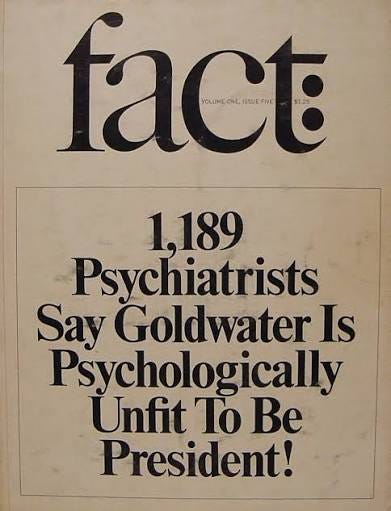
In the September-October 1964 issue of a magazine called Fact, under the title “The Unconscious of a Conservative,” the publisher Ralph Ginzburg reported the results of a survey. He had written to 12,356 psychiatrists asking whether Barry Goldwater was psychologically fit to be president. The cover announced that 1,189 of them said no.
The cover did not mention that 12,356 had been asked. It also did not mention that 2,417 replied, that 657 of those said Goldwater was fit, and that 571 said they did not know enough about the man to have an opinion, which was the correct answer and did not receive a cover line.
Most of the responses were unsigned. One respondent volunteered that Goldwater was suffering from a chronic psychosis, from a desk, having never met him. The medical director of the American Psychiatric Association wrote to Ginzburg on October 1 warning that the replies had no validity absent a thorough clinical examination, and the association’s president described the compilation as a hodge-podge of the personal political opinions of selected psychiatrists speaking as individuals.
Goldwater sued. He was awarded one dollar in compensatory damages and seventy-five thousand in punitive, the judge having found actual malice, in part because Ginzburg had edited the quotations to improve them.
In 1973 the association added Section 7.3 to its ethics code, which forbids members from offering a professional opinion on a public figure they have not personally examined. It is universally known as the Goldwater Rule. It was reaffirmed and expanded in 2017, for reasons that will not require explanation.
So the profession that could answer this question has, since the Nixon administration, had a written rule against answering it, adopted after a magazine survey with a nine percent response rate was edited for effect and cost its publisher seventy-five thousand dollars. The one group of people qualified to speak has formally recused itself, permanently, which leaves the question to columnists, relatives at dinner, and me.
One thing needs saying plainly before proceeding, because the register of this piece is not the register of the subject. Mental illness is a real thing that happens to real people, most of whom are not presidents, and the joke here is not on them. The joke is on the confidence of everyone attempting the diagnosis from a chair.
The evidence, such as it is.
The inventory is not in dispute. All of it is documented, most of it by the administration itself.
During the Iran war, military officials assembled for the president a daily video of the most successful American strikes of the preceding forty-eight hours. It ran about two minutes. One official described the contents as clips of things exploding.
He convened his cabinet in December for three and a half hours, twenty-eight people at the table, most of it spent going around the room so each could tell him how he was doing. In January he told a magazine that these meetings bore him and that he cannot wait to get out of them, which means he has constructed and maintains a ritual he does not enjoy, in the manner of a man who has decided that a thing can be simultaneously essential and unbearable and that the correct response is to schedule it quarterly.
He dictated the text of bronze plaques for a White House hallway, calling one predecessor the worst president in American history and another divisive, and had them screwed to a wall of the executive mansion. In the same hallway he replaced Joe Biden’s portrait with a photograph of an autopen, and hung two portraits of himself on either side of it.
In May, standing outside the Oval Office, he interrogated an associate about the columns in the latest ballroom renderings, insisting portions were missing and demanding clarity on the number of columns. This was the same day the United States was exchanging proposals to end the war whose highlights he was receiving in two-minute form.
For years a framed Time magazine cover featuring him hung in at least five of his golf clubs. Time never published that issue. The forgery was built using a graphic design tutorial that postdates the cover date printed on it by a year.
He is currently conducting a public campaign for a Nobel Peace Prize awarded by a five-member Norwegian committee whose deputy leader has said publicly that lobbying tends to work against a candidate.
And on Wednesday he shared, to his own followers, a month-old post by somebody else itemizing the failures of the Republican Party, four of the five items being things only a president can deliver, one of them a demand his own administration satisfied over a year ago.
The analytical difficulty.
Here is the trouble with the file.
Every item is consistent with the hypothesis that something is medically wrong. Every item is also consistent with the hypothesis that this is a seventy-nine-year-old man who has behaved this way since the 1970s, who was rewarded for it by a television network, a political party, and twice by an electorate, and who has never once encountered a room willing to say stop.
There is no observation in the inventory that distinguishes those two accounts, because they generate identical behavior. This is why the question has been argued for a decade without moving, and why it will still be argued in a decade, and why every participant is equally certain.
What the verdict would actually do.
Set the diagnosis aside. The word itself has a function.
Insanity is an exculpatory category. In law it is a defense. In ordinary speech it means a person is not answerable for what they did, that the thing happened to them rather than being done by them. A finding of madness moves every item in that inventory out of the column marked choices and into the column marked symptoms, and it does so retroactively, all the way back.
Which makes it the most generous reading available, and the one his defenders should be reaching for daily.
They are not reaching for it, and the reason is mechanical rather than mysterious. The Twenty-Fifth Amendment provides for exactly this circumstance, and Section 4 requires the vice president together with a majority of the principal officers of the executive departments. That is the cabinet. The same cabinet that sat at the table for three and a half hours in December taking turns.
So the insanity verdict is unavailable, and the unavailability has nothing to do with whether it is true. The only body empowered to act on the finding is composed entirely of people whose positions depend on never making it, and they have spent the year demonstrating in televised sessions exactly what they will do with the afternoon instead.
Every one of them would have to conclude that the two-minute war video was a symptom. It is easier, and considerably safer, to conclude that it was a preference.
Which leaves us where we started, except worse.
I cannot tell you whether the president is ill. Neither can anyone else who has not examined him, and nobody is going to examine him.
What I can tell you is that the question has become a place to put the discomfort. If he is mad, the situation is a tragedy, and tragedies are things that befall people, and there is a strange relief in that framing which is why it keeps getting reached for by people who despise him.
The alternative reading requires no diagnosis and explains the same evidence. A man wanted the praise and arranged to receive it. He wanted the plaques and had them cast. He wanted the columns and asked about the columns. He wanted the prize and lobbied for the prize. He wanted the war to be interesting and it was made interesting, in two-minute segments, by officers who understood the assignment.
Nobody in that account is confused. Everybody in it is doing what they meant to do.
Sanity is the likelier verdict. He is exactly what he appears to be, and he has been permitted.
That is the harder verdict, and it is the one that leaves the responsibility where it belongs, which is with him, and with the twenty-eight people at the table, and with the rest of us in November.
I am a mental health professional of the Clinical Social Worker subtype. As you have correctly pointed out, sanity is a legal term, not a diagnosis or a word we use in the profession.
By the legal definition, it appears that he is sane, in the sense that he knows the difference between right and wrong. It could be argued that this may be slipping if he indeed has dementia as his father did; however, as you have also pointed out, his behavior is exactly the same as it has been since the 1970s.
The supposition that can be drawn from this is that he simply doesn't care about the right/wrong dichotomy, or he does not believe that such things apply to him, which evidence supports by the fact that he has never truly been held accountable for any of the horrible, illegal, and morally unforgivable things he has done.
As many people have pointed out, he does exhibit what appear to be classic signs of narcissism and a complete lack of compassion for anyone or anything that is not himself.
Let's leave mental health out of it. Some things are simply choices, not chemical imbalances, brain damage, or reactions to circumstances beyond one's control. He is as he is because he chooses to be so and because he has never been sufficiently punished for his actions.
My conclusion is that he is a sane asshole.
I speak from another country and with no knowledge of Psychiatry or mental infirmities.
My diagnosis is that Trump is beneath contempt but his enablers and his cheering crowds are the real evil , Trump himself is just an ignorant and cruel dick.