


On Monday, at a press conference in Tehran, the spokesman for the Islamic Revolutionary Guard Corps, Hossein Mohebbi, announced a 25-page open letter addressed to “the honorable people of the United States of America.” Its audience, he said, was American voters rather than the administration. It arrived 35 days before a midterm election, from the armed force of a country the United States has been at war with since February, and it says what it wants.
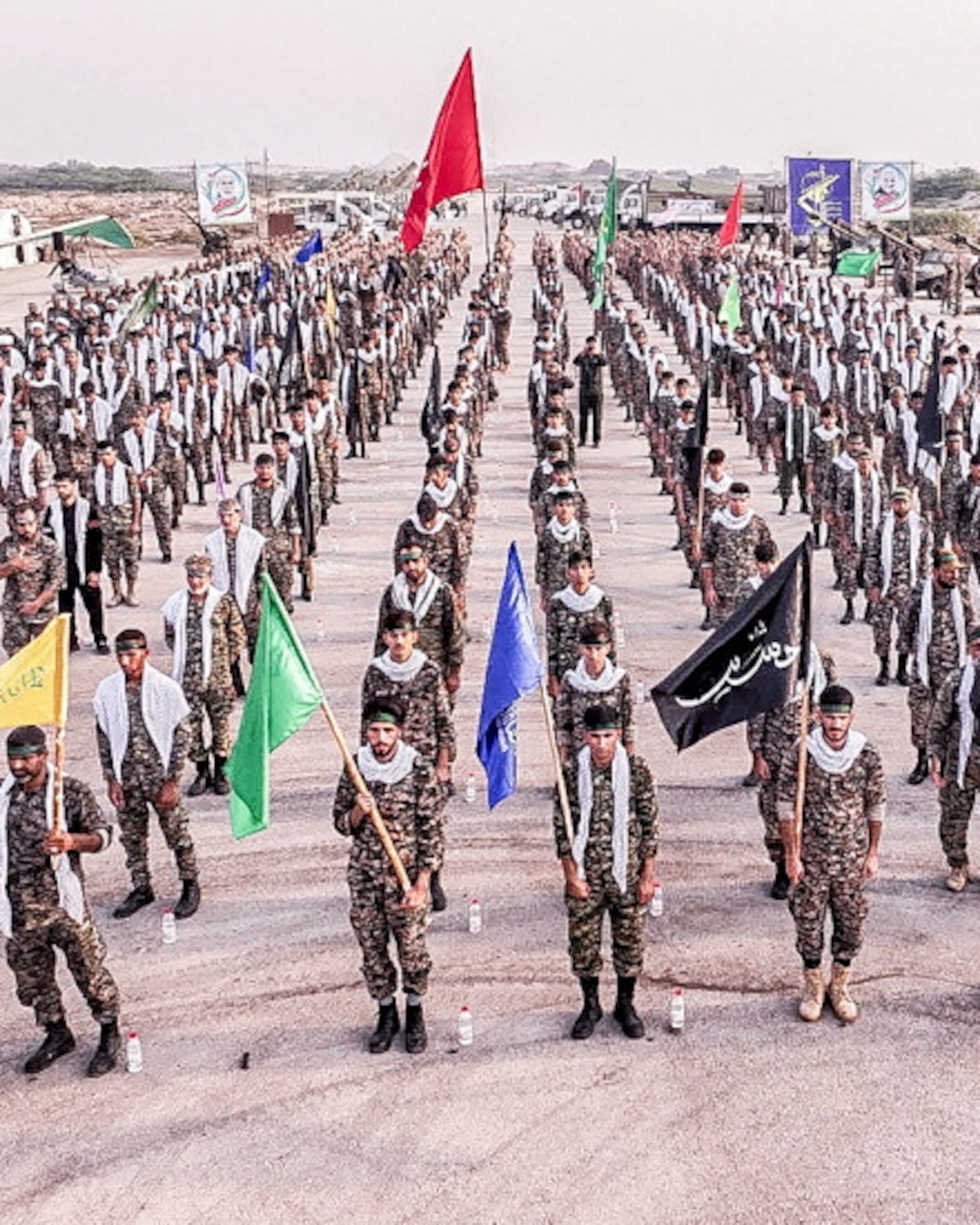
It says the IRGC has “already won the war.” It calls Trump “an inveterate liar” who “calibrates the pace of war” to his own stock profits, and the White House “a nonstop factory of lies.” It says the Strait of Hormuz remains closed whatever the oil tankers suggest. It says American tax dollars are paying for genocide in Gaza and Lebanon. It says “the American political system is at its weakest,” that “Americans need to wake up,” that “people all around the world are looking to Americans to stop their government,” and it asks them to “wrest control back from corrupt politicians” and to “rise up and put an end to this miserable situation.” It reinterprets “Death to America” as a prayer for the removal of America’s ruling elite rather than its people, which is the kind of clarification a writer offers when he knows exactly who is reading.
With the theology and the victory claims removed, what remains is a campaign document: an adversary at war with the United States, telling the United States’ electorate whom to blame, five weeks before that electorate votes. Iran has done versions of this before. What is new is what happens next on the American side, which, on the current record, is nothing.
What the letter is doing
The letter’s arguments were lifted from American newspapers, and that is the point of it. A Reuters/Ipsos poll in late August found 59 percent of Americans disapproved of the strikes on Iran and 54 percent said the war had not been worth it. The same poll found the cost of living was voters’ top concern. Diesel is at a record. Brent crude closed last week above $104. Three American service members were killed in Jordan in July. Trump told the United Nations eight days ago that Iran was stalling negotiations “to see how I do in the midterm election,” and when asked last week whether he would strike Iran before November he said, “I don’t want to say that,” then “it’s possible,” then again that he did not want to say it. Treasury Secretary Bessent predicted this week that Iran’s economy would collapse within two weeks. The rial hit 2.5 million to the dollar on Tuesday.
Every one of those facts is available to any American with a newspaper, and the IRGC’s letter adds only one thing to them: authorship. Influence operations do not work by introducing new arguments; they work by attaching a hostile hand to arguments that already exist, so that the arguments and the hand become hard to separate. Americans who oppose this war on its merits, and there are a great many of them, now share a talking point with the Revolutionary Guard, and the Revolutionary Guard arranged that on purpose. Americans who support the war can now say the opposition is doing Tehran’s work, and the Revolutionary Guard arranged that too. A country that receives a document like this needs an institution whose job is to say, publicly and quickly, exactly what it is, who sent it, and what it is for, so that the domestic argument can proceed without the foreign hand on it.
What the United States did last time
In 2024, Iran ran a covert version of this. IRGC-linked hackers broke into the Trump campaign, stole internal documents, and tried to feed them to news organizations and to the Biden campaign. The response was fast and it was official. On September 18, 2024, the Office of the Director of National Intelligence, the FBI, and the Cybersecurity and Infrastructure Security Agency issued a joint statement attributing the operation to Iran and describing its goals. Nine days later, the Justice Department indicted three IRGC-affiliated hackers by name. ODNI’s Foreign Malign Influence Center had already told the public that Iran “clearly wanted to undermine Trump’s candidacy.” Four years before that, when Iranian operators sent threatening emails to Democratic voters disguised as the Proud Boys, the government named Iran within a day and later indicted the two men responsible.
The pattern across both cycles was the same: identify the foreign operation, say so in public, put names on it, and let the electorate decide what to make of an argument once it knows who is making it. It required an apparatus, and neither agreement with the argument nor suppression of it.
What exists now
This publication keeps a running record of that apparatus on The Dismantling Tracker, and the election-security section reads, this week, like an inventory of exactly the offices a 25-page letter from Tehran would have gone to.
On February 5, 2025, her first day in office, Attorney General Pam Bondi disbanded the FBI’s Foreign Influence Task Force, the unit created after 2016 to investigate covert foreign campaigns aimed at American elections, on the stated grounds that it freed resources and reduced the risk of politicized enforcement. That same month, more than a dozen CISA staffers who worked on election security were placed on leave and the agency announced a review of its election work. In March, CISA ended roughly $10 million in annual funding for the Elections Infrastructure Information Sharing and Analysis Center, the network through which state and local election officials shared threat information with each other and with the federal government. On August 20, 2025, Director of National Intelligence Tulsi Gabbard announced that the Foreign Malign Influence Center, the office that had named Iran in 2024, would be “reduced and absorbed” into the rest of the intelligence community, with no successor identified. In September 2025, CISA told California it would no longer participate in the joint federal-state task force supporting county election offices, and it was largely absent from the November 2025 elections. CISA’s staff has fallen from about 3,400 to roughly 2,500. As of the last check, it had no confirmed director.
And the FBI, which would ordinarily be the domestic end of any response, is the agency whose counterespionage staff were fired in March, whose Cyber Division a senator warned was being cut by half, and whose personnel files were taken by a criminal hacking crew last week.
So the sequence is this. The government took apart the specific machinery that identified and exposed Iranian election interference in 2020 and 2024, on the argument that it was politicized or unnecessary. Then it went to war with Iran. Then Iran’s military wrote directly to American voters, in a document that names the election, names the president, and asks for an uprising, and the machinery that would have answered it in a day has no one left to answer.
The problem this creates for everyone
Tehran’s letter will swing no votes on its own; nobody in Ohio is going to read 25 pages from the Revolutionary Guard and change a ballot. Its effect is structural rather than persuasive, and it lands on both parties at once.
For the administration, it is an accusation it cannot make cleanly. Trump has already said Iran is timing the war to the midterms. The obvious response to the letter is a formal attribution, an accounting of what Iranian influence activity looks like in the current cycle, and a public statement from the intelligence community, which is what his own first administration’s institutions did in 2020. Those institutions were dismantled by his current one, so the administration’s options are to say nothing, or to make the charge without the apparatus that would give it credibility, which turns a counterintelligence finding into a campaign talking point.
For the opposition, it is a poison pill. Every Democrat running against this war in November now runs alongside a document from the IRGC saying the same things, and every one of them will be asked about it. The correct answer, that opposing a war on its merits has nothing to do with who else opposes it, is true and it is also the answer the letter was written to force them to give.
For voters, it is a preview. Iran is the loudest of the actors with an interest in November, because it is the one at war, and it is far from the only one. Russia and China ran documented operations in 2024, and the offices that documented them are the same offices that no longer exist. A letter with a return address is the easy case. The hard cases, the fake local news sites and the manufactured videos of ballots being destroyed, which the Foreign Malign Influence Center identified in 2024, arrive without one.
What should happen, and what will
The right response to the IRGC’s letter is dull and procedural. The Director of National Intelligence should say, in public, what the intelligence community assesses Iran’s intentions and activities toward the midterms to be, as her predecessors did in 2020 and 2024. The FBI should say whether the letter is part of a broader operation and what it is watching. CISA should tell the states what to look for. Congress should ask, in the oversight hearings it holds every week, which office in the federal government is now responsible for answering a document like this, and should refuse to accept “it has been absorbed” as an answer, because absorbed offices do not issue statements.
What will happen, on the record of the last twenty months, is that the White House will treat the letter as evidence that Iran fears Trump, the opposition will treat it as an embarrassment to be stepped around, and no one in the federal government will publish the assessment that used to be routine. The next foreign message to American voters will learn from that, and it will arrive without a press conference.