


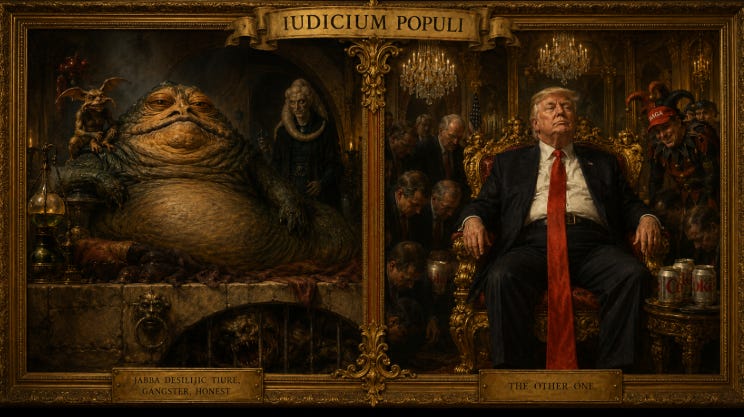
I owe Jabba the Hutt an apology. I have, for the better part of four decades, considered him one of the more reliably repugnant figures in popular cinema, the kind of imaginative achievement you point at when you need a quick visual shorthand for gross, for corrupt, for appetitive in the bad way. The slug on the dais. The little laughing creature on his shoulder. The frog he ate live, on camera, on the only screen we owned in 1983. I disliked him then. I have disliked him in every rewatch since. I wish, this evening, to retract that dislike, or at least to soften it substantially, because the events of the past decade have forced upon me a reconsideration that I would not, in any previous chapter of my life, have considered possible. Jabba, as it turns out, is the more sympathetic of the two figures available for comparison. The competition is closer than you would expect. The verdict comes down in his favor anyway. Permit me to walk you through the file.
Begin with appearance, since this is the place the casual observer will object loudest, and the place the comparison most quickly tilts in the Hutt’s direction. Jabba was a Hutt by accident of biology, an enormous gastropod evolved across a great many generations into precisely the slumped, drooling, magnificent form he wore on screen, and within the strict limits of his species he was, frankly, well groomed. He was not making choices. Whatever he looked like, he looked like by nature, and the dignity of nature is that no one can be blamed for it. The other man, by contrast, is a human being, equipped from birth with the full suite of available human dignity, and he has spent five decades selecting, every morning, the orange tan applied in defiance of the surrounding flesh, the architectural superstructure of hair lacquered into the approximate shape of a hair, the suit jacket whose buttons do not meet across the meridian, the necktie ending somewhere south of the belt for reasons no tailor has ever explained. Jabba’s appearance was the inevitable expression of what he was. The other one’s appearance is a daily creative decision, renewed at sunrise, defended in court, photographed for posterity. The slug, on appearance, wins easily.
Now the throne room. Jabba held court in a dim sandstone fortress on the outskirts of Mos Espa, a low-ceilinged hall lit by guttering candles, with a small house band of grotesques playing in the corner and a sleeping pit beneath the floorboards containing a great mammalian carnivore he was professionally entitled to release upon his enemies. It was, within the genre, honest. It declared itself. Mar-a-Lago, by comparison, is a former breakfast cereal heiress’s vacation house in Palm Beach, gilded in the manner of a Versailles franchise location, sold to its founder for a fraction of its appraisal and converted, over the course of a long second act, into a paid membership club, a federal records repository, a Saudi cocktail bar, and the unofficial seat of an alternate government conducted from poolside cabanas. Jabba’s court was a dive. The other man’s court is a dive that charges initiation fees. The slug, on real estate, wins on points.
The household staff is where the gap widens. Jabba surrounded himself with Bib Fortuna, a Twi’lek majordomo of demonstrable competence; Salacious B. Crumb, a small monkey-lizard whose entire job description was to laugh at the boss’s jokes, and who performed it admirably across the run; a working bullpen of professional bounty hunters operating under codes of conduct sufficient to support a guild; and the assembled service workers of a functioning, if revolting, criminal enterprise. They were paid. They got their lunches. None of them sued him for unpaid wages. The other man’s household is staffed by a press secretary who has not yet encountered a microphone she would not lie directly into; a Secretary of Defense whose qualifications were summarized by his employer, on national television, as central casting and a man who loves war; a Vice President who, in private text messages later made public, once described his current boss as America’s Hitler; and an Acting Attorney General who, until very recently, was his own personal defense lawyer, and who has lately busied himself signing settlements between his employer and his employer for sums that begin with a B. Jabba’s people knew what they were doing. The other one’s people are auditioning to be the laughing lizard, and most of them are nailing it.
I am compelled, here, to take up the matter of women, and I do so with the awareness that this is the chapter where Jabba comes off worst and still comes off better. He kept Princess Leia, a sitting head of state engaged in a covert rescue operation, chained to his dais in a metal bikini, an act of unambiguous sexual coercion against a captive officer, indefensible by any standard then or since. He was strangled to death, in due course, by his own victim using the chain he had placed around her, in what remains one of the most narratively satisfying outcomes in the history of cinema. The other man, by way of contrast, was found liable in 2023 by a federal jury for the sexual abuse and subsequent defamation of the writer E. Jean Carroll, in a verdict the court has since had to affirm against his ongoing appeals. He was, in 2024, convicted on thirty-four felony counts of falsifying business records to conceal a hush money payment to a pornographic film actress during a presidential campaign. He has been credibly accused, by dozens of women, of conduct that overlaps substantially with the audio recording, made in 2005 and released in 2016, in which he described in his own voice his preferred technique for greeting women he had not previously consulted. Jabba had one named victim, who killed him. The other man has a roster, and a docket, and a series of confidential settlements, and he is still in office. The slug, in this category, wins on the technicality that he was eventually stopped.
The criminal enterprise. Jabba ran spice, an unregulated narcotic somewhere between adderall and heroin, across a poorly policed star system, with the discretion of a man aware he was operating outside the law. The other man oversaw, across forty years, an organization that a New York Supreme Court justice ruled in 2024 had committed fraud for over a decade, with a judgment in the hundreds of millions; a charity dissolved by court order for what the state attorney general called a shocking pattern of illegality; a university shuttered after paying twenty five million to defrauded students; and a casino fined by the federal government for money laundering, including, specifically, Russian money laundering, which one does not stumble into by accident. He has, most recently, contrived to sue his own Justice Department for ten billion dollars, settled with himself, his own former personal lawyer signing the paperwork, for one billion seven hundred seventy-six million dollars of the United States Treasury. Jabba understood that what he was doing was a crime. He was at peace with this. The other man insists, against forty years of court records, that the same conduct, when performed by him, is excellent business, and his courtiers nod, and his rallygoers cheer, and the slug, who at least did not gaslight the galaxy about the nature of his trade, wins this round walking.
Cruelty. Jabba kept a Rancor in a pit beneath his throne and occasionally dropped a displeasing dancer through the floor as entertainment for his court. A horrible, fictional cruelty, contained within the architecture of one building, executed by means of one trained animal, against named individuals whose deaths can in principle be counted. The other man’s first administration, as a matter of explicit, publicly announced federal policy, separated more than five thousand migrant children from their parents at the southern border, without bothering to keep the kind of records that would later permit reunion, and a number of those children remain, to this day, unaccounted for. The Rancor was special effects. The children are real, and their parents are real, and the policy was real, and the names of the officials who designed and implemented it are real, and they are mostly back in office now. Jabba’s victims were countable. The other one’s are not. The slug wins this category by the cruel arithmetic that he was bounded by what one creature in one pit could physically eat in a workday.
I had not anticipated being moved to defend Jabba on the question of loyalty to his employees, but the data have left me no choice. Jabba paid his bounty hunters. Boba Fett, perhaps the most respected freelancer in his sector, never once filed suit against his client for unpaid invoices. The Hutt clan, for all its faults, met payroll. The other man, by contrast, has a forty year documented history of stiffing the contractors, carpenters, plumbers, painters, dishwashers, lawyers, consultants, pollsters, and architects who built his empire, his campaigns, and his defenses. There are entire law firms in Manhattan whose senior partners’ first major case was a fee dispute against him. Jabba paid the help. Jabba paid the help. The slug, on employment law, wins in a rout.
Honesty about what he was. Jabba claimed nothing he was not. He did not run for office on a platform of draining the swamp. He did not pretend to be a working-class champion. He did not eat photo op cheeseburgers in front of a press pool while gilding the toilet handles of his private jet. He was a gangster, on a remote desert planet, in serene possession of his own self-knowledge, and he made no public appeal to any virtue he did not in fact possess. The other man has spent a lifetime obscuring what he visibly is, through the steady manufacture of brand: the populist who eats like a member of the working class he has spent his life fleecing, the businessman whose businesses keep collapsing, the billionaire who borrowed every dollar he claims to have made, the patriot who skipped his own war and now sells his name on Bibles, sneakers, cologne, trading cards, and a piece of furniture optimistically described as the Trump Mattress. The slug, in this category, had the moral dignity of an honest appetite.
And then, finally, the republic. Jabba ran a smuggling outfit on Tatooine, a planet so administratively peripheral that the Galactic Empire had not bothered to garrison it with serious force. He held no seat in the Senate. He commanded no electoral apparatus. He never funded a campaign of disinformation against a sitting head of state. He never tried to overturn a vote in any system that had one. He never sent an armed mob to interrupt the certification of a legislative process in mid-session. He never made a recorded phone call to an election official begging him to find the precise number of votes he had failed, fairly, to obtain. The other man did all of these things, in this country, in our lifetime, on television. The Capitol of the United States was attacked, on January 6, 2021, by a mob he had pointed at it from the Ellipse, and officers were beaten with the very flags the rioters claimed to revere, and the count was paused, and the peaceful transfer of power, the single greatest civic invention of the American experiment, was attempted to be canceled by force, on a Wednesday afternoon, in real time, and he is now back in the same building, signing the laws, naming the judges, running the fund that pays the rioters who came that day on his behalf. Jabba, whatever else he was, never threatened the constitutional order of anywhere. The slug, on the single most important question available for comparison, wins by a margin so wide it has its own zip code.
I find, accordingly, in light of the assembled record, that Jabba Desilijic Tiure of Nal Hutta, gangster, smuggler, slaver, and slug, was the lesser of the two figures under consideration. He was, within his species, consistent. He was, within his profession, competent. He was, within his household, solvent. He confined his cruelty to a single carnivore in a single basement. He met payroll. He made no false claim to virtue. He never tried to dissolve a democracy, because he had no access to one. He was strangled, properly and on schedule, by the woman he had wronged most visibly, and the song of that strangling has been sung for forty years.
The other one has done worse, on a wider stage, with a longer roster, in a louder voice, under brighter lights, in a real country, with his name engraved on it, and he is still doing it, and the strangling has not arrived, and the song has not yet been written.
To Jabba the Hutt, then, I offer the apology that is owed. You were not, on the available data, the worst possible thing. You were, by the standards of the comparison we have lived to see, an honest crook doing honest crook work in your modestly populated corner of a galaxy far, far away. I withdraw the half-life of contempt. The Sarlacc pit, on reflection, swallowed the wrong character.
Jabba wins. It is not close.
Concisely put, and absolutely correct.
I enjoyed every word. Thank you