


Warning: Potential spoilers ahead.
The premise of Pluribus, for the six of you who skipped it: astronomers pick up a radio signal from somewhere else that spells out a strand of RNA. Someone builds it in a lab, because of course someone does. It spreads, and everyone it touches convulses, gets up, and is no longer a person in the singular. They are the Others, one mind in eight billion bodies, sharing every memory, permanently content, incapable of violence, incapable of lying, and so considerate that when a woman in Albuquerque asks for groceries the shelves are restocked overnight by people who used to be her neighbors. Thirteen humans on Earth are immune. The one we follow, Carol Sturka, is a romance novelist who held her own bestsellers in contempt and whose wife dies in the first hour. The hive would like very much to make Carol happy. Carol would like the hive gone.
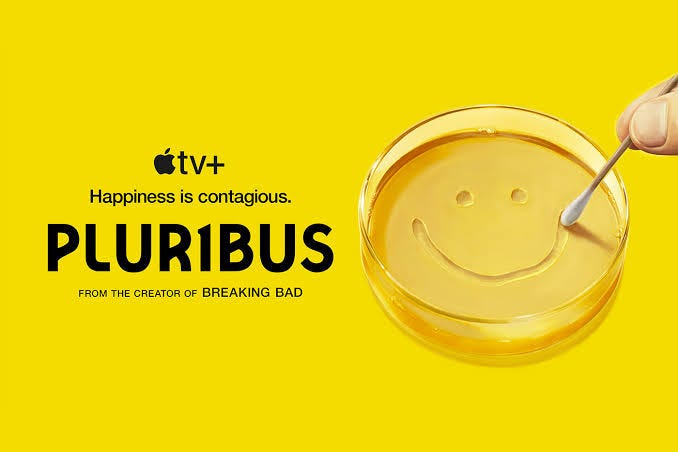
The show’s title is a joke on our money. E pluribus unum, out of many, one, and Gilligan said it was “a tip of the hat to the unofficial motto of America.” He also said he wrote it because he had grown “weary of writing bad guys,” which is the detail that matters. The Others are the first antagonist in his career who want nothing for themselves. They are the nicest apocalypse ever filmed. So the question the show asks, and the one you asked me, is whether the human race is better off as it is or under something like that. I want to give it a real answer, which means answering it badly for us first.
The case for the virus. Start with the week. A government department is in federal court asking a judge to hold a Senate seat if the wrong candidate wins. The president has posted a cash bounty for fraud tips and called for a sitting congresswoman to be prosecuted. A newspaper told allied governments that the war on hold for our election resumes after it. In Israel, a party that came up short of a majority announced within a day that the election was “stolen by Arab parties.” In Brazil, the loser fled to Miami. The Speaker of the House promised a peaceful transfer of power that would transfer nothing. None of this is unusual; it is a Thursday. The species as-is runs on a background hum of lying, which the hive cannot do, and violence, which the hive cannot do either, and the assumption that someone else’s loss is required for your win, which the hive cannot even parse.
Now imagine the Joining lands on that Thursday. The lawsuit is withdrawn by 4 p.m., because the people who filed it no longer want anything the people they sued don’t also want. The bounty is unclaimable because nobody will lie about a neighbor. The war ends by the absence of anyone who wishes to fight it, with no treaty required. The Arab parties and Likud are the same voter. Within a day, the problems that have consumed every piece I’ve written since this publication started are solved by the simple removal of the thing that produced them, which is the gap between what one person wants and what another one does. If you measure a civilization by what it does to its weakest member on an ordinary afternoon, the Others win and it is not close. Nobody in the hive is hungry, nobody is shot, nobody is told that their vote is illegitimate because of who they are. Carol asks the hive for an atom bomb and it says yes, because it cannot refuse her and cannot imagine using it. That is a better record than ours on the first day, and we have had ten thousand years.
What it costs. The arrival killed 886 million people. The show says so plainly and then moves on, because the Others have moved on; a mind that contains the memories of the dead does not grieve them the way we do, and it would be rude to make Carol watch. The survivors eat what the show calls human-derived protein, processed from the bodies, because eight billion contented people still need to be fed and the hive does not waste. It cannot lie, but it can decline to volunteer, and it took Carol most of a season to find the packaging plant. When she loses her temper at it, people around the world seize and some of them die, so the hive learns to handle her the way you handle a gas leak. When she tells it to leave her alone, Albuquerque empties, and she lasts a few episodes before she paints a message on the ground asking them to come back. And the Others have one project, which is to finish the job: thirteen people are not yet in, and by the end of the season they have built a custom virus from each immune person’s own cells. The only thing they need is consent. They will wait for it. They are very patient and they are everywhere.
Critics saw conversion therapy in that, and settler colonialism, and AI, and the pandemic, and they are all right, because the show is about the same thing all of those are about: a system so confident of its own benevolence that your refusal registers only as a symptom. The hive never once asks whether it is wrong. It can’t. There is no one left to tell it, and the thirteen who could are, by definition, the people it is working to cure.
The thing nobody says out loud. I would take it. Not today, probably, and not with my eyes open. But on the right week, and I have had several this year, if the offer came as a glass of water and a promise that I would never again read a court filing that asks a judge to pre-cancel an election, I would drink. So would you. The show knows this, which is why it makes Carol so hard to like. She is rude, she is selfish, she is miserable before the virus and miserable after, and she is the only person on Earth asking the right question, and the show makes you sit with the fact that the right question is being asked by someone you would not want to be. Gilligan built the hive to be irresistible and then built the resister to be a pain in the ass, so that your honest answer would indict you. Mine does.
Why I wouldn’t, in the end. The answer is not dignity, or the soul, or the sanctity of the individual, all of which are things people say when they haven’t thought about what the individual actually does with a free afternoon. The answer is correction. The human race as-is is wrong about nearly everything nearly all the time, and its single redeeming feature is that it can be told so, by someone inside it, and sometimes it changes. That is the whole of the case for us. It is the case for courts, which exist so a government can be told no by a person it pays; for a free press, which exists so the powerful can be told no by a person they can’t fire; for elections, which exist so a majority can be told no on a schedule. The Others have none of this because they need none of it. They arrived at a conclusion, and the conclusion was them.
A mind that cannot be wrong cannot be corrected, and a mind that cannot be corrected will do the arithmetic the hive did: 886 million dead, weighed against peace, called a fair price, and never revisited, because revisiting requires a dissenter and the dissenters are the project. Every human movement that has promised an end to argument has done that sum. The numbers were smaller and the kindness was absent, but the structure was the same: once everyone agrees, the people who died getting there were the cost of agreement, and the people who still don’t are the last item on the list. There is no malice in the hive, only the finished form of a wish that has killed more people than any other wish we’ve had, the wish to stop being disagreed with.
The uncomfortable part. Which brings the show back to the week. We are not being offered the virus. We are being offered the hive without it: the unanimity, the certainty, the treatment of dissent as a disease, delivered by people who are still fully capable of lying and violence and who have kept both. A Speaker who announces a peaceful transfer in which nothing transfers is describing a hive. A department that asks a court to withhold certification until the result is the right one is describing a hive. A party that calls a sixth of the parliament illegitimate for having voted is describing a hive. None of them come with the restocked shelves. Faced with that, the kind version starts to look like the better deal, and that is exactly the moment to be most suspicious of it, because the kind version and the cruel version agree on the one thing that matters, which is that you should stop.
Carol, in the seventh episode, alone in an empty city, paints a message on the ground asking the Others to return. She does not join them when they come. She argues with them. That is the species as-is, in one scene: unable to live without each other, unwilling to become each other, and insufferable about both. It is a worse arrangement than the hive on every measurable day, and it is the only one that can notice when it is wrong. I’d keep it. I’d also understand anyone who, this week, wanted the glass of water, and I’d want them to know the hive is counting on exactly that.
I loved this show. Can’t wait for the next season to come out 😁👍