


Science has given us many gifts.
The germ theory of disease. The polio vaccine. The discovery that washing your hands before surgery is, on balance, advisable. These are achievements that reflect humanity’s highest capacity for rigorous inquiry and the systematic pursuit of truth.
None of them, however, have managed to explain Donald Trump.
This is not a political statement. It is a medical one. By every measurable marker available to modern diagnostics, Donald J. Trump, 79, should not be doing what he is doing, which is flying around the world in a Qatari jet, threatening Spain, and confusing Iran with Japan at NATO summits attended by thirty-two heads of state. He should, by the conventional actuarial logic of his lifestyle choices, be somewhere quieter. Possibly horizontal.
And yet.
Let us review the evidence, clinically, and with the detachment that the subject deserves.
The Cardiovascular Situation
Trump has calcium deposits in his coronary arteries extensive enough to qualify as diagnosed coronary artery disease, visible on CT scans taken over multiple years and increasing in quantity each time, like a slow-motion geology project nobody asked for. He takes rosuvastatin and ezetimibe for cholesterol, which is the pharmaceutical equivalent of throwing a throw pillow in front of a freight train, and daily aspirin for cardiac risk, which causes persistent bruising to his hands because aspirin thins the blood, which is fine and normal and in no way an unsettling visual at every handshake.
In July 2025, he was diagnosed with chronic venous insufficiency, which is a condition where the veins in the legs struggle to return blood to the heart efficiently, producing swelling and discomfort and an overall circulatory picture that cardiologists would describe as “a lot going on.”
The Diet
Here is where the science becomes genuinely uncomfortable.
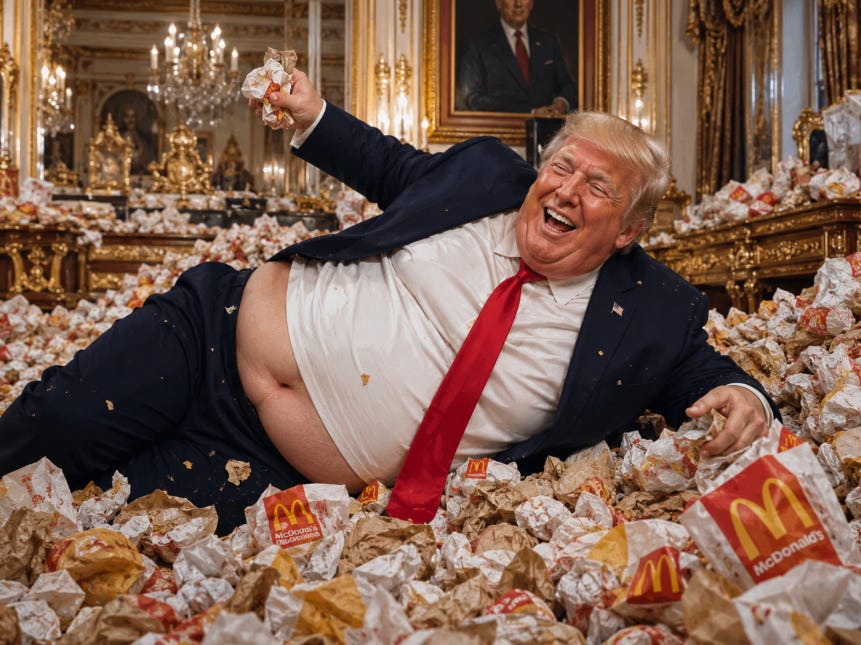
A single McDonald’s order of Trump’s typical scale contains nearly 3,600 milligrams of sodium, which is already above the American Heart Association’s recommended daily limit for an entire human adult, delivered in one sitting. Adults with the highest consumption of ultra-processed food face a 47% higher risk of heart attack or stroke. Higher fast food consumption is associated with a 55% increased risk of non-alcoholic fatty liver disease and a 37% higher risk of obesity. People who ate ultra-processed foods at the highest levels had a 31% greater chance of dying than those who did not.
This is comparable, statistically, to moderate alcohol use.
RFK Jr., his own Secretary of Health and Human Services, a man who has stored a dead bear in Central Park and eaten it, looked at Trump’s diet and said, publicly and on the record: “I don’t know how he’s alive. He eats really bad food, which is McDonald’s and candy and Diet Coke. He has the constitution of a deity.”
This is the Secretary of Health saying this. About the President. Out loud. To reporters. We simply moved on.
Sleep: The Official Position vs. The Video Record
Trump averages approximately four to five hours of sleep per night, which sleep specialists link to increased cognitive strain, cardiovascular stress, and a 30% higher chance of dementia diagnosis in older adults.
The Haberman-Swan book Regime Change reports that Trump’s staff became so accustomed to erratic schedules that “one late morning, when no one had heard from Trump and his staff were unable to reach him, an aide checked on the President only to find that he was still asleep in the residence.” Former aides began to say privately that, for the first time, he was “beginning to seem old.” The signs they cited: moments of fatigue, a cupped hand behind the ear.
This would be of limited concern if Trump were simply sleeping in. He is not simply sleeping in. He is sleeping at work.
The documented public dozing incidents now span at least thirteen confirmed occasions across his second term, verified by fact-checkers including Snopes: a December 2025 Cabinet meeting, multiple November 2025 Oval Office briefings, an April 2026 Oval Office meeting, a May 2026 White House maternal health event where he closed his eyes seconds after delivering his own remarks while other speakers were still at the podium, a Memorial Day ceremony at Arlington National Cemetery on May 25 while Pete Hegseth delivered remarks honoring soldiers killed in the Iran war, and, most recently, a June 4 coal industry announcement where Trump was documented nodding off with his eyes closed five separate times over the course of 76 minutes, slumping sideways in his chair.
The White House response to each incident follows an identical script: the president was not sleeping, he was using a “listening mechanism,” he is the sharpest and most energetic president in American history, and reporters who suggest otherwise are lightweight and glue-sniffing. Secretary of State Marco Rubio testified to Congress under oath that he had “never seen him fall asleep.” A Democratic congressman responded by playing video of Trump sleeping directly into the congressional record. “The American people trust their own eyes,” he said.
Dr. Jonathan Reiner, the cardiologist who kept Dick Cheney alive for decades, reviewed the footage and diagnosed Trump with “severe daytime somnolence,” which he classified as a “severe illness.” The White House did not respond to Reiner’s assessment. They were busy accusing CNN anchor Dana Bash of falling asleep because she blinked in a screenshot.
The Cognitive Picture
This is where the dry clinical detachment becomes somewhat harder to maintain.
Dr. John Gartner, a former Johns Hopkins professor of psychiatry, has stated that Trump has been displaying signs of frontotemporal dementia since 2019 and that his deterioration is now accelerating to a degree that he is “not the same man he was four weeks ago.” Frontotemporal dementia specifically targets judgment, impulse control, language, and empathy. Gartner notes Trump’s habit of drifting into lengthy tangents about construction projects and ceiling heights as a specific symptom, since tangential speech anchored to concrete, spatial subjects is a documented feature of frontotemporal presentations.
Ty Cobb, Trump’s former legal counsel, has observed that the late-night Truth Social posting timestamps and the documented daytime somnolence together align with sleep-cycle reversals seen in Alzheimer’s disease.
Journalist Michael Wolff, who has studied Trump as closely as almost any journalist alive, said in March 2026 that much of what now comes out of Trump’s mouth is “literally meaningless. Not only are the words wrong, but he has no particular thought he’s trying to express.”
This week, at the NATO summit in Ankara, Trump called Iran “the Islamic Republic of Japan” and referred to Zelensky as “President Putin” twice in the same press conference while Zelensky sat beside him. His aides did not correct either error. They have stopped correcting errors. This is itself a data point.
Trump’s father Fred was diagnosed with dementia at 86 and confirmed to have had Alzheimer’s disease. A parental history of dementia is associated with roughly a twofold increase in relative risk. His niece Mary Trump, a clinical psychologist, has said she watches her uncle and sees her grandfather.
The Cognitive Test: A Special Exhibit
There is a screening tool called the Montreal Cognitive Assessment. It takes ten to fifteen minutes to administer. Its tasks include identifying a drawing of a lion or a camel, drawing a clock face set to a specific time, connecting sequences of numbers and letters, and confirming that you know the current date and your current location. It was specifically designed to detect early signs of dementia and mild cognitive impairment. Neurologists describe it as presenting multiple “tripwires” for people struggling with early cognitive decline, which is how it works as a clinical instrument. For people with normal cognitive function, it is, as a practical matter, exceedingly easy to pass.
Donald Trump has taken this test, by his own count, four times. He has scored 30 out of 30 each time, which he describes as “extreme intelligence,” and which he announced on Truth Social in a post that also, in the same breath, accidentally claimed he had served three terms as president.
Trump’s most celebrated cognitive test moment came in 2020, when he described memorizing a five-word sequence: “Person. Woman. Man. Camera. TV.” He recounted this on national television with visible pride, noting that recalling the words twenty minutes later was “not easy” and represented a significant achievement. He has returned to this story repeatedly across four years.
Ziad Nasreddine, the Canadian neurologist who invented the Montreal Cognitive Assessment, noted that the specific word combination Trump describes does not appear on any version of the test. He also noted that Trump, in separate retellings, described being asked to identify a whale among the animals shown, and that “I don’t think we have a version with a whale.” Community notes on Trump’s viral cognitive test videos describe it as “a 10-minute screening tool for mild cognitive impairment that people with normal cognition easily pass.”
Dr. Jonathan Reiner, who is becoming quite the recurring character in this essay, said he is shocked Trump’s advisers are not imploring him to stop bragging about a dementia screening. Advisers are not imploring him to stop bragging about it. He continues to brag about it.
One post on Truth Social called his perfect score evidence of “extreme intelligence.” Another demanded that all future presidential candidates be required to take mandatory cognitive examinations. “Unlike other U.S. Presidents, none of whom have ever taken an approved, high difficulty, Cognitive Test,” he posted, “I scored a perfect 30 out of 30, considered ‘extreme intelligence.’ Are the Dumocrats really surprised?”
The test is designed to determine whether a patient has dementia. A passing score indicates the absence of dementia. It does not indicate the presence of genius. These are different things. Experts have explained this repeatedly. Trump has not updated his position.
The Stimulant Question
We must discuss the stimulants.
Noel Casler, a talent producer who worked on The Apprentice for six seasons, has described Trump openly snorting crushed Adderall on set, with white powder visible under his nose, and stated this was well-known among production staff. The White House Medical Unit during Trump’s first term was described by former staffers as “like the Wild West,” with thousands of doses of the stimulant modafinil ordered, and Adderall, fentanyl, morphine, and ketamine among the controlled substances distributed with what one source described as scant oversight. Former staffers compared the environment to college campuses where students pass around Adderall for all-nighters, except the all-nighter in question is the American presidency.
Reports going back decades assert that doctors prescribed Trump phentermine, a stimulant approved for weight control but also used off-label for attention and energy. One psychiatrist examining video footage noted Trump’s pupils were substantially larger during certain speeches than during others under similar lighting conditions.
No verified medical records confirming personal amphetamine use have been made public. The picture is anecdotal, behavioral, and circumstantial. It is also, as circumstantial pictures go, extremely detailed.
The stimulant hypothesis would explain both the frenetic nocturnal energy and the progressive cognitive deterioration, since chronic stimulant misuse accelerates neurological decline while providing short-term performance. It would be, if true, a perfect biological irony: the thing keeping the machine running is also disassembling it from the inside.
So Why Is He Still Alive?
This is the question the entire preceding catalog makes unavoidable, and medicine, to its credit, has some answers.
His father lived to 93. His mother lived to 88. Having parents who reach their late eighties and nineties is one of the strongest predictors of genetic resilience available to actuarial science. Trump is, biologically, playing with a stacked deck, and the deck was stacked before he ever ordered his first Quarter Pounder.
He does not drink. He does not smoke. These are not trivial omissions. Smokers die approximately a decade before non-smokers. Regular drinkers lose close to seven years. Not having engaged in either habit for eighty years is a substantial head start that his diet has spent those same eighty years attempting to neutralize.
He has the finest emergency medicine on earth available to him within minutes. Should Trump suffer a cardiac event or a stroke, the response time, the technology, and the expertise available would be without parallel in human history. The presidency extends lives partly because it makes its occupants the most medically monitored human beings on the planet.
There is also the narcissism buffer, which is underappreciated as a longevity mechanism. Chronic shame, guilt, and internalized failure are physiologically corrosive over time, spiking cortisol and degrading cardiovascular and immune function in ways that accumulate across decades. Trump appears constitutionally incapable of experiencing those states. He does not metabolize defeat. He does not carry loss. He externalizes everything that would otherwise eat him alive, and then he goes to sleep for four hours, posts about it, and falls asleep again during the coal briefing.
This psychological impermeability is, paradoxically, keeping him breathing.
And then there is the bullet.
In July 2024, at a rally in Butler, Pennsylvania, a bullet fired from approximately 130 meters away grazed Donald Trump’s ear. The margin between that outcome and a different one was, by any reasonable physics, measured in millimeters. He turned his head at the right moment. The wound healed with barely a visible scar. He raised his fist.
Some things do not have clean explanations. Medicine acknowledges this, even if it does not enjoy doing so.
The confirmed damage list is substantial: coronary artery disease, chronic venous insufficiency, an ultra-processed diet that his own HHS Secretary cannot account for, documented sleep deprivation, at least thirteen confirmed public dozing incidents including one at Arlington while soldiers were being honored, progressive cognitive decline consistent with frontotemporal dementia per multiple specialists, a genetic predisposition to Alzheimer’s, malignant narcissistic personality disorder, credible but unverified reports of stimulant dependency, and a relationship with a dementia screening tool that he has mistaken for a Mensa entrance exam across four years and counting.
What’s keeping him going: exceptional genetics, the abstinence bonus, the best emergency medicine in human history on permanent standby, a psyche that cannot register failure, and the specific, stubborn randomness that governs which 79-year-olds are still here and which are not.
Once a person reaches 80, there is approximately a 5% chance they die within the next year. The average 80-year-old American man lives to nearly 89. He has already survived the most dangerous actuarial passages.
The machine, against all available evidence, stays on.
Science is doing its best fuck yeah…
We are always leaving out, one Very Dangerous Symptom (in his position) of Dementia —one which I observed & saw finally “diagnosed by a Geriatrics specialist” in my now 94 y.o. mother, some 3 - 4 yrs ago: “Complete Lack of Insight”, sometimes referred to by the Latin “Anosognosia”. At the time, Mom acted suspicious of “going to a doctor”, and I assured her she was to see a Specialist in Old People, because, at age over 90, “You now qualify!”, like it was a treat. The nurse, weaving it into a cheery, “How you doing?”-conversation, gave her a version of the Cognitive Screen; many questions she did remarkably well: e.g. she could spell “WORLD” backwards. But, she did not know whether it was morning or afternoon, or what season or month it was, what city she was in (living in that same city since 1970). Yet, then, while resisting any physical examination by the doctor, the doctor then talked to her about her work-history: Mom, “I was a person in a travel office; and I was very good at it.” (True; but note she’d quite lost the actual words “agent” or “agency”.) “And, I haven’t worked in travel for quite some time, so to do it again, I’d need to brush up on the modern procedures.” Indeed!, I nearly laughed, as knowing the season, date, and what city you’re in, are pretty basic to travel-planning! And, the doctor, in an aside, came to tell my sister and me, that “She has complete Lack-of-Insight; she doesn’t think there’s anything wrong with her!”. All that, being also incurable. So, we were to act in her interest, using our Powers of Attorney. Now 94, she can barely speak. (I am, her daughter, a retired physician in Canada, myself.)
Just think, and add “Anosognosia” to an already Narcissistic personality: Trump is less & less accurate, knows less and less about anything; and the “lack of self-awareness” of his brain disease, makes him not-know what-it-is that he doesn’t know, and leaves him even more certain that he’s always right, while speaking more & more gibberish. USA, you have a problem!
Spite. Pure and simple.