


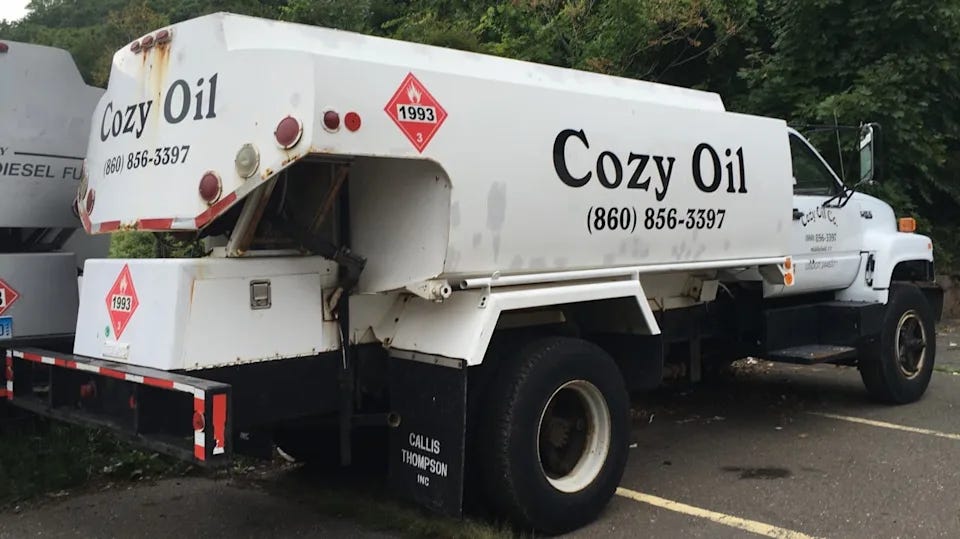
The number that matters this week is $6.02. That is what a gallon of heating oil cost in Maine on October 2, according to the governor's office, a record, and about $2.70 a gallon more than it cost a year ago. Half the homes in Maine heat with oil, the highest share of any state. A standard residential tank holds 275 gallons. Filling it now costs about $740 more than it did last October, and a house in central Maine fills it three or four times between now and April.
The National Energy Assistance Directors Association, which represents the state officials who run the federal heating-aid program, put out its projection for the season on September 28. The average household that heats with oil will spend $2,627 this winter, against $1,749 last winter, an increase of $878, or 50 percent. In Maine the projection runs from $1,664 to $2,939, a 77 percent increase. Vermont is the same percentage. Massachusetts is paying $6.15 a gallon, up from $3.52; New York, $6.27. The Northeast holds 4.36 million oil-heated households and burns 82 percent of the heating oil consumed in the United States, so this is a regional emergency with a national cause. Two weeks earlier, on September 14, the same association had projected a 31 percent increase for oil and an 8.7 percent increase for heating overall, with natural gas up 5.8, electricity up 9, propane up 8.7. The oil number moved nineteen points in a fortnight because the price of diesel did; heating oil and diesel are the same distillate with different dye, and diesel set a national record of $6.53 on September 22.
The cause of the price is the war. Brent crude was about $72 a barrel before the strikes on Iran began in March and has spent most of the fall between $100 and $108, with the Strait of Hormuz tolled, a naval blockade in place, and the third carrier group of the largest American buildup since 2003 sailing to arrive in late October. The president said last Thursday that the war would end “right after the election, maybe before,” and that when it did, energy prices would come down “rapidly, rapidly.” The heating season in Maine does not wait for November 3, and a tank filled at $6.02 in October is not refunded in December.
That is the price. The rest of this piece is about the program that exists to absorb it for the people who cannot, and what has happened to that program since this administration took office.
What LIHEAP is, and who runs it
The Low Income Home Energy Assistance Program was created in 1981. It is a block grant: Congress appropriates the money, the Department of Health and Human Services sends it to the states by formula, and the states pay it out to households below an income line, mostly as a credit on a heating bill or a delivery of fuel. About six million households receive it. It is, by the standards of federal social programs, small, bipartisan, and unglamorous. Maine’s share last year was a little more than $42 million.
The federal side of the program was, until last year, a staff of about ten people inside HHS. They calculated the state allocations, released the money, answered the states’ questions, and policed how it was spent. On April 1, 2025, as part of the reorganization of the department under Secretary Kennedy, every one of them was dismissed. They have not been replaced. NEADA’s own summary of the situation is that states are running the program “without federal training, guidance, or HHS staff support,” which is the trade association’s way of saying that the people who knew how the money moved were sent home and the money still has to move.
The effect was visible within months. The 2025-26 funds, which states normally receive in October and November, had not arrived by Thanksgiving. On November 25, 44 members of Congress, led by Jared Golden of Maine with Republican Mike Lawler of New York among them, wrote to Kennedy asking him to release the money by the end of the month, to shorten the four-week disbursement process, and to assign additional staff to a program that no longer had any. The money came, late. The final ten percent, which is normally released in late winter, required another round of letters: Susan Collins in March, Chris Pappas and colleagues in April, noting that $400 million was still sitting at HHS with the heating season nearly over.
What the budget says
The president’s budget for fiscal 2026 proposed eliminating LIHEAP entirely, on the theory that states could cover the need from other block grants. Congress declined, and funded it at $4.045 billion, a small increase. The president’s budget for fiscal 2027, the year that began last Thursday, eliminates it again. Governor Mills’s letter to Maine’s delegation on October 2 puts it plainly: the program has been “fully eliminated” in the president’s request, twice, in the two years that the price of the fuel it pays for has risen by three-quarters.
There is no 2027 appropriation yet; the government is running on a continuing resolution through December 11, which funds programs at last year’s level and lets HHS release a portion of the prior-year amount. So the money for this winter exists on paper, at a level set before the war, to be sent by an office that has no staff, through a department whose secretary has proposed its abolition two years running, to states where the fuel it buys costs 77 percent more than the allocation assumed. NEADA calculates that serving the same eligible oil-heat households it served last winter will cost $3.3 billion instead of $2.1 billion, and has asked Congress for $3 billion in emergency supplemental funding. Mills asked the delegation for a supplemental on October 2. Mark Wolfe, the association’s director, said in September that “Congress cannot wait for the first cold snap,” which was a warning when he said it and is a forecast now. Caribou usually sees its first frost by the third week of September.
What the delegation said
Mills wrote to all four members of the delegation. Golden led last year’s letters. Susan Collins, who chairs the Appropriations Committee and is on the ballot in four weeks, told a Maine station on Monday that she supports the governor’s call and has asked the federal government to release the maximum amount available. Asked what else should be done, she said, “I have always thought that we should build a pipeline” to bring “Shale Gas from Pennsylvania into Maine.” She added that natural gas “is cleaner than home heating oil” and “a good supplement.” A pipeline from Pennsylvania to Maine would cross four states, take the better part of a decade to permit and build, and heat nobody’s house this February. It is the answer of a senator who would rather talk about the next decade than the next ninety days, and it is the only new idea a Republican officeholder from the region has offered for this winter.
The president’s trade adviser, Peter Navarro, named Maine last week as one of two states where Canada had better not “interfere in our elections.” Maine’s heating oil comes, in large part, through terminals in Portland and Searsport from refineries in New Brunswick, which is to say from Canada, which the administration has spent twenty months threatening with tariffs. Nobody in the White House has connected those two facts in public.
The case that this is fine
It can be made, and it should be stated. LIHEAP is funded; the continuing resolution carries it. The fired staff were a dozen people, and the money got out last year, late but intact. Oil prices are a function of a war the president says is ending. The G7 announced on Friday a release of up to 100 million barrels from strategic reserves, with a frontloaded diesel component the president said would arrive “immediately.” If crude falls in November, the February fill-up is cheaper than the October one, and the worst of the projection does not arrive.
All of that depends on the war ending on the schedule the president has given it, which is the schedule he has given it four times since March. It depends on a reserve release that analysts at Reuters could not tell was new supply or the remainder of the March pledge repackaged. And it depends on a program whose operating staff was eliminated, whose funding was proposed for elimination twice, and whose money last year arrived after the first cold snap and required four congressional letters to finish arriving. A household that fills its tank this month pays this month’s price. The relief, if it comes, comes after the election, like the end of the war, like the rate cut, like the deal with Iran, like every other thing this administration has told the country to wait for.
What the number is
$878 is the national average increase. In Maine it is closer to $1,275. The arithmetic for a family at the income line in Aroostook County this winter is a tank at $1,655, a federal allocation sized when a tank cost about $900, and a secretary of health who has twice told Congress the benefit should not exist. The people who could have fixed the benefit’s size for this winter were fired on April 1, 2025, and the money that will reach Maine in the next several weeks will be released by whoever at HHS has been handed their work on top of their own.
Winter in Maine starts in October, with no reference to the Federal Reserve, the G7, or the midterm calendar. The war’s end has a date, and the date is after the vote; the first fill-up at $6.02 has already happened.
Hello Maine! Are you paying attention yet? Time for a change IN THE SENATE!
Collins must be removed