


Two papers came out in the last year that would have ended a career in 1995.
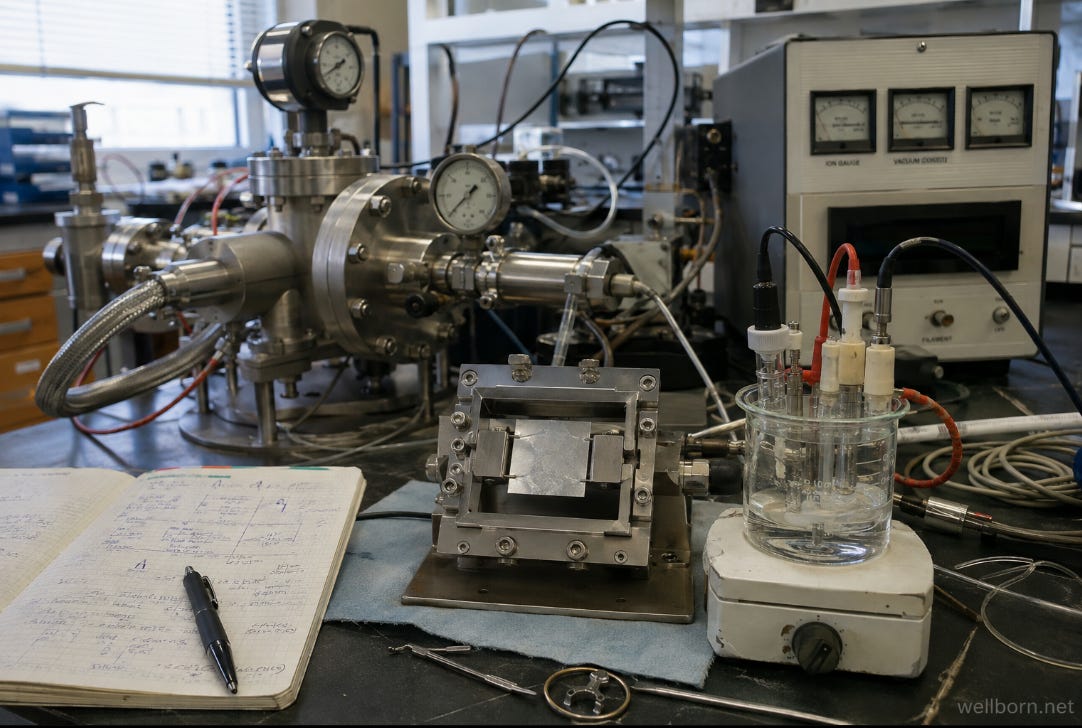
The first, published in Nature in August 2025 by Curtis Berlinguette’s group at the University of British Columbia, describes a benchtop device they call the Thunderbird Reactor. Deuterium ions are accelerated into a palladium target at thirty kilovolts. Separately, deuterium is driven into the same palladium from the opposite side by an electrochemical cell running off a lead-acid battery. Loading the metal this way increased the rate of deuterium-deuterium fusion by 15 percent, plus or minus 2.
The second, in Nature Communications in July 2026, reports something stranger. In palladium and titanium foils, deuterium-deuterium fusion yields do not fall away to nothing as the energy drops. Below roughly 2 keV the yield settles onto a floor, a plateau where standard screened tunneling models predict exponential suppression toward zero. The effect appears in two different host metals.
Before going further: neither of these is cold fusion, and any piece that lets a reader think otherwise deserves to be taken apart.
The deuterons in the Berlinguette experiment are accelerated at thirty thousand volts, which is the opposite of cold. The device produces less than ten to the minus tenth of the energy it consumes, meaning you would need to run it for an implausible span of the universe’s lifetime to get back what you put in over lunch. Nobody claims excess heat. The authors describe an instrument for studying fusion at low energies, and that is what it is.
Now the part worth writing about.
The apparatus is the joke
Palladium, deuterium, and an electrochemical cell. That is, item for item, the Fleischmann-Pons setup. In March 1989 two electrochemists at the University of Utah held a press conference announcing they had achieved nuclear fusion by loading deuterium into palladium electrodes at room temperature. The claim collapsed within months under failed replication, and the collapse was among the most public humiliations in the history of modern science.
What happened next is the thing this piece is about, and the most precise description of it appears in Nature, written by scientists rather than by critics. The failures to reproduce the effect, they wrote in 2019, effectively led to the disqualification of the subject from further study.
Disqualification. Not refutation. The subject was removed from the list of things a person could work on and keep a job.
The secret program
In 2015 a Google researcher named Matthew Trevithick approached Berlinguette, and Google put roughly $10 million and about thirty researchers across MIT, Lawrence Berkeley, UBC, Maryland, and CIFAR into a multi-year effort to re-evaluate the cold fusion claims to a modern standard of rigor.
The program ran for years without becoming public. Physics World reported that the secrecy extended so far that some members of Berlinguette’s own research group did not know it was happening.
That detail is the whole argument in miniature. This was not classified work. There was no clearance, no national security equity, no export control, nothing anyone could file a request against. It was a well-funded scientific investigation into a published claim, conducted by researchers at major institutions, and it had to be concealed from colleagues down the hall because of what association with the topic would cost.
What they found
They found nothing.
Three years of work, published in Nature in May 2019, produced no evidence of cold fusion. They could not even reliably create the conditions the original claim required. Palladium ordinarily takes up about 0.7 hydrogen atoms per metal atom, and the long-standing claim held that fusion begins somewhere around 0.875. Across several dozen attempts, they exceeded that threshold twice.
That result cuts both ways. The experiment everyone assumed was simple enough to dismiss in 1989 turns out to be difficult to even set up correctly, which is an argument for the skeptics about why nothing was ever reproducible, and simultaneously an argument that the parameter space was never properly examined.
The team said both things. Continued skepticism about cold fusion is warranted, they wrote, and the judgment that had removed the subject from study may nonetheless have been premature, and there remains real science in the underexplored space around it.
They also produced calorimeters that work reliably under extreme conditions and techniques for making and characterizing heavily hydrided metals, which are the tools the two recent papers rest on.
The honest accounting of what came out
Six years later, the same laboratory that ran the careful debunking is publishing measurable effects in the same materials.
The effects are small. Fifteen percent on a fusion rate is a real number and a modest one. A yield plateau below 2 keV is an anomaly that standard models do not capture, which means either the models need a term or the measurement needs scrutiny, and the history of this exact field counsels the second before the first.
The likeliest explanation is a condensed-matter screening effect: electrons in a metal lattice altering the effective barrier between two nuclei in ways the homogeneous plasma models were never built to describe. That would be genuinely interesting physics with no energy implications whatsoever, and it would be the outcome I would bet on.
None of this vindicates Fleischmann and Pons. Their claim was excess heat at room temperature with no accelerator, and nothing here supports it.
What it does vindicate is a process argument
The finding has nothing to do with fusion.
A question does not need to be suppressed to become unavailable. It does not need a classification stamp, a gag order, or an agency. It only needs to be embarrassing, and embarrassment is far cheaper to maintain than secrecy and considerably harder to appeal. There is no Freedom of Information request for a topic that everyone has quietly agreed makes you look like a crank.
For thirty-five years the low-energy end of this parameter space was not examined, and the reason was reputational rather than evidential. When it was finally examined properly, the examination required a technology company’s money, a multi-institution team, and a level of discretion normally associated with defense work, in order to look at a published claim in open literature.
And when they looked, they found no cold fusion, said so plainly in the most visible journal available, and argued in the same paper that the dismissal had been bad process anyway.
That is what the thing is supposed to look like. It is also rare enough that I can point to it as an example, which is the actual indictment.
The part that applies elsewhere
I write about unidentified aerial phenomena in this section, and the lesson here cuts against the disclosure community as hard as it cuts against anyone.
The Berlinguette program is the model precisely because it looked carefully and came back with nothing. Disqualifying a subject from study is a failure of process, and establishing that failure tells you exactly nothing about whether the disqualified claim was true. Both propositions hold at once, and holding both is the entire discipline.
Avi Loeb, who chairs the White House UAP science council, said something this year that belongs next to this: if the evidence resolves into drones and classified systems and known phenomena, scientists should be prepared to accept that and move on.
The cold fusion story is what it looks like when someone actually does that. Three years, ten million dollars, a null result published without hedging, and a companion argument that the question had been closed for the wrong reasons.
The palladium papers are not a comeback. They are a small measurement in a space that stayed empty for a generation because looking into it was socially expensive.
The empty space is the story. It always was.
This is modern day alchemy